





Key takeaways
-
A/B testing product ads works best when you separate the idea from the look. First test hooks and concepts inside one consistent style, then test styles using only the winning script.
-
Invideo Money Shot makes AI ad testing practical because it generates short 8 to 10 second AI video ads with accurate packaging and zero text hallucinations, even across dozens of variations.
-
The fastest way to create clean, comparable generative product ads is to keep the same product image set, the same duration, and the same structure, then change only one major variable per round.
-
A simple naming system plus a lightweight scorecard lets your team pick winners before anything goes live, so you stop guessing and start scaling what is proven.
Why you should A/B test before full production
If you have ever shipped a hero ad that looked amazing and still underperformed, you already know the problem. Production quality does not save a weak idea. The hook misses, the benefit feels generic, or the proof is not believable, and the audience scrolls anyway.
Most teams still build the hero first, then test later. That sequence is expensive and slow. It also forces you to defend choices you have already paid for.
Here is the better sequence, and it is the one we run as a creative team when speed matters.
Validate the idea first, then commit to production. That is what A/B testing product ads is supposed to do. It is not just a media tactic. It is a creative filter.
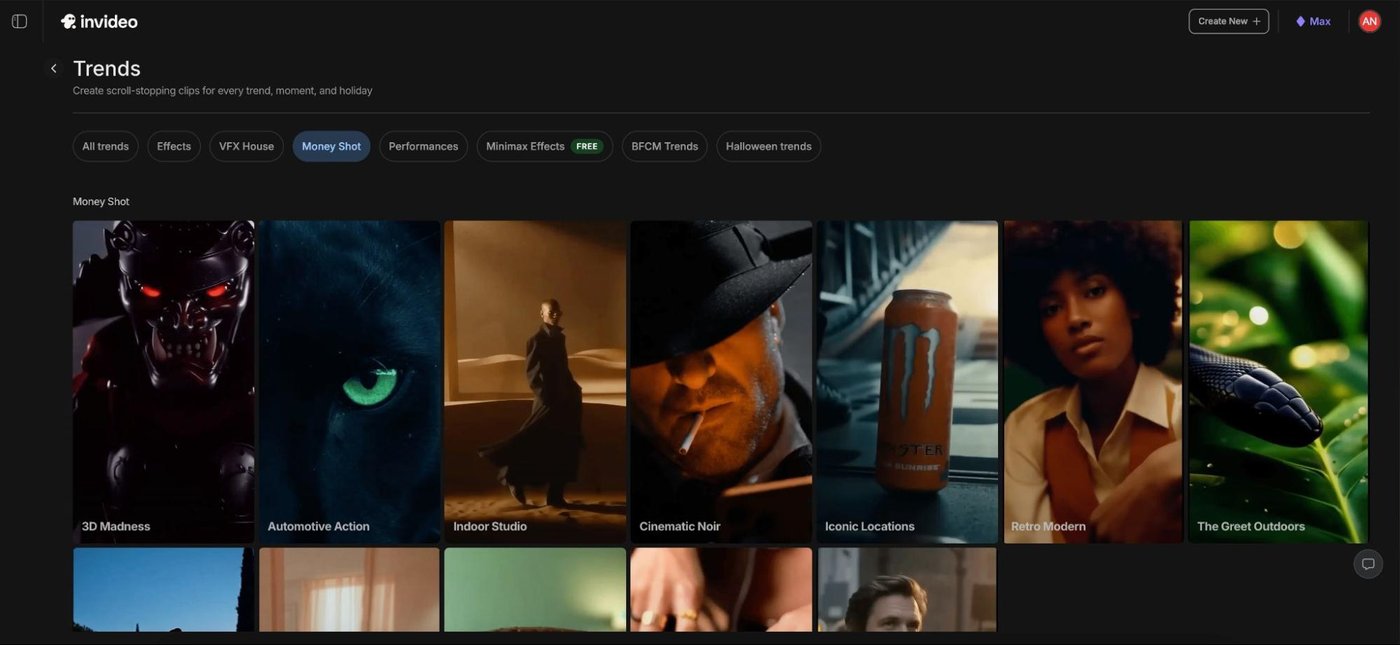
Money Shot on invideo makes that filter realistic at modern speed. It lets you generate short, polished AI video ads from a handful of product images while keeping the product perfectly consistent. Packaging stays true. On pack text stays true. That accuracy is what makes comparisons fair, and it is what makes invideo Money Shot a practical engine for AI ad testing.
The lipstick walkthrough we will build
This walkthrough uses a demo brand called INVO. The product is a satin finish lipstick in a fashion and lifestyle category. The point is not lipstick. The point is the workflow for generating and testing ad variations fast, using invideo.
You will build two rounds of variations.
Round one keeps one consistent Money Shot look and tests three different concepts. Round two keeps the winning concept and tests a few compatible Money Shot styles.
Money Shot on invideo
Later, once winners are clear, those ads can be scaled into longer edits using the AI video generator, turned into creator-led formats with UGC ads, or tightened for vertical pacing inside the TikTok video editor. That comes after the testing loop, not before.
How to think about concepts versus styles
When teams say “we tested creative,” they often changed everything at once. New script, new pacing, new shots, new style. The results look random because the test is random.
Here is the rule that keeps your data clean and your learnings reusable.
In round one, test ad concepts vs styles by locking the style and changing only the concept. In round two, lock the concept and change only the style.
Testing video concepts inside one style
Round one is about the message. It is where you find the hook that deserves to scale.
Step 1 - Define the goal like a testing director
This step is where most teams get vague, so the whole test drifts. A real goal has three parts.
-
It has A/Business outcome you care about later,
-
a creative signal you can judge right now,
-
and constraints that keep the variations comparable.
Here is how we define goals before generating a single invideo product ad.
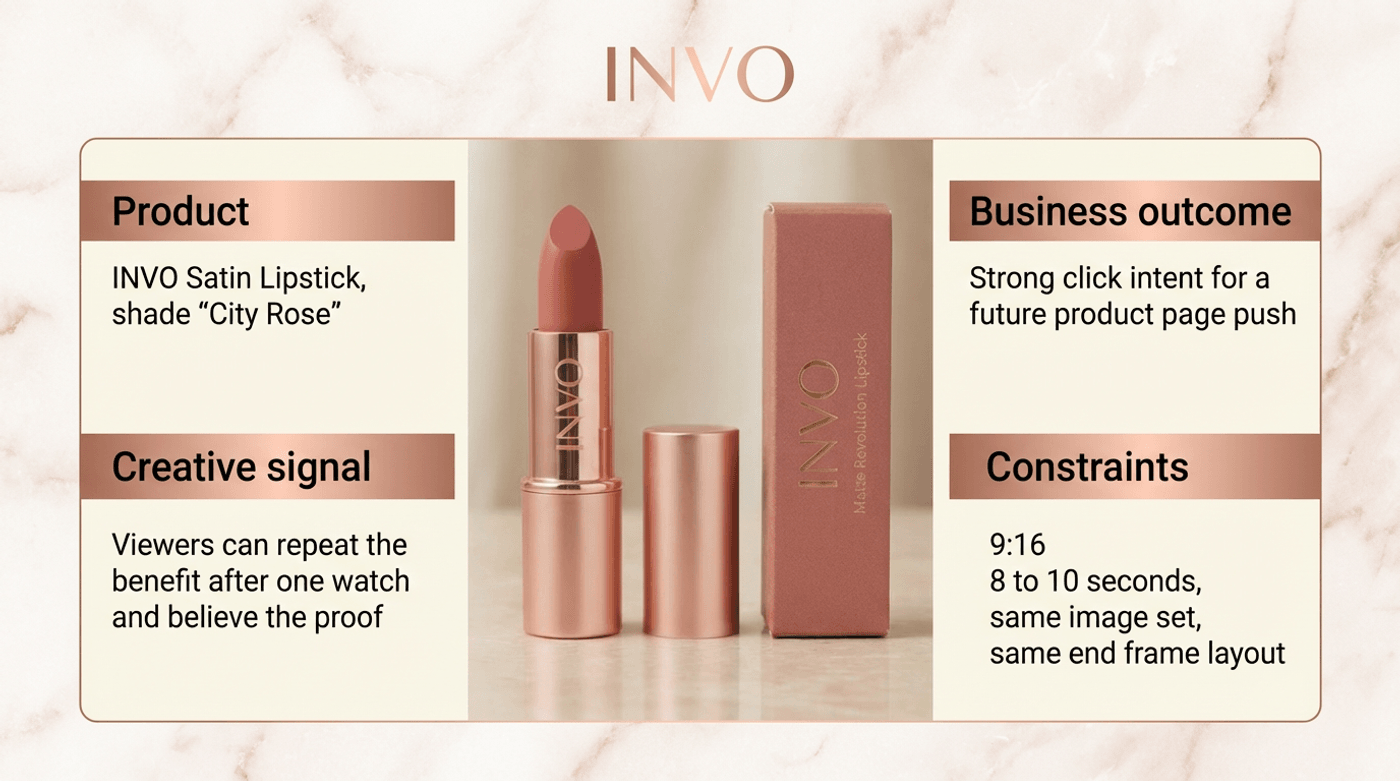
1. Pick the business outcome the ad should eventually support. For product ads, it usually falls into one of these buckets. Driving clicks to a product page, driving adds to cart, driving purchases, or increasing perceived quality and recall for a new launch.
2. Pick the creative signal you will judge in this pre-launch test. Since nothing is live yet, you are not chasing platform metrics. You are judging whether the ad earns attention and understanding. The most useful signals are hook clarity in the first 2 seconds, benefit comprehension after one watch, proof believability, and brand fit.
3. Write constraints so your comparisons stay fair. Same duration, same aspect ratio, same product images, and the same end frame structure. This is what makes the batch readable.
Here is an example brief for INVO that works well for A/B testing product ads:
Step 2 - Build the hook matrix
Now you decide what you are actually testing. For INVO, we will test three classic angles. Shade match, long wear, and texture payoff.
The matrix below is the control panel for the whole round. It tells you what changes and what stays stable.
Step 3 - Prep images that Money Shot can trust
Money Shot is brutally honest about inputs. Great inputs give you consistent outputs. Messy inputs give you noise.
For INVO, the goal is 6 to 8 product-only images with clear text and clean backgrounds. That typically includes a front pack, an angled pack, A/Bullet close up, a logo detail, one or two texture swatches, and a small shade lineup.

Prep images for INVO
If your images are low resolution, do not brute force it. Upscale and clean them first using Nano Banana Pro on invideo. It is a quick way to improve sharpness and detail before generating AI video ads, and it lives here: Nano Banana Pro.
This image step is what lets invideo Money Shot keep packaging and on-pack text accurate across dozens of generative product ads.
Step 4 - Generate the first batch in invideo Money Shot
Now you generate the three 8 to 10 second variations.
Inside invideo, open Money Shot from Trends, select the Lipstick Fashion And Lifestyle template, upload the INVO image set, and lock these settings for the whole round: 9 by 16 and 8 to 10 seconds.
Then generate one video per variation. Keep the style constant. Keep the structure constant. Only change what the matrix says should change.
Variation A Shade match prompt
“Create an 8 to 10 second vertical AI video ad for the brand INVO. Use my uploaded product images so the INVO lipstick packaging and all on pack text stay perfectly accurate with zero hallucinations. Style: modern fashion and lifestyle. Story: 0 to 2 seconds close up of the INVO lipstick bullet rotating, show the INVO logo clearly. 2 to 6 seconds swatches on two different skin tones. 6 to 10 seconds clean pack shot with multiple INVO shades’ Keep camera moves smooth.”
Variation B Long wear prompt
“Create an 8 to 10 second vertical AI video ad for the brand INVO. Use my uploaded product images so the INVO lipstick packaging and all on pack text stay perfectly accurate with zero hallucinations. Style: modern fashion and lifestyle. Story: Close up of lips applying the INVO lipstick. 2 to 6 Talk about weightless and velvet soft features. 6 to 10 talk about full stroke application and matt finish’ Keep the product and branding crisp and readable.”
Variation C Texture payoff prompt
“Create an 8 to 10 second vertical AI video ad for the brand INVO. Use my uploaded product images so the INVO lipstick packaging and all on pack text stay perfectly accurate with zero hallucinations. Style: modern fashion and lifestyle. Story: 0 to 2 seconds macro glide across the INVO lipstick bullet texture. 2 to 6 seconds single stroke swatch showing rich pigment. 6 to 10 seconds close up of comfortable looking lips and a quick pack shot, talking about features and luxury end line Use soft diffused lighting and gentle transitions.”
Step 5 - Name exports like a testing team
Naming is not admin work. It is what lets you look at results and understand them instantly.
For the INVO batch, a practical convention is:
INVO Lipstick FL HookA ShadeMatch V1
INVO Lipstick FL HookB LongWear V1
INVO Lipstick FL HookC Texture V1
Keep these names on the files and in whatever review doc you use. This becomes even more important when you scale to 20 or 40 AI video ads.
Step 6 - Run pre-launch A/B reviews that actually predict performance
Since this is before anything goes live, you are not chasing platform outcomes yet. You are testing whether the creative itself earns attention and communicates A/Benefit fast.
Here is the simplest review method that consistently works.
First, collect 15 to 30 viewers who resemble your audience, plus a few internal stakeholders. Show them the three ads in randomized order. Ask the same questions for every ad.
A tight scorecard looks like this:
– What is the product
– What is the main benefit
– How believable is the proof from 1 to 5
– How likely are you to click to learn more from 1 to 5
– Which one do you remember 2 minutes later
The key is the two-minute recall question. It reveals which concept stuck, not which one looked “cool.”
Step 7 - Pick the winning concept and write the learning
Pick a winner based on patterns, not one loud opinion.
If Variation B consistently wins on recall, belief, and click intent, the learning is not “long wear wins.” The learning is more specific. It might be “proof moments beat broad claims” or “time-based framing makes the benefit feel real.”
Write the learning in one sentence, then lock it. That line becomes the brief for round two.
Step 8 -Test styles for the winning concept
Round two answers a different question. Now that the message is chosen, which look and feel carries it best.
This is the part that makes Money Shot feel like a creative playground, but it still needs discipline. Same script. Same product images. Same duration. Only the style changes.
Step 9 - Render the same winning script in multiple Money Shot styles
Assume the winning concept for INVO was Long wear. Keep the same story beats and end line, then render it through three compatible styles.
Indoor Studio prompt
Create an 8 to 10 second vertical AI video ad for the brand INVO. Use my uploaded product images so the INVO lipstick packaging and all on pack text stay perfectly accurate with zero hallucinations. Style: Indoor Studio. Keep the background minimal and premium.
High End Luxury prompt
Create an 8 to 10 second vertical AI video ad for the brand INVO. Use my uploaded product images so the INVO lipstick packaging and all on pack text stay perfectly accurate with zero hallucinations. Style: High End Luxury. Use the same long wear story beats. Use rich contrast, slow confident camera moves.
Retro Modern prompt
Create an 8 to 10 second vertical AI video ad for the brand INVO. Use my uploaded product images so the INVO lipstick packaging and all on pack text stay perfectly accurate with zero hallucinations. Style: Retro Modern. Keep motion graphics clean and readable.
Outdoor
Create an 8 to 10 second vertical AI video ad for the brand INVO. Use my uploaded product images so the INVO lipstick packaging and all on pack text stay perfectly accurate with zero hallucinations. Style: Outdoor. Keep motion graphics clean and readable.
Step 10 Review styles like a brand director
In round two, people often confuse “my favorite look” with “the best vehicle for the message.” Bring it back to the brief.
Ask three questions.
1. Does this style make the proof feel believable?
2. Does it fit the product brand world?
3. Does it make the product feel like it is worth its price?
Pick one style as the control. Keep a close runner up as the refresh. This is how you avoid creative fatigue later without starting from zero.
Step 11 Use Advanced Director to lock brand specificity
Templates and styles get you fast. Advanced Director gets you specific.
Once the concept and style are chosen, Advanced Director is where you tighten the details that make an invideo product ad feel unmistakably yours. Lighting temperature, palette, environment, typography rules, and camera energy all become controllable without changing the proven script.
This is the best time to use Advanced Director because the big creative decisions are already made.
Turn this into a weekly system
Once this is in place, you stop treating creative things like a big event. It becomes a repeatable loop.
A single afternoon can produce a full round of AI video ads, a clean concept test, a style test, and one polished winner. That is the real value of invideo Money Shot. It turns A/B testing product ads into something your team can actually keep up with.
From there, expansion is straightforward. The winners can be extended into longer edits with the AI video generator, rebuilt into creator-first formats with UGC ads, and tightened into platform-native pacing.
If the goal is to find the best AI tool for product ad A/B testing, the real answer is the system plus the tool. Money Shot gives you the speed and product accuracy. The two-round structure gives you clean learnings. Together, they let you ship better creative with less guesswork and far less waiting.
Also check out these related articles:
-
The New Rulebook for Product Photos: How to Shoot Images That Turn into Flawless Commercials
-
What Is Product Advertising and Why It Matters More Than Ever
-
AI Prompting Techniques To Take Product Shots In Different Angles
FAQs
-
1.
What is the fastest way to do A/B testing for product ads before launch?
The fastest approach is to generate a controlled batch of 8 to 10 second variations from the same product image set, then compare them with a simple scorecard before any campaign goes live. Money Shot on invideo makes this practical because you can produce many product-accurate AI video ads quickly without packaging or text drifting.
-
2.
How detailed should Money Shot prompts be for reliable comparisons?
Prompts should be specific about timing and story beats and consistent across variations. Call out what happens in the first 2 seconds, what the proof moment is, and what the end frame line is. Avoid adding extra scenes or new claims in only one variation since that breaks comparability.
-
3.
How do you keep packaging and product text accurate in AI video ads?
Use 6 to 8 clean product-only images with legible on-pack text and neutral backgrounds. Keep that image set constant across the batch. Money Shot is designed to maintain product consistency and avoid text hallucinations when the inputs are clear and varied.
-
4.
Can this workflow work outside beauty products?
Yes. The lipstick example is just a demonstration. The same A/B testing structure works for skincare, supplements, electronics, CPG, fashion accessories, and most ecommerce products, as long as you choose compatible styles and keep your variables controlled.
