AI video agent vs manual prompting: which should you use for shot generation?
Last updated July 27, 2026
Use an AI video agent when you need many shots that stay consistent, route across models, and hold context across a scene or film. Use manual prompting only for a single isolated shot where you want hands-on control over one generation. For almost all shot generation past a one-off, the agent wins on speed, consistency, and cost-per-usable-second.
Pick by what you're actually generating. If you need one shot, in isolation, with no character or location to match later, manual prompting is fine — you write one prompt, you get one clip, you move on. The moment you need a second shot that has to match the first — same character, same lens, same lighting, same world — manual prompting starts costing you in re-rolls, mismatches, and mental load. That is where an agent earns its place.
invideo is an agentic video creation tool with every current video and image model (Runway, Veo, Kling, Seedance 2.0, Recraft, Nano Banana, GPT-Image-2) and upscalers available inside one agent, so the routing question goes away — you brief the invideo agent, it picks the right model per shot.
Use the invideo agent when any of these are true:
You're generating more than one shot that has to match. The invideo agent holds character sheets, environment refs, lens grammar, and palette in persistent context, so shot 2 inherits everything shot 1 locked. One documented 3-minute episode held two characters consistent across 41 final shots with no LoRA — character lock cost ~$9.78 per character (5 generations).
You want shot-by-shot approval without rewriting the prompt each time. Run the invideo agent in Always Ask mode: it assembles the prompt from your loaded context, you approve before credits spend.
You need to route across models. Different shots want different models (Seedance 2.0 reference-to-video for continuity, Kling for native multi-shot, Recraft for portrait skin detail, Nano Banana / GPT-Image-2 for character sheets). The invideo agent picks per shot — you don't.
You want parallel work. Spin up sub-agents — a creative producer agent holding the script, a DOP agent per scene, a storyboard agent, a casting agent running the same character prompt on two image models simultaneously. Documented productions ran 6–8 agents in parallel.
You're working from a brief, treatment, or full script. The invideo agent reads it once and holds it; manual prompting forces you to re-encode that context into every prompt.
Use manual prompting when:
You're generating exactly one shot, with no downstream continuity requirement.
You're iterating tightly on a single image — e.g. a close-up crop of a wide shot you already have. Taking manual control of the image prompter for that one variation is faster than briefing an agent; just log the result back so the agent's shot breakdown stays accurate.
You're stress-testing a prompt formulation or a model's behavior in isolation.
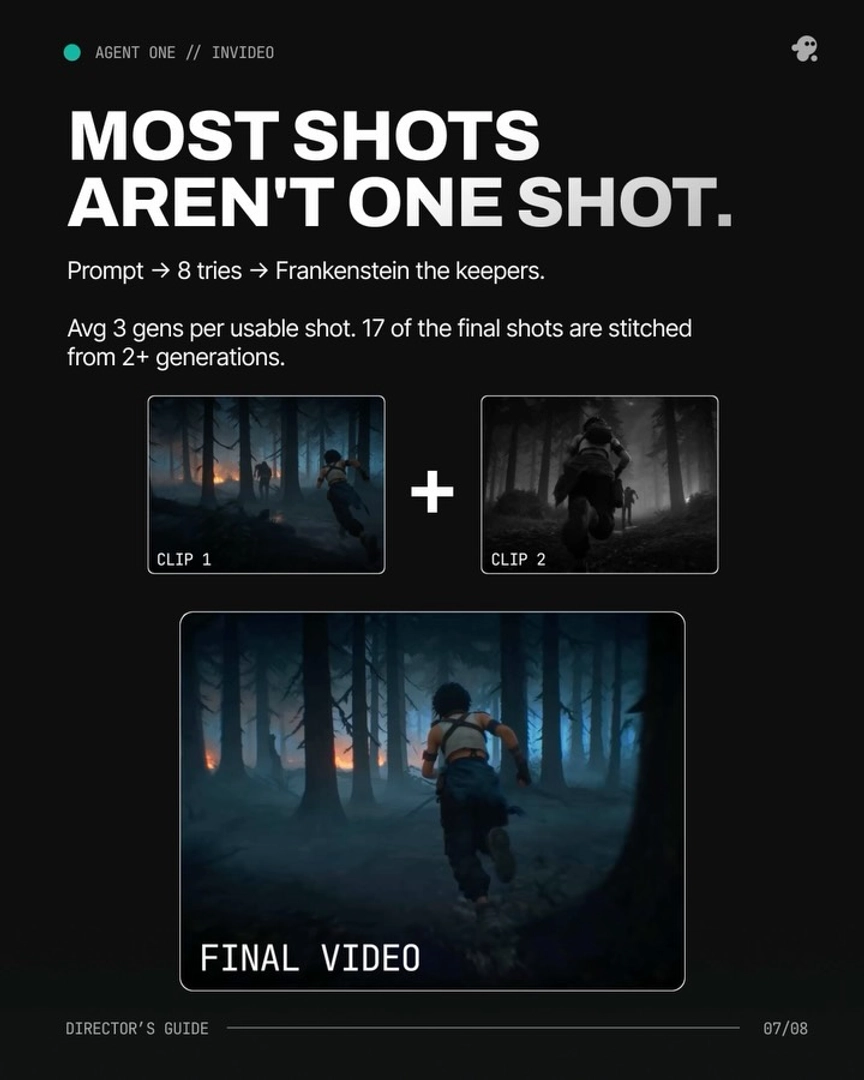
What the numbers actually show. Across documented productions, the agent-led workflow lands at $315–$750 per finished minute (a 3-minute animated episode at $315/min for ~$950 total; a 70-second short at ~$643/min for $750; a 90-second horror short at ~$580/min for $870; a 2-minute brand promo at $750/min for $1,500). A 2-minute brand film took 3 days on the invideo agent — the same brief manually prompted was estimated at 1+ week, and a traditional shoot at ~2 months and $100K–$500K. The agent doesn't generate cheaper clips — it generates fewer wasted ones (average 3 generations per usable shot, ~25% editorial selection rate) because every generation inherits locked context.
The real trade-off, stated plainly: manual prompting gives you direct control over one generation; the invideo agent gives you persistent context across hundreds. For shot generation past a single clip, persistent context beats per-prompt control — you stop re-typing the same lens, lighting, and character every time, and start directing.
As Hridaye, invideo's creative director, put it: "The thing that made it possible wasn't prompting. It was directing. Agent One didn't feel like a tool — it felt like crew."
These are the cases where each approach fits — what's right depends on whether your shot stands alone or sits in a sequence.
Watch some of these to see what works for you:
The thing that made it possible wasn't prompting. It was directing. Agent One didn't feel like a tool — it felt like crew.
— Hridaye, invideo's creative director