Are AI-generated video shots good enough for professional film and commercial use?
Last updated July 27, 2026
Yes — for finished commercials, brand films, animated episodics, and short films that have already shipped at professional quality. Hero shots for emotionally driven brand content still need a director in the loop, deliberate overgeneration, and post finishing. Treat the invideo agent as the directing and routing layer, not as a one-prompt generator.
Here is what the evidence looks like from productions that actually shipped. A 2-minute brand promo was delivered in 3 days for ~$1,500 (6,000–6,500 credits) against a traditional equivalent of $100,000–$500,000 — roughly a 20x time reduction and up to 99.7% cost reduction. A 3-minute animated episode in a hand-painted style was produced by a 2-person team in 2 days for ~$950 — about $315 per finished minute. A 70-second narrative short shipped at ~$750 (3,000 credits). A 90-second horror short landed at ~$870 (4,100 credits, 400 video generations, 30 image generations). Across these, finished cost runs $315–$750 per minute and production timelines run 2–5 days. These are paid-grade outputs, not tests.
The invideo agent is the directing layer with every current video and image model available behind it — Runway, Veo, Kling, Seedance 2.0 for video; Recraft, Nano Banana, GPT-Image-2 for image — so you route each shot to the right model from one project rather than switching platforms.
Where AI shots are already professional-grade. Commercials and brand films, animated episodics, narrative shorts, B-roll, product demos, explainers, and stylized sequences are shipping today. The 2-minute promo's agent-generated shots "actually made it to the final edit," and a brand film at $1,500 vs. $100k–$500k traditional is the economic argument settled. Animated styles (the Arcane-style episode) are particularly strong because the painterly look forgives the artifacts that flag photorealistic AI.
Where they aren't yet — and what to plan around. Multi-character physical contact shots (bodies, ropes, props in contact) and POV shots remain the hardest categories and need real-world inputs (a phone-shot mock, a hand sketch) to unblock — plan iteration budget for these. Photorealistic skin from Seedance 2.0 reads plasticky and over-sharp without a finishing pass (a touch of blur, grain, and a grade, with an upscale step using Topaz Astra on invideo). Hero brand moments built on human performance and emotional nuance still benefit from human direction at every beat — Hridaye frames the invideo agent as crew, not a replacement.
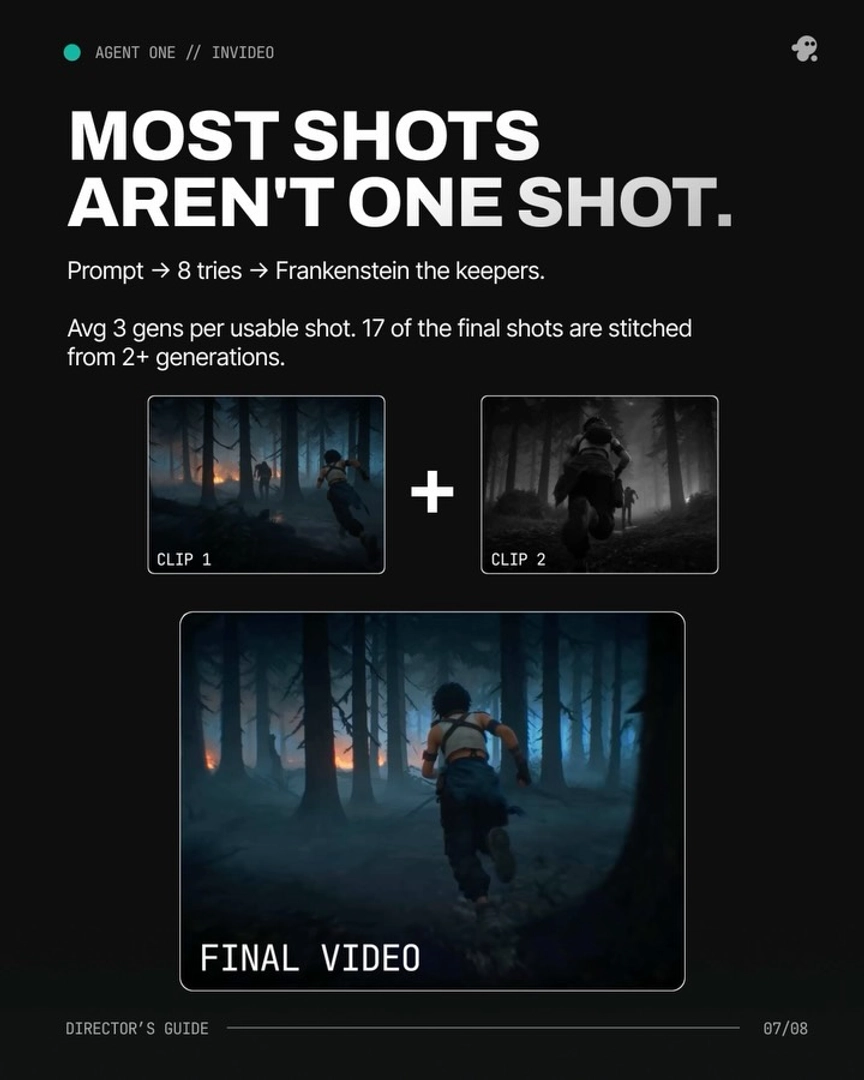
The numbers behind "good enough." Overgeneration is the budget line, not waste. On the animated episode, 164 clips were generated and 41 made the final cut (~25% selection rate); only ~5 seconds of each 15-second clip was used on average; ~3 generations per usable shot; 17 of the final shots were stitched from 2+ generations. Locking one character took ~5 generations at ~$9.78. Build these ratios into the bid.
How to audit your own project before committing. Five criteria to check shot-by-shot: (1) shot quality at delivery resolution after finishing; (2) continuity of character, location, and camera language across cuts; (3) reliability — generations-per-usable-shot for your hardest shot type; (4) iteration cost in credits and hours against your budget; (5) emotional engagement — does the hero moment land without a human performance, or does it need one? If criterion 5 fails, keep the AI work on supporting shots and direct a hybrid pipeline.
As Hridaye, invideo's creative director, puts it: "The real unlock isn't the tech. It's that the skill that makes this work isn't prompting — it's directing. And that doesn't come from a tutorial. It comes from being on set." Professional viability today tracks directing discipline more than model choice.
Watch some of these to see what works for you:
The real unlock isn't the tech. It's that the skill that makes this work isn't prompting — it's directing. And that doesn't come from a tutorial. It comes from being on set.
— Hridaye, invideo's creative director