Can AI create a complete animated short film without a traditional production crew?
Last updated July 27, 2026
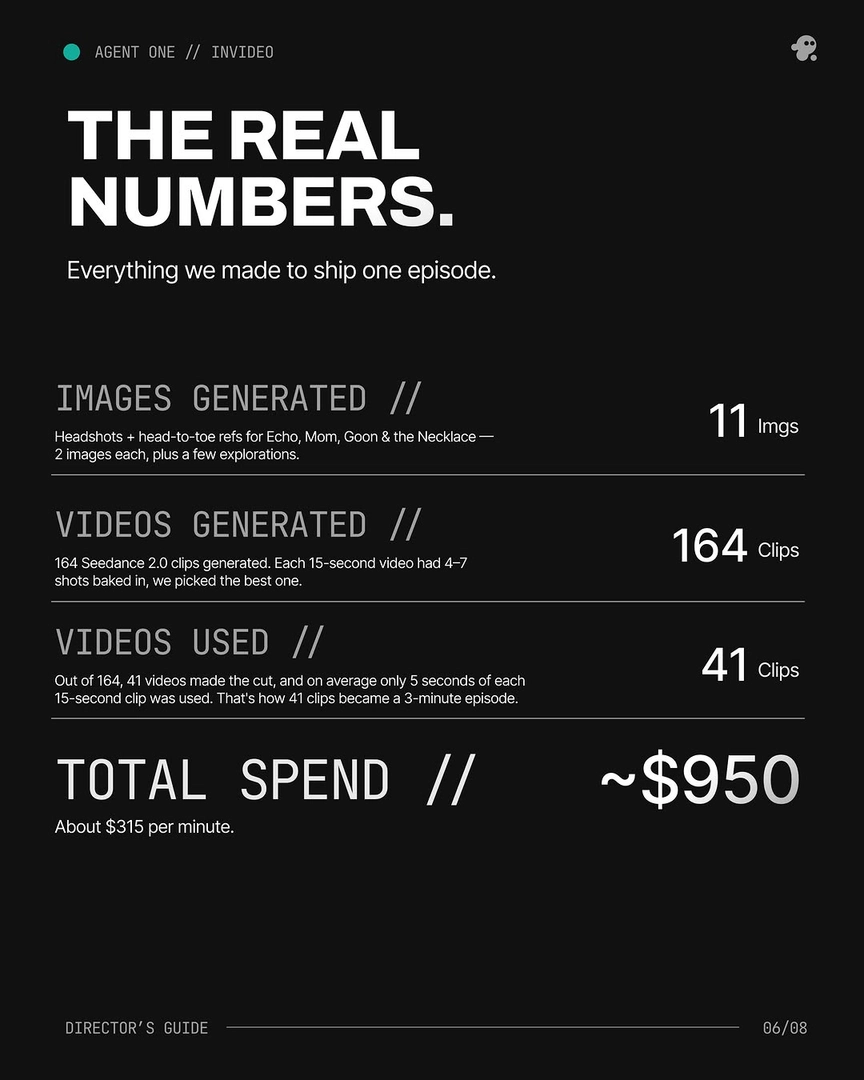
Yes — solo creators and 2–4 person teams are already finishing animated shorts entirely with AI, no traditional crew. Documented productions range from a 70-second short for $750 to a 3-minute animated episode for $950 and a ~90-second horror short for $870, each made in 2–5 days by 1–4 people directing AI agents end-to-end.
Treat yourself as the director and let a crew of agents do the rest. The invideo agent is an agentic video tool that holds your script, references, and style in persistent context and routes each shot to the right model — Seedance 2.0 for video, Recraft and Nano Banana for stills, with Veo and Kling available when a shot calls for them — so you never platform-hop. From there, the workflow that's actually shipping films is short:
Lock the world before you generate anything. Spin up a creative producer agent and load the full script, character notes, and any visual references. Generate four options per character sheet and per environment plate, pick the strongest, and lock them. One documented 2-person team uploaded 64 reference frames in one message, told the agent to save the style to context, then prefixed every later prompt with that style block — that single discipline carried consistency across a 3-minute episode with no fine-tuning.
Run a crew of sub-agents in parallel, not one agent doing everything. Initialize a creative producer agent as the vision-holder, then spin up named sub-agents for the roles you'd normally hire: a storyboard agent to visualize shots before you direct them, a costume agent you brief by mood when you don't have an exact spec, a DOP agent per scene (different scenes want different eyes), a director's assistant agent to sequence the shot breakdown. Documented setups ran 6–8 sub-agents simultaneously across separate project pages — that parallelism is what collapses a 2-month traditional shoot into a 3-day promo.
Generate in short chunks with shot-by-shot approval. Break the script into 15-second segments, attach character sheets and the style block to every prompt, and use the agent's approve-before-spend mode so you greenlight each generation. Plan for roughly 3 generations per usable shot and a ~25% editorial yield — the Arcane-style episode generated 164 clips to land 41 in the cut, averaging only 5 seconds used from each 15-second clip. Overgeneration is the budget line, not waste.
Direct in plain language, not prompt syntax. Talk to each sub-agent the way you'd talk to a DOP on set — "hold on him, no cutting until he lunges" — and let the agent translate that into prompts and model choice. Hridaye, invideo's creative director, puts the principle bluntly: "The thing that made it possible wasn't prompting. It was directing. Agent One didn't feel like a tool — it felt like crew." Years of on-set instinct become an advantage here, not a liability.
Close the loop with an AI maker-checker pass. Once you have a rough cut, send it back to the invideo agent with "what's working, what's not" — it catches pacing drift, emotional-register mismatches, and sound problems a tired solo editor will miss. Skipping this pass is the most common failure mode.
The economics across documented productions are consistent: $750–$5,000 all-in, 2–5 production days, 1–4 people, and finished-minute costs of $315–$750 depending on length and ambition. A 2-minute brand promo that traditionally costs $100,000–$500,000 came in at ~$1,500 on this workflow — roughly a 20x time reduction and up to a 99.7% cost reduction versus a live shoot.
Beyond the workflow itself: "without a crew" still means one human directs. Character consistency in physical-contact shots, true emotional nuance in performance, and editorial taste are the parts you don't outsource to the model — you carry them. Plan on roughly 40–80 hours of directed work for a 2–3 minute short, budget for overgeneration, and lock your world before you press generate.
Watch some of these to see what works for you:
The thing that made it possible wasn't prompting. It was directing. Agent One didn't feel like a tool — it felt like crew.
— Hridaye, invideo's creative director