Can AI keep a character visually consistent across an entire short film without fine-tuning or LoRA?
Last updated July 27, 2026
Yes — character consistency across a full short film is achievable without LoRA or fine-tuning, using locked multi-angle character sheets fed into a context-holding agent that attaches them to every generation. Documented productions hold 2 characters across a 70-second film and 4 characters across a 3-minute episode this way. Drift still appears under extreme lighting or angle changes — fix it surgically at the character sheet, not by re-rolling shots.
Generate a multi-angle character sheet for each character before you generate any video. The pattern that holds up across documented AI short films is: a front/side/profile/back turnaround at 4K, plus a face close-up and a mid-angle close-up so small details (scars, accessories, costume trim) stay locked when the camera moves in. Generate four options per character and pick one — across these productions, that selection step is what prevents downstream consistency problems.
Load those locked sheets into the invideo agent — an agentic video tool that holds project context (script, character sheets, references, style) across every shot and routes each generation to the right model — and attach them to every prompt. One documented 70-second, 2-character short film held the same person across every scene this way, with no LoRA: $750 total, 3,000 credits, 2 days. A 3-minute 4-character animated episode used the same approach across 164 generated clips, locking each character in about 5 attempts at roughly $9.78 per character lock.
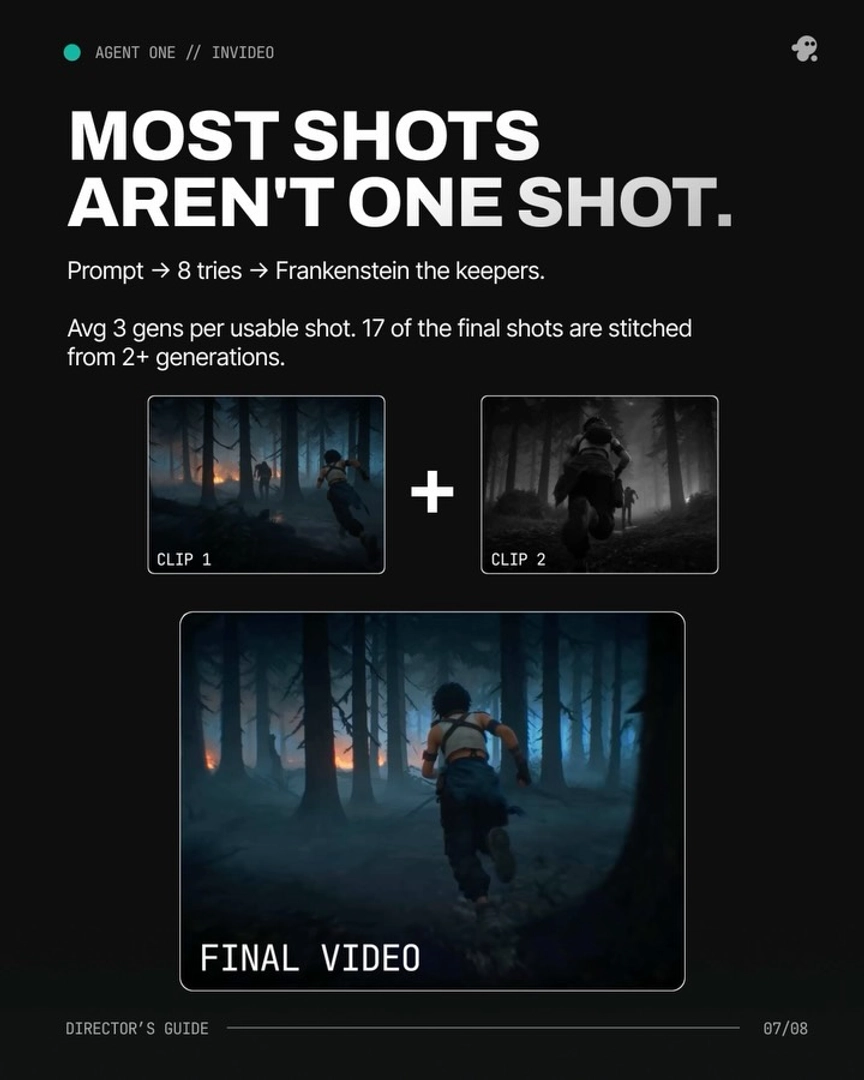
Run generation in your delivery format with the character sheet and a short identity block attached to every prompt — same description, same wardrobe notes, same hair/skin specifics, verbatim, every time. Use the invideo agent's shot-by-shot approval mode so you confirm each generation against the sheet before credits are spent. Plan for roughly 3 generations per usable shot — overgeneration is a budget line, not waste, because only about 25% of clips clear the consistency bar editorially.
When a continuity error shows up — wrong earring, missing scar, hair length off — do NOT re-roll the shot. Ask the invideo agent to inspect the character sheet itself; in one documented case it identified the exact panel containing the error (an AirPod that shouldn't have been there), corrected it in context, and every subsequent shot inherited the fix. As Hridaye, invideo's creative director, puts it: "It traces the source in your character sheet, fixes it there, leaves the rest of the film intact. Surgical edits. Not slot-machine re-rolls."
For characters whose appearance evolves across the film — a costume change, a prop added, an injury — build a separate character sheet per beat. One documented production had a character accumulating a new trinket in every sequence and needed a distinct sheet for each, all locked the same way, all held in agent context.
Where it gets unreliable without LoRA: extreme angle changes from the sheet's coverage (over-the-shoulder is a known weak point of current image models), heavy lighting shifts that confuse skin tone and hair, and multi-character physical contact shots (bodies touching, props passed between hands) — these break models faster than anything else. Two practical mitigations inside the same no-LoRA workflow: route shots through Seedance 2.0 reference-to-video, which carries character context across clips better than start/end-frame methods, and for sequences the prompt can't crack, hand the agent a phone-shot mock or a sketch as a visual anchor. Across roster video models — Runway, Veo, Kling, Seedance 2.0 — the invideo agent routes the shot to whichever best preserves identity for that setup, so you don't pick a platform per model.
These approaches hold character identity for short films without fine-tuning — what works depends on how much your character changes and how varied your lighting and angles get.
Watch some of these to see what works for you:
It traces the source in your character sheet, fixes it there, leaves the rest of the film intact.
— Hridaye, invideo's creative director