Can an AI agent maintain a director's visual style across an entire short film without constant re-prompting?
Last updated July 27, 2026
Yes — a single agent can hold a director's visual style across an entire short film without re-prompting, provided you load a structured visual-language document into its context once at the start. Documented productions ran 70–180 seconds of finished film with the style holding shot-to-shot, no per-prompt re-explanation.
The mechanism is one upfront load, not constant nudging. invideo is an agentic video tool with the current video and image models routed by the invideo agent, so you teach the agent the director's visual system once and it carries that system into every generation request after.
Write the director's visual language as a structured document, then upload it once. The document that did this for a Wong Kar-wai short film ran 25 pages across 14 sections — camera, angles, colour tone, atmosphere, mood, lighting, composition, movement, film palettes, prompt templates, negative prompts, and a quick-reference card. A James Wan version added a five-stage emotional architecture (each stage with its own camera, lighting, sound rules) plus a 'what never to do' clause per stage. The richer and more decision-ready the document, the less the agent has to guess later. As Hridaye, invideo's creative director, puts it: "This is the core reason why I insist you take your own sweet time while building the production doc in the beginning, because the more clarity you bring to the project, the more sharply the agent will hold it for you across the project."
Encode style as a language, not as references to copy. Name the tonal modes with exact hex values ('Mode A — split-toned amber and emerald'), name the lens behaviour (spherical, circular bokeh, no horizontal flares), name the dark-to-light ratios (Wan's 85:15), and write explicit negative prompts ('not live-action, not photorealistic; every surface has hand-painted brushstroke texture'). Negative constraints in the style block are what stop drift toward the model's default photoreal look.
Lock a 9-element prompt assembly order in the agent's context so every shot gets built the same way: camera spec → lens & aspect ratio → lighting source → palette → composition → atmosphere → mood register → film/DP attribution → negative prompt. Once that order is in context, you direct in plain language and the agent reassembles the full grammar under the hood — even a three-word continuation like "Everything should match" is enough to carry character, lighting, lens grammar, and spatial logic into the next shot.
Validate the document before generating a single frame. Ask the agent to apply the style to a genre the director never worked in (a courtroom thriller through a Wan lens, for instance). If it asks clarifying questions and the output is stylistically coherent, the grammar is internalized; if it pattern-matches surface aesthetics, the document needs more decision rules. The horror short's agent later flagged a Stage A shadow leaning blue-green instead of neutral gray on its own — that is what an internalized document looks like in production.
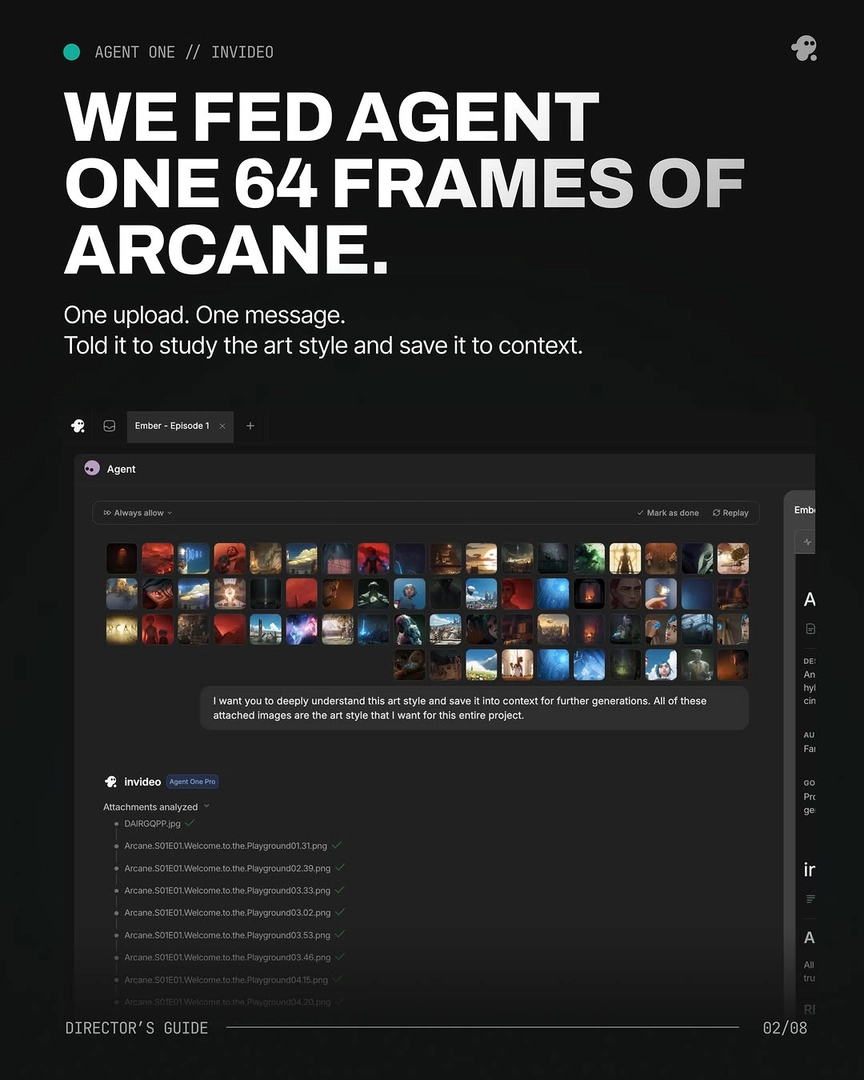
Treat the style block as the spine of every prompt for the rest of the film. On the Arcane-style animated episode, the team uploaded 64 reference frames once, instructed the agent to save the style to context, and every prompt after that opened with the same style block. The result: 41 final clips across a 3-minute episode in one consistent visual language, with the agent gating each generation against the document before returning it. Hridaye describes the effect as "camera continuity carries from the treatment doc forward — you set it once, it holds."
Where model choice matters for look consistency, the invideo agent routes between Seedance 2.0 (reference-to-video carries character and location context across clips), Veo, Kling, and Runway from inside one project — you don't switch platforms per shot, which is itself a major source of style drift on multi-tool workflows.
The honest limit: an agent holds the visual grammar autonomously, but you still review. The most useful step most people skip is sending the rough cut back to the agent with an open 'what's working, what's not' prompt — on the Wan-style horror short, the agent caught that the entity reveal was running at the wrong emotional stage register, a structural miss a human editor would have shipped. Style holds without re-prompting; editorial judgment stays a loop.
Watch some of these to see what works for you:
This is the core reason why I insist you take your own sweet time while building the production doc in the beginning, because the more clarity you bring to the project, the more sharply Agent One will hold it for you across the project.
— Hridaye, invideo's creative director