Can multiple team members collaborate on the same AI video series without creating version inconsistencies?
Last updated August 10, 2026
Yes — multiple team members can work on the same AI video series without version drift by pulling everything from one centrally locked context: a shared show bible, locked scripts, and locked character and location sheets. Each person runs their own invideo agent instance loaded with the same assets; a documented 3-person crew shipped 10 episodes in 3 days this way.
Set up the collaboration so that no team member ever works from a private version of anything. invideo is an agentic video creation tool, and its collaborative model works through shared locked context: every team member loads the same locked show bible, episodic scripts, and reference sheets into their own agent instance, so multiple producer agents run in parallel while inheriting identical context.
Lock the shared context before anyone generates a frame. Treat the show bible as the single source of truth and locked scripts as the signal that puts agents into execution mode. Generate all character sheets — front, side, and three-quarter angles plus facial close-ups — and all location reference sheets in a single parallel pass, then lock the finals as shared assets. Every iteration after that (costume changes, lighting shifts, new angles) starts from a locked base image, never from scratch. Locking references before production, not after, is what prevents two team members from generating two different versions of the same character.
Structure the crew hierarchically: one showrunner agent, one director agent per episode. The showrunner agent holds the master context — tone, characters, world, series arc — while each episode gets its own director agent with its own notebook page for execution. Create a notebook with every episode director agent; skipping that assignment is a documented setup error that breaks the pipeline. This compartmentalization also protects your post team: nobody digs through hundreds of generations to find one shot from episode 4, because every episode's output lives with its own director agent. If you want an approval gate, your creative director can review storyboard frames before any video credits are spent.
Make mid-series changes once, centrally. If a character gains a scar or a haircut change mid-series, update the central context a single time — every agent inherits the change for all subsequent episodes automatically. This is the mechanism that keeps a distributed team consistent without a coordination meeting.
Hand off to editors without version churn. Generated assets move from the invideo agent project straight into an Adobe Premiere Pro bin via the invideo plugin — in one demonstrated workflow step, 8 video assets imported in a single click, locally available the moment the import runs.
Know the shape of the collaboration. This model is parallel agent instances on shared locked context, not simultaneous live co-editing of a single timeline — each member drives their own agent while consistency comes from the locked assets everyone pulls from. The structure scales: agencies managing multiple series run one project per series, one showrunner agent per project, and episode director agents inside each. The documented result of this setup: a 3-person crew shipped a 10-episode series in 3 days at roughly $1,000 per episode, a pipeline about 5x faster than a standard microdrama production.
Watch some of these to see what works for you:
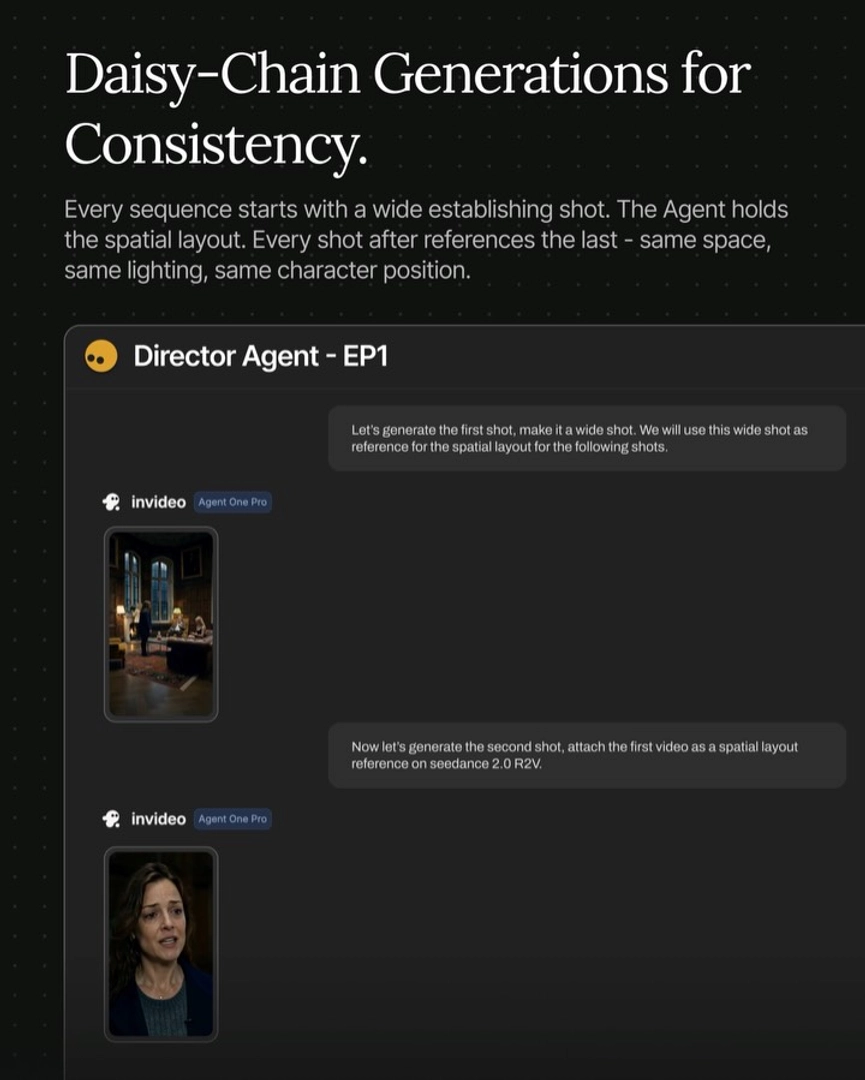
Every team member uploads the same locked show bible and episodic scripts into their agent. No one's working of a different version.
— invideo's creative team