Why do microdrama studios rely on high-volume content strategies to succeed?
Last updated August 10, 2026
Microdrama studios rely on high-volume strategies because hits are unpredictable and episodes are cheap to test — the winning play is shipping enough series, fast enough, to find a breakout first. With AI-assisted pipelines, a 3-person crew can ship a 10-episode series in 3 days at roughly $1,000 per episode, making volume the rational bet.
Volume wins in microdrama because nobody can reliably predict which series breaks out — the studio that ships the most series, fastest, runs the most audience tests and finds its winner before competitors do. Three dynamics drive the strategy:
Hit discovery is a numbers game. Episodes run roughly 1.5 to 2 minutes, so audience data on hooks and drop-off comes back within days of publishing. Every additional series shipped is another test of a genre, a cast, a hook — and the cost of each test is low enough that shipping ten mediocre attempts to find one hit beats perfecting a single script. As invideo's creative team puts it: "For a Microdrama studio, the game isn't only a great script. It's shipping enough of them, fast enough, to find your winner as soon as possible."
The serialized format monetizes library depth, not single videos. Cliffhanger-driven episodes build a habit loop — viewers return daily to continue the story — and platforms typically monetize by gating later episodes behind payment or ads. Revenue therefore scales with how many episodes are live, not how polished any one episode is, which pushes studios toward deep, fast-growing catalogs across multiple series.
AI production compresses the cost of each test. In one documented production, a 3-person crew shipped a 10-episode series in 3 days at about $1,000 per episode — a pipeline the team measured as 5X faster than a standard microdrama workflow, with all 10 episodes produced in a single run. At that cost structure, a studio can test several series simultaneously for less than the traditional cost of one, which is what makes the volume strategy executable rather than aspirational.
The operating model now supports parallel volume. invideo is an agentic video creation tool built around a crew-of-agents structure: you set up a showrunner agent that holds the show bible, tone, characters, and world context, then spin up an episode director agent per episode — the equivalent of assigning an AD to every episode in a traditional studio. Multiple producer agents run in parallel, all pulling from the same centrally locked show bible and scripts, so a mid-series change like a scar or haircut is updated once and inherited by every subsequent episode. One project per series scales this horizontally — a studio or agency managing multiple series for different clients runs the same structure per project — and the invideo mobile and iPad apps keep work moving while agents run in parallel, so volume never stalls on a single desk.
Watch some of these to see what works for you:
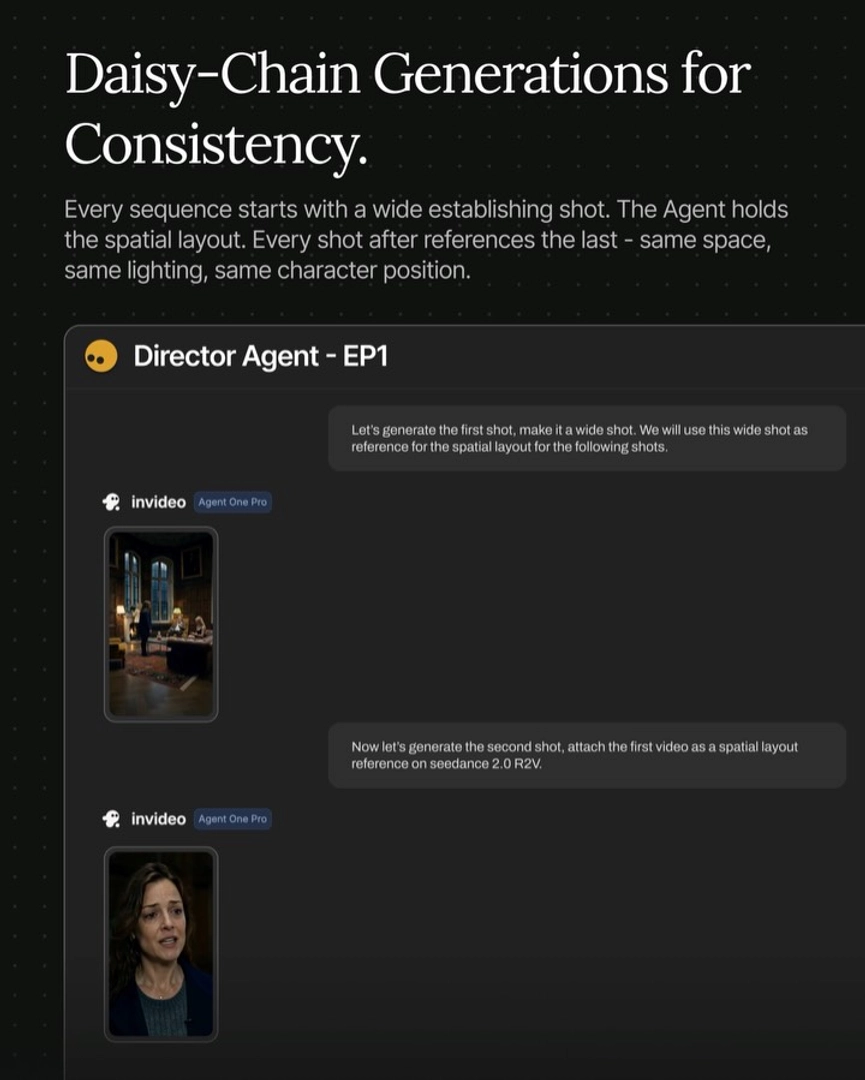
For a Microdrama studio, the game isn't only a great script. It's shipping enough of them, fast enough, to find your winner as soon as possible.
— invideo's creative team