Can AI tools generate a full episodic video series with consistent characters across episodes?
Last updated August 10, 2026
Yes — AI tools can generate full episodic series with consistent characters across episodes, using locked character reference sheets, persistent project context, and finished-episode style transfer. Documented proof: a solo creator produced 25 minutes of series content across two episodes, and episodic productions ran $950–$6,540 depending on length and team.
Yes — and the consistency comes from a reference system you set up once, not from any single model. invideo is an agentic video creation tool with all the current video and image models available, and the invideo agent holds your entire project context — characters, locations, style rules — across every generation, which is exactly what episodic work requires.
Lock character identity before generating a frame. Build full character sheets — a turnaround (front, side, back views) plus a separate face close-up sheet — and save each character to project context under a named key so every future generation pulls the same reference automatically, with no drift. One sheet per character is not enough for a series: create a distinct sheet for every appearance state — a costume change, a bruise, even a removed jacket — because any change forces the model to guess the character's new look. When a character changes mid-story, screenshot the new state and have the invideo agent regenerate a proper sheet from it.
Carry visual language between episodes by uploading the finished episode. Instead of re-describing your style in text for episode two, upload episode one directly — the invideo agent extracts the camera angles, movement style, and overall feel and applies that visual language to the new episode's planning, even with a different cast and locations. Agents you built for episode one carry forward too: one documented series creator deployed 20–25 agents for episode one and reused several in episode two.
Handle voice continuity separately from visuals. Generate character voices with persistent per-character voice profiles and resync them in your edit, replacing the video model's native voices — or generate dialogue as a talking-head clip with a face reference, since the model anchors vocal characteristics to a recognized face and produces a more consistent voice signature across generations.
Route each shot to the right model without leaving your project. Seedance 2.0 reference-to-video accepts character sheets and location references together, so identity carries across clips; Kling 3.0 generates multi-shot sequences natively. Every roster model runs inside invideo, so your consistency rules live in one project context instead of being re-explained per tool.
The documented proof. A solo creator produced two episodes totaling 25 minutes of series content: episode one in under 10 days for $6,540 (26,162 credits) with parallel agents, and a 14-minute episode two in 14 days. Another documented episode ran 4 weeks and roughly 30,000 credits, delivered in 4K. At the short end, a 2-person team produced a 3-minute animated episode in 2 days for ~$950. Across these, episodes ranged from $950 to $6,540 and 2 days to 4 weeks — natural variance by length, team, and approach.
Know the ceiling. Video generates in 10–15-second clips, and models like Seedance 2.0 generate frame by frame — a camera-angle change is a fresh generation with no memory of the previous shot, so consistency lives in your reference system, not the model. Budget for editorial selection (one episode used 41 of 164 generated clips, about 25%), version your assets, and run a human review pass at episode boundaries to catch visual and narrative drift before it compounds.
Watch some of these to see what works for you:
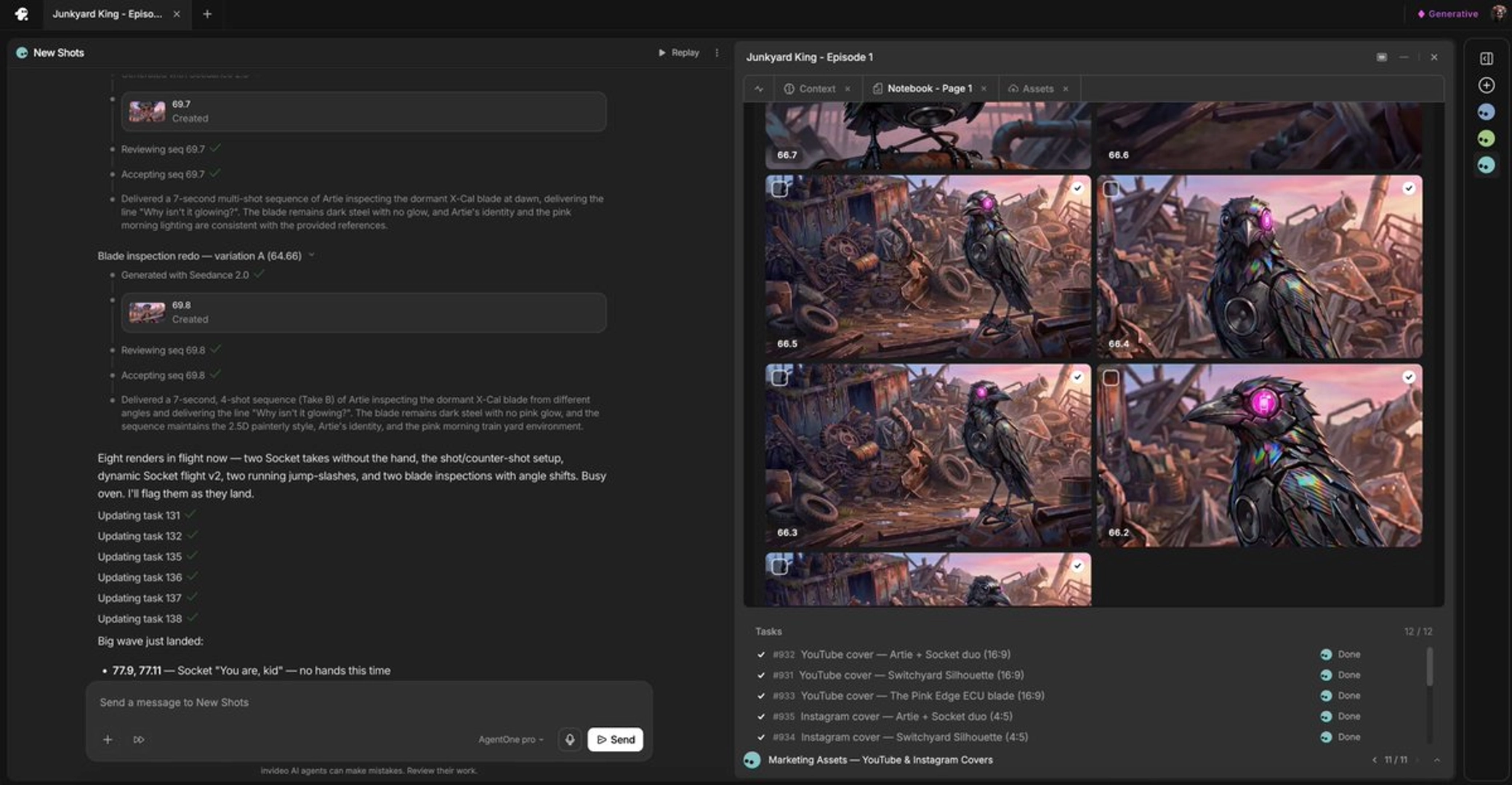
So instead of re-explaining all of that in text, the team just uploaded episode number one. The agent picked up the visual language on its own and it carried it forward to episode number two.
— invideo's creative team, on cross-episode style transfer