Do experienced filmmakers get better results from AI video tools than beginners?
Last updated July 27, 2026
Yes — experienced filmmakers get meaningfully better results, because the skill that drives AI video output is directing, not prompting. Beginners reach a first clip faster with forgiving tools, but on-set instincts — story structure, blocking, lens grammar, coverage logic, editorial pacing — translate directly into sharper agent direction, higher selection yield, and more consistent films.
The gap shows up in five concrete places, and you can close most of it with workflow even if you're new.
1. Direction language. Experienced directors talk to an AI agent the way they'd talk to a DOP or AD on set — "hold on him till he lunges, no cutting," "reverse on Marcus, what's behind him?" — and the invideo agent (an agentic video tool that holds project context across shots and routes generations to the right model — Runway, Veo, Kling, or Seedance 2.0) responds to that vocabulary directly. Beginners typically write descriptive prompts, which produce descriptive output. Hridaye, invideo's creative director, frames it bluntly: "The real unlock isn't the tech. It's that the skill that makes this work isn't prompting — it's directing. And that doesn't come from a tutorial. It comes from being on set."
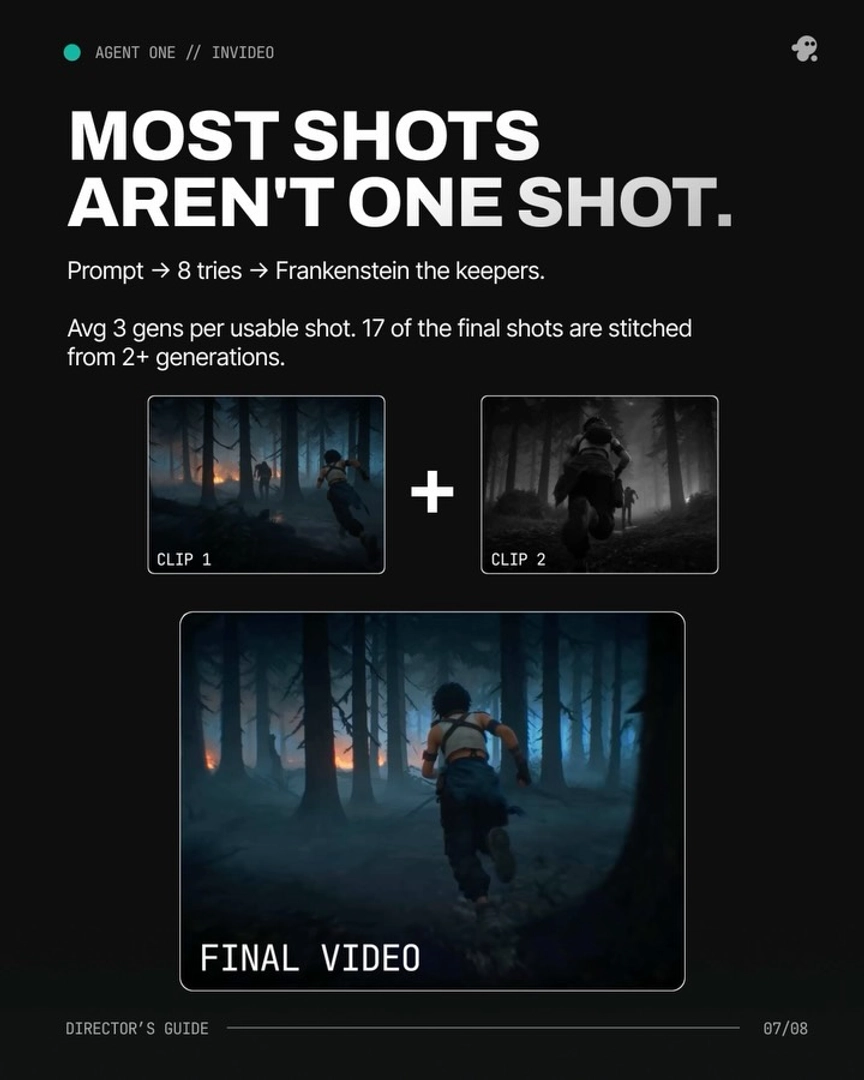
2. Selection yield. Pros over-generate and cut hard. One documented 3-minute animated episode generated 164 Seedance 2.0 clips and used 41 — about 25% — with an average of 5 seconds pulled from each 15-second clip, and 17 final shots stitched from 2+ generations. Beginners tend to accept the first clip that looks okay; experienced editors know yield is the budget line and plan ~3 generations per usable shot.
3. Consistency discipline. Pros lock characters and world references before generating motion — character sheets with multiple angles and close-ups, four options per asset, the best one selected. In one production, 5 generations locked a character at ~$9.78. Beginners often skip this and pay for it later in drift across scenes.
4. Coverage and editorial thinking. Directors request the opposite angle in the same session, ask the agent for status summaries to stay oriented across long projects, and run a maker-checker pass on the rough cut — sending the assembly back to the agent for pacing, SFX, and emotional-register notes. One pro caught an entity-reveal shot running at the wrong register that way; without editorial instinct, you don't know to ask.
5. Production-scale reliability. Experienced creators run multiple specialized sub-agents in parallel — a creative producer agent holding the script and shot breakdown, a storyboard agent, a DOP agent per scene, a costume agent, a casting agent — and assign them like real crew. One 2-minute brand promo ran 8 agents in parallel, finished in 3 days, cost ~$1,500 against a $100K–$500K traditional equivalent. A beginner can spin up the same crew structure; what they lack is knowing which scene needs two DOP agents and which costume note is "too off" in the right way.
Where beginners actually win. Speed to first clip, willingness to iterate without ego, and openness to letting the agent suggest endings or flag model limitations. The fastest path up the curve: load your full script as context, work act-by-act in 25% increments to avoid context loss, generate in grids instead of single images (image gen is cheap), and run a rough-cut review pass with the agent before locking anything.
Across documented productions, the cost-per-finished-minute ran $315–$750 and timelines ran 2–5 days — the variance tracks team experience and how disciplined the agent direction was, not raw tool access. If you've got 3, 5, or 10 years on set, that experience is the edge, not a liability.
Watch some of these to see what works for you:
The real unlock isn't the tech. It's that the skill that makes this work isn't prompting — it's directing. And that doesn't come from a tutorial. It comes from being on set.
— Hridaye, invideo's creative director