Ghibli style vs 3D animation for AI video — how do you choose the right look?
Last updated July 27, 2026
Choose by emotional register and motion complexity, not aesthetics. Ghibli/2D wins for warmth, atmosphere, and character-driven stories with simpler camera moves. 3D wins for spatial realism, product integration, and shots with depth, parallax, or complex camera movement. Run a side-by-side frame test before committing, then score the project on five questions: tone, motion complexity, shot count, distribution, and audience.
Start with a side-by-side frame test before you commit either way. Inside the invideo agent — an agentic video tool with the current image and video models routed under one interface — ask a storyboard agent to render three identical script frames in a Ghibli/2D look and the same three frames in a 3D look. Looking at the same beats in both styles makes the decision concrete instead of theoretical, and image generation is cheap enough that this costs almost nothing relative to the project.
Pick Ghibli/2D when the story leans on warmth and atmosphere. Hand-painted 2D registers as nostalgic, intimate, and emotionally soft — it carries character-driven stories, dream states, slice-of-life, and stylised worlds where mood matters more than physical realism. It also tolerates simpler camera work well: locked frames, gentle pans, and parallax-style moves stay coherent. One documented production fed 64 reference frames from a hand-painted animated series into the invideo agent, locked the style block once with explicit negative constraints ("not live action, not photorealistic, every surface has hand-painted brushstroke texture"), and applied that block to every prompt — that is the move that holds a 2D look across a film.
Pick 3D when the project needs spatial realism, depth, or heavy camera movement. 3D handles product shots, architectural interiors, environments with strong parallax, and any sequence where the camera tracks, orbits, or pushes through space. It also integrates more cleanly with live-action plates and brand work where photoreal materials matter. A 2-minute brand promo produced inside the invideo agent in 3 days for ~$1,500 relied on this kind of dimensional look — the same project shot traditionally was estimated at $100,000–$500,000.
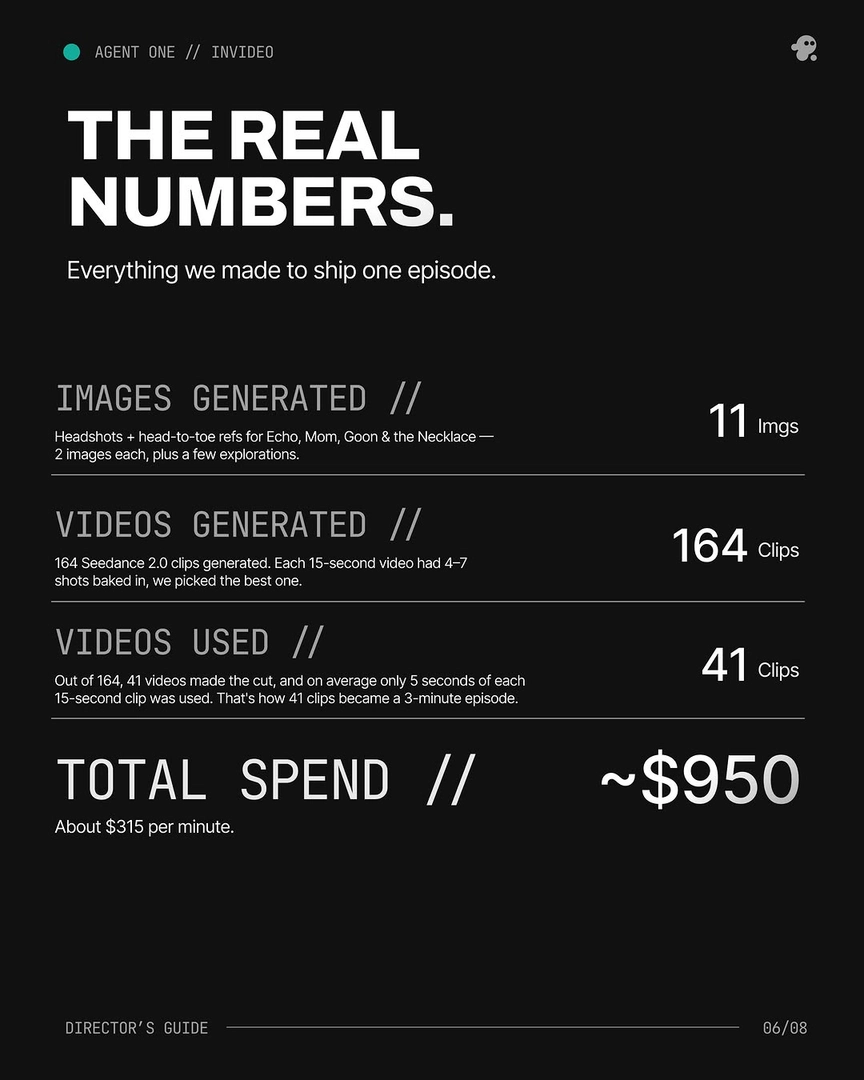
Factor in motion consistency risk before locking style. Ghibli/2D is harder to hold consistently across many shots in motion — character proportions and brushstroke texture drift between generations, and the wider your shot count, the more the drift compounds. 3D drifts too, but in more forgiving ways (lighting, material response) that read as natural variance. As a rule of thumb: under ~20 shots, 2D is manageable; above that, budget extra generations for continuity or lean 3D. Across documented productions, usable shots took around 3 generations each on average, and ~25% of generated clips made the final cut — overgeneration is the budget line, and 2D tends to push that ratio higher.
Match style to distribution and audience. Short-form vertical for social, anime-leaning audiences, and emotional narrative pieces favour 2D. Brand films, product launches, explainer content, and cinema-format pieces favour 3D. As Hridaye, invideo's creative director, puts it: "It isn't a look. It's a language. Color as diagnosis. Subliminal dollies. Dread before dialogue." The style is a communication system, not a skin — choose the one whose grammar matches what you're saying.
The 5-question scorecard. Run your project through these before locking:
Story tone — warm/atmospheric/character-driven (lean 2D) or grounded/dimensional/product-led (lean 3D)?
Motion complexity — locked/simple moves (2D fine) or tracking/orbiting/depth-heavy (3D)?
Shot count — under ~20 (2D manageable) or above (3D safer, or budget more 2D iterations)?
Distribution — anime/social/narrative platforms (2D) or brand/cinema/product surfaces (3D)?
Audience expectation — does your audience read 2D as appropriate for this subject, or will it feel like a stylistic dodge?
Whichever you pick, lock the style block before generating a single video clip: a written style directive plus the reference images that define the look, attached to every prompt. Inside the invideo agent that block lives in persistent context, so you set it once and every shot inherits it — that is what stops drift across a long project, in either style.
Watch some of these to see what works for you:
IT ISN'T A LOOK. IT'S A LANGUAGE. Color as diagnosis. Subliminal dollies. Dread before dialogue.
— Hridaye, invideo's creative director