Ghibli style vs 3D animation — which should I use for my AI short film?
Last updated July 27, 2026
Pick Ghibli-style when your film leans on emotion, warmth, weather, and quiet character moments — its painterly surface forgives motion imperfection. Pick 3D when you need spatial clarity, hard action, reusable characters from many angles, or a sci-fi/product look. The deciding factors are story tone, character complexity, and how much consistent multi-angle coverage you need.
Start by matching the look to what your story actually does on screen. Ghibli-style is the right call for slice-of-life, memory, romance, grief, kid-and-creature, and any story where mood beats action — the hand-painted surface adds warmth and hides the small motion artifacts AI video still produces. 3D wins when shots demand readable geometry: chases, fights, vehicles, mecha, product hero shots, or anything where the camera circles a character and the audience must track exact spatial relationships.
Next, weigh character and coverage complexity. 3D-style assets behave like rigged models — once you lock a character sheet with multi-angle turnarounds, the same face holds across wides, profiles, and close-ups, which is what you want for action coverage or recurring heroes. Ghibli-style is more forgiving on faces but drifts faster on hard surfaces, vehicles, and complex props; if half your film is a character carrying another character through contact-heavy blocking, painterly styles tend to break down before 3D does.
For model routing, invideo is an agentic video tool with the current models and upscalers available, and the invideo agent picks per shot rather than locking you into one. For Ghibli-style, Kling 3.0 and Veo handle painterly motion and atmosphere well; Seedance 2.0 reference-to-video carries a hand-painted style block across clips once you upload reference frames and instruct the agent to save the style to context. For 3D-style, Seedance 2.0 and Veo hold geometry and lighting consistency across angles, and GPT-Image-2 or Nano Banana generate clean multi-angle character sheets you reuse as references. Run the same script frame in both styles before committing — generating three identical frames per style side-by-side is a reliable way to decide with your eyes instead of your assumptions.
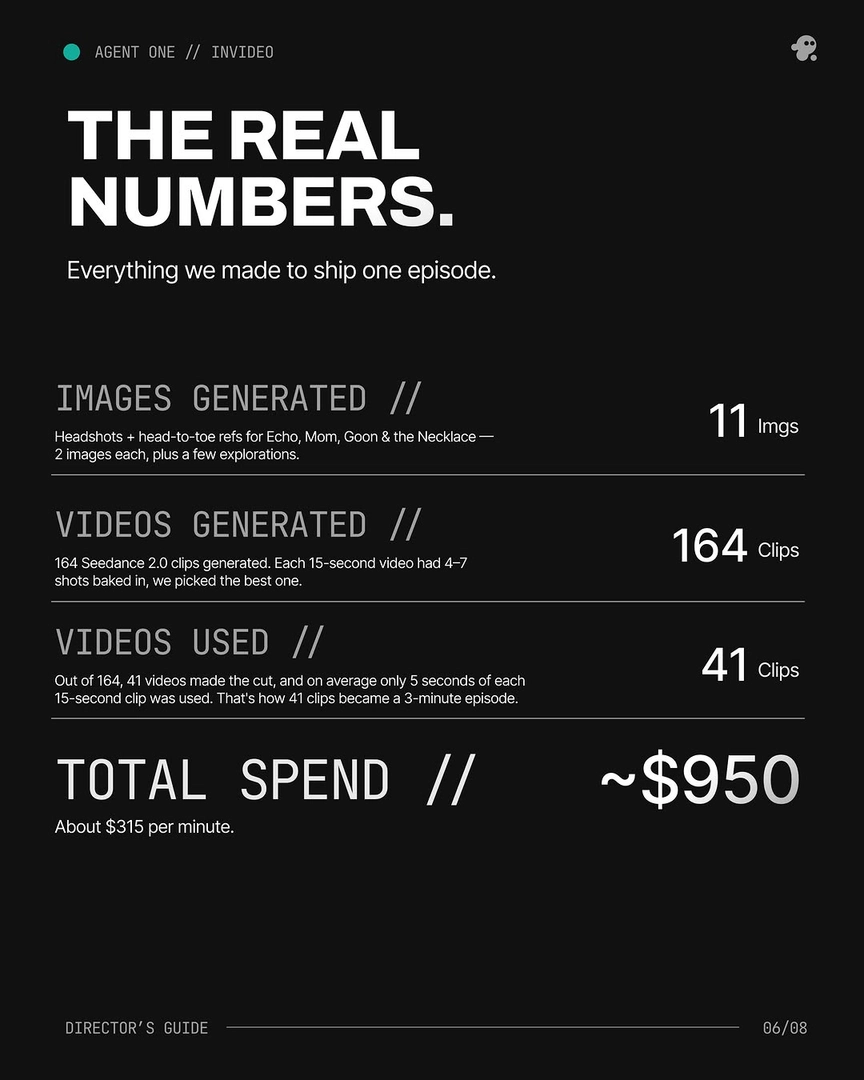
On production effort and budget, both styles land in a similar range on this workflow — a 3-minute hand-painted animated episode came in at roughly $950 (~$315 per finished minute) over 2 days with a 2-person team, while documented productions in other styles ran $750 for a 70-second short, $870 for a ~90-second piece, $1,500 for a 2-minute promo, and up to $5,000 for a longer multi-location short. Expect ~3 generations per usable shot and roughly a 25% editorial selection rate from raw clips regardless of style. As Hridaye, invideo's creative director, puts it: "An agent is only as powerful as what you teach it. We taught one Wong Kar-wai. You decide who your agent learns from next." The same applies here — a tight style block (reference frames + explicit negative prompts like "not photorealistic, not live-action, hand-painted brushstroke texture on every surface") is what makes either style hold across a whole film.
Match the choice to platform and audience last. Ghibli-style reads strongly on short-form vertical (Reels, TikTok, Shorts) for emotional storytelling and indie festival shorts. 3D-style fits sci-fi, action, gaming-adjacent audiences, brand and product films, and anything destined for a 16:9 cinematic frame.
These are the main axes to weigh — what works depends on your story, your characters, and what you want the audience to feel.
Watch some of these to see what works for you:
AN AGENT IS ONLY AS POWERFUL AS WHAT YOU TEACH IT. We taught one Wong Kar-wai. You decide who your agent learns from next.
— Hridaye, invideo's creative director