How do you achieve the Arcane painterly animation style in AI-generated video?
Last updated July 27, 2026
Upload 60+ Arcane frames as style reference, lock them into a persistent style block that names the painterly grammar (hand-painted brushstroke texture, cel-shaded depth, no photoreal) AND explicitly bans live-action, then prepend that block to every prompt. Route generations through Seedance 2.0 with character sheets attached so the painted look holds shot to shot.
Start by ingesting the look as data, not vibes. One documented 3-minute Arcane-style episode fed 64 frames from Arcane Season 1 Episode 1 into the invideo agent in a single message with the instruction: "I want you to deeply understand this art style and save it into context for further generations. All of these attached images are the art style that I want for this entire project." invideo is an agentic video tool that holds that context across every subsequent shot, so you ingest the style once instead of re-prompting it per clip.
Write a style block that names the painterly grammar AND bans its opposite. The exact block used on the documented production read: "This MUST look and feel like Arcane animation — not live action, not photorealistic. Every surface has hand-painted brushstroke texture. Every element in frame must feel painterly and handcrafted like a moving Arcane frame." The negative clause matters as much as the positive one — without it, video models drift toward photoreal skin and clean CG surfaces. Every prompt after the style block is locked starts with it; that discipline is what produces visual consistency, not the model choice.
Lock characters before you generate a single video clip. Generate a multi-angle character sheet per character (front, side, back, face close-up) in the painted style, pick the best of 4 variations, and keep that sheet attached to every shot prompt for that character. The Arcane-style production locked 4 characters and 1 prop across 11 reference images, averaging 5 generation attempts per character at roughly $9.78 in credits each — no LoRA, no fine-tuning, just sheets plus persistent context. This is what stops the face from morphing between cuts.
For video, Seedance 2.0 reference-to-video is the model that handles this best inside invideo because it accepts the character sheet AND a style reference simultaneously and carries that context across the clip. Kling and Veo are alternatives where you need different motion behavior, and the invideo agent routes to the right one per shot — you don't pick a platform per model, every model is available in one place. Generate in chunks at your film's aspect ratio; the documented production ran 15-second chunks and used the agent's approval mode so credits weren't spent on off-style generations.
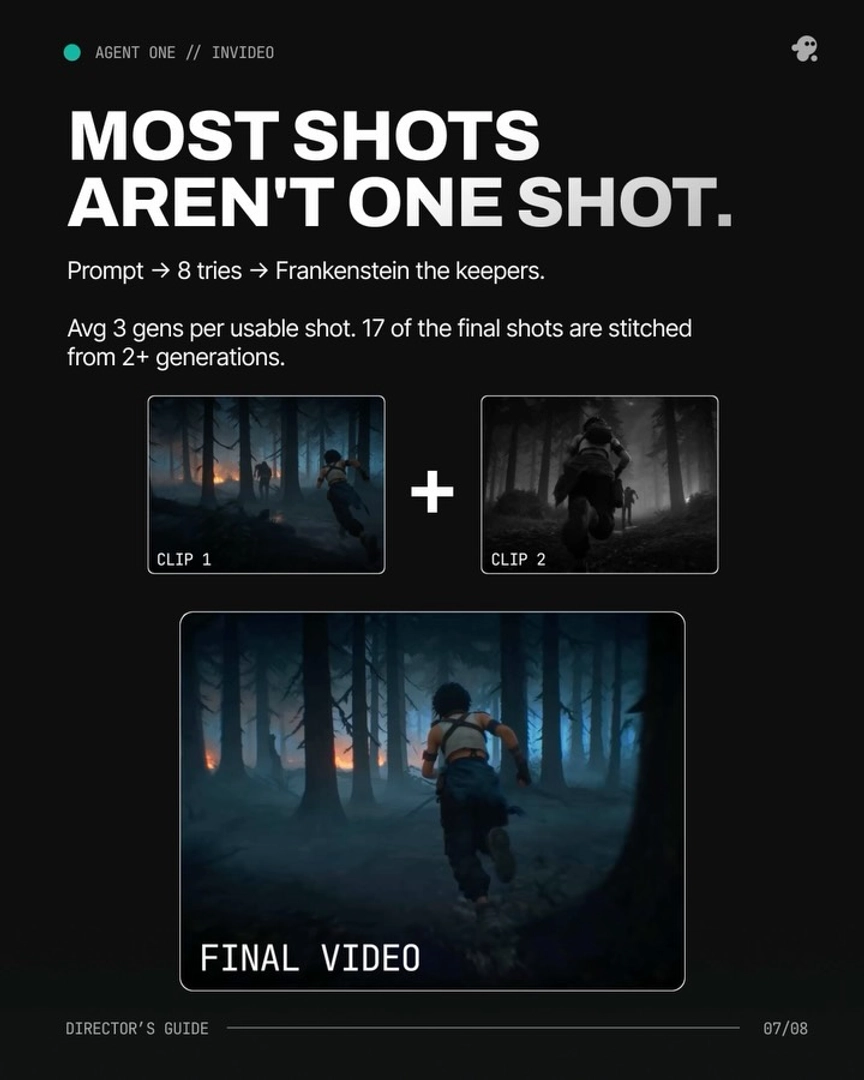
Overgenerate, then cut. The Arcane-style episode generated 164 clips to land 41 in the final edit — roughly a 25% selection rate — with an average of 5 seconds used per 15-second clip and about 3 generations per usable shot. Budget for that ratio from the start: at ~$315 per finished minute (~$950 all-in for 3 minutes, 2 people, 2 days), the overgeneration is the line item, not a waste. The painterly look survives across the cut because the same style block and the same character sheets sit behind every generation, not because any single clip nailed it.
Beyond the pipeline itself: temporal flicker on brushstroke texture is the honest weak point — no current model perfectly holds painted-frame consistency across motion. The mitigations are the ones above (locked style block, locked sheets, reference-to-video over text-to-video, aggressive editorial selection), and a light grade pass at the end to even out variance between clips.
Watch some of these to see what works for you:
This MUST look and feel like Arcane animation — not live action, not photorealistic. Every surface has hand-painted brushstroke texture. Every element in frame must feel painterly and handcrafted like a moving Arcane frame.
— style block used on a documented 3-minute Arcane-style AI episode produced on invideo