How do you assemble multiple AI-generated clips into a polished short episode?
Last updated July 27, 2026
Plan for a ~25% selection rate, then assemble: from ~160 generated clips you'll keep ~40, using an average of 5 seconds from each 15-second take. Score every clip against story beat, shot variety, emotional arc, and style match; stitch the keepers in a sub-agent or NLE; bridge continuity gaps with reference-to-video; and run an AI review pass before lock.
Start by scoring your raw clips. One documented 3-minute animated episode generated 164 clips and used 41 in the final cut — about a 25% selection rate, with an average of 5 seconds pulled from each 15-second take. Plan against that math: to hit a 3-minute episode you need roughly 40 keepers averaging 4–6 usable seconds each, which means generating 120–180 takes if your hit rate is similar.
Score each clip against five criteria before it goes on the timeline: (1) story beat — does it cover a moment in the script, (2) shot variety — wide/medium/close coverage across the sequence, (3) emotional arc — does it sit at the right register for that beat, (4) visual style consistency — palette, lens, lighting match the rest, (5) audio-syncability — does the action land on a beat you can cut to. Mark each clip A/B/C; A's are first-cut candidates, B's are bridge material, C's get dropped.
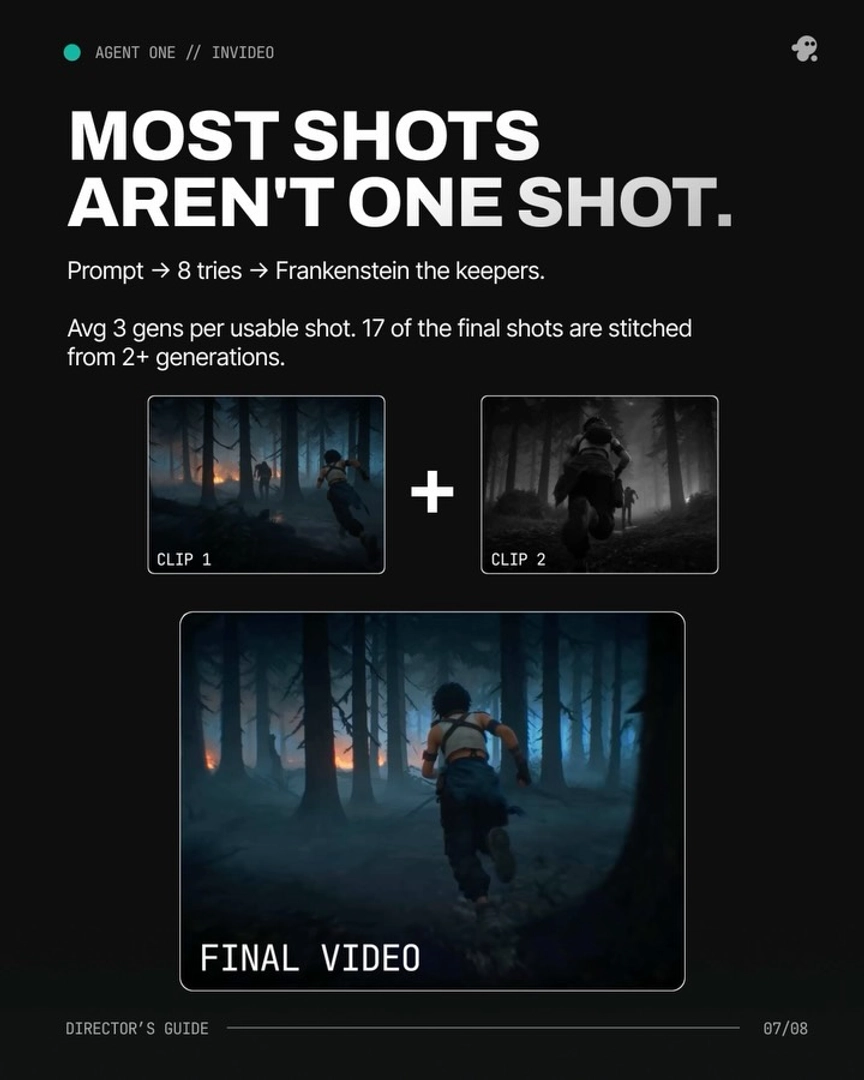
Assemble the rough cut act by act, not end-to-end. Working in 25% increments keeps context tight and prevents the agent (and you) from losing track on a long-form project. invideo is an agentic video tool with all current video and image models routed through one agent, so you can stay inside one timeline: drop the A-clips against the script, trim each to the 4–7 seconds that actually work, and use the strongest segments from multiple generations of the same prompt as a single composite shot — in the documented episode, 17 of the final shots were stitched from 2+ generations, more than 40% of the cut.
When two adjacent clips don't connect — a camera move that doesn't continue, a character that drifts, a location that jumps — bridge with reference-to-video on Seedance 2.0. Clip the last frame (or last second) of the outgoing shot, re-upload it to the invideo agent with your character sheets and location plates attached, and generate the next segment from that anchor. That carries camera movement, framing, and atmosphere across the boundary in a way start/end-frame extension cannot, because the model sees the full prior clip plus the references. For pure connective tissue between scenes, generate an image-to-video bridge from a still you already approved rather than rolling a fresh prompt.
For model routing during assembly: Seedance 2.0 reference-to-video is the workhorse for continuity bridges because it accepts character and location refs simultaneously; Kling handles multi-shot sequences natively if you need a coverage pair from one prompt; Veo is strong for clean single-take inserts. The invideo agent picks per shot — you don't switch platforms.
Run an AI review pass on the rough cut before you lock. Export the assembly and send it back to the invideo agent with an open prompt — what's working, what's not, against the treatment. Hridaye, invideo's creative director, describes one pass that caught a register error he'd missed: "it got one thing that I would have never noticed, the entities reveal shot. The moment it first appears clearly was running at the wrong stage register." That maker-checker step catches pacing, SFX, and emotional-register mismatches a human editor under deadline can drift past.
Finish in a post pass that pulls the plasticky look off the footage: upscale through Topaz Astra on invideo first, then add a touch of blur and grain, then grade. Generated video out of any current model carries an ultra-sharp, glassy skin quality — light grain plus a film grade closes most of that gap before delivery.
Watch some of these to see what works for you:
it got one thing that I would have never noticed, the entities reveal shot. The moment it first appears clearly was running at the wrong stage register.
— Hridaye, invideo's creative director