How do you create a consistent multi-shot AI video that flows like one continuous take?
Last updated July 27, 2026
Treat the whole sequence as one shot with shared context, not many shots stitched after the fact. Lock characters, location plates, and a style block once inside the invideo agent, generate in segments using reference-to-video so each next clip inherits the last frame plus those references, and chain segment-to-segment until the take is complete.
invideo is an agentic video tool where you direct a crew of sub-agents and it routes each shot to the right model (Seedance 2.0, Kling, Veo, Runway) — useful context because the one-take workflow below depends on that persistent context layer.
1. Lock the inputs before you generate a single second. Load the full script or sequence beat-sheet into a creative producer agent so it holds the narrative through-line. Generate character sheets with multiple angles plus close-ups (not just wides — small details like accessories drift across models otherwise). For continuous takes where the character changes — a costume swap, a prop added between beats — build a separate character sheet per beat. Scout the location plates next: the invideo agent can pull real-world landmark references off the internet, and you pick the ones that match the geography of your take. Finally, write a short style block — palette, lens grammar, lighting source, atmosphere — and instruct the agent to save it to context for every subsequent generation.
2. Generate the first segment with reference-to-video, not text-to-video. Seedance 2.0 reference-to-video accepts your character sheets AND your location plates simultaneously, which is what carries continuity that start-frame/end-frame extension cannot. Prompt the segment in directorial language — camera move, blocking, what holds, what cuts — and attach the style block plus all references. Generate in your film's segment length (typical generations land around 10–15 seconds); inside that segment the camera can move, reframe, and reveal without any cut.
3. Chain segments by clipping the tail and re-feeding it. When segment one returns, clip the final beat of that clip and re-upload it to the invideo agent. The agent attaches that tail clip back to Seedance 2.0 reference-to-video along with the same character sheets, location plates, and style block, and generates segment two starting from exactly where one ended. Camera movement, framing, and atmosphere carry across the seam. Repeat for each segment. As Hridaye, invideo's creative director, puts it: "Once that's done, you clip it, and now you re-upload that to Agent 1. And Agent 1 then attaches that to Seed Dance reference to video, and continues the next whole sequence in one seamless continuous take."
4. Route by model where the take demands it. Kling 3.0 generates multi-shot sequences natively from one structured prompt with labeled shots, which is useful when your "one take" is really a tightly choreographed sequence with internal reframings. Seedance 2.0 reference-to-video wins when you need character and location context held across longer chained segments. The invideo agent has every model on the roster, so you don't pick a platform per model — you describe the segment and the agent routes it.
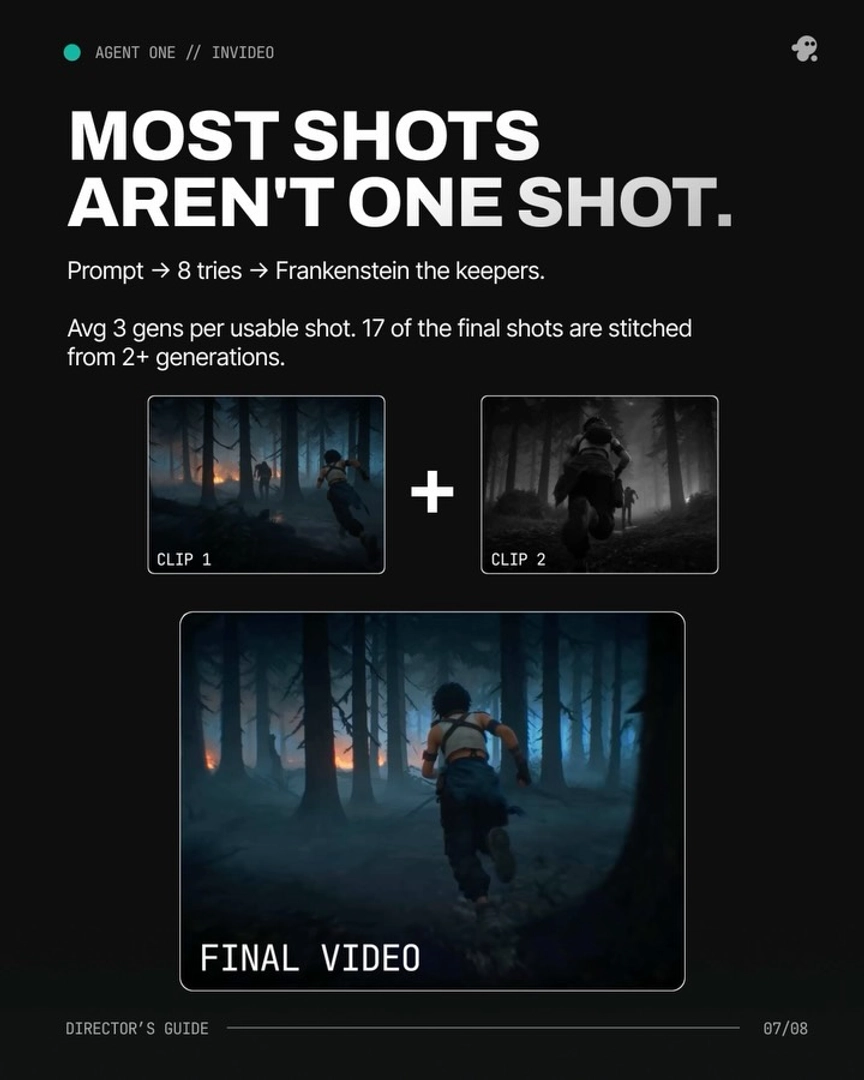
5. Plan for overgeneration and seam repair. Empirically, average around 3 generations per usable segment, and expect roughly 25% of clips to make the final cut (in one documented 3-minute production, 41 of 164 generated clips made it). When a single generation gives you a great first 8 seconds and a broken last 4, take the strong seconds and stitch them with the strong seconds of another generation of the same prompt — about 40% of finished shots in that production were composited this way. For the join itself, use the last clean frame of your kept piece as the reference frame for the next attempt so the camera motion and lighting carry through.
6. Use a fallback when continuity breaks. If reference-to-video drifts on a particular segment, anchor a keyframe: generate a still that matches the last frame's framing, character pose, and lighting, then use it as the start frame of the next segment. This is the stitching pipeline — more manual control, less native continuity — and it's the right move only when chained reference-to-video can't hold the seam.
Different teams produce continuous-take sequences at very different budgets — documented productions ran 2–5 days with 2–4 person teams and total spends from $750 to $5,000 — but the workflow above is what makes the take read as one shot regardless of scale.
Watch some of these to see what works for you:
Once that's done, you clip it, and now you re-upload that to Agent 1. And Agent 1 then attaches that to Seed Dance reference to video, and continues the next whole sequence in one seamless continuous take.
— Hridaye, invideo's creative director