How do you create psychedelic or hallucination-style AI video?
Last updated July 27, 2026
Generate psychedelic AI video by leaning into the techniques that normally fight consistency: ask the invideo agent for 5+ wildly different visual interpretations of the sequence, lock the strongest one as a reference, then chain generations so the warp evolves shot-to-shot instead of resetting. Route to Seedance 2.0 or Kling for fluid morph motion; use Recraft or Nano Banana for the still hallucination plates.
Start by getting variations on the table before you commit to a look. invideo is an agentic video creation tool with every current video and image model available behind one agent, so you can ask it to generate 5 distinct visual interpretations of the hallucination sequence — melting architecture, fractal bloom, kaleidoscopic recursion, form-constant tunnels, pareidolic faces — then pick one as the canonical reference for the rest of the scene. One documented production used exactly this approach for a hallucination beat, generating 5 variations before selecting one.
Write the prompt in layers, not adjectives. A flat "psychedelic, trippy, LSD" prompt collapses to cliché; a layered prompt holds. Stack: subject and camera move (slow dolly-in on a face), then the warp mechanic (recursive fractal bloom from the pupils outward, form-constant tunnel geometry), then palette as named tonal modes with hex values ("Mode A: split-toned magenta #FF2EC4 and emerald #1FE39A, 70/30"), then texture (oil-on-water iridescence, wet ink bleeding into adjacent frames), then a negative prompt (no live-action skin, no photorealism, no static frames). The 9-element prompt order one production used — camera, lens, lighting, palette, composition, atmosphere, mood, attribution, negative — holds for trippy work too; the difference is you push palette and atmosphere into surreal territory.
Pick the model by what kind of trip you want. Seedance 2.0 reference-to-video is the strongest pick for fluid morphing across a 15-second clip — it carries the reference's palette and texture into motion, so a kaleidoscopic still becomes a kaleidoscopic move. Kling handles multi-shot sequences natively, useful when the hallucination escalates across cuts. Veo gives you cleaner camera language if the trip is grounded in a real environment that distorts. For the still plates feeding all of them, GPT-Image-2 and Recraft produce dense, detail-rich surreal imagery; Nano Banana is better for character-anchored hallucinations where a face has to remain recognisable while the world melts around it. The invideo agent routes each shot to the right model — you describe the effect, it picks the engine.
Chain the shots so the warp evolves. A psychedelic sequence reads as one trip, not five separate effects, only if continuity carries forward. Clip the last second of the previous generation, re-upload it, and let the agent feed it as a reference into the next generation alongside the locked palette and character sheet. The hallucination intensifies frame-to-frame instead of resetting to baseline at every cut. For abstract beats with no character anchor, lock the palette and texture references and let the agent extract every angle from one anchored frame.
Overgenerate, then cut. On a 3-minute production, the team generated 164 clips and used 41 in the final cut — a ~25% selection rate, with an average of 5 seconds used from each 15-second clip. Psychedelic sequences need even more — the magic seconds inside a generation rarely fill the full clip, so plan for 3+ generations per usable shot and stitch the best seconds from multiple takes into one composite (a Frankenstein shot). Hridaye, invideo's creative director, puts it directly: "MOST SHOTS AREN'T ONE SHOT. Prompt → 8 tries → Frankenstein the keepers."
One note on intensity: hard strobe, high-frequency flicker, and aggressive zoom-pulse can trigger photosensitive viewers. Ask the agent to cap flicker rate and ease motion curves on any sequence intended for broad audiences.
Watch some of these to see what works for you:
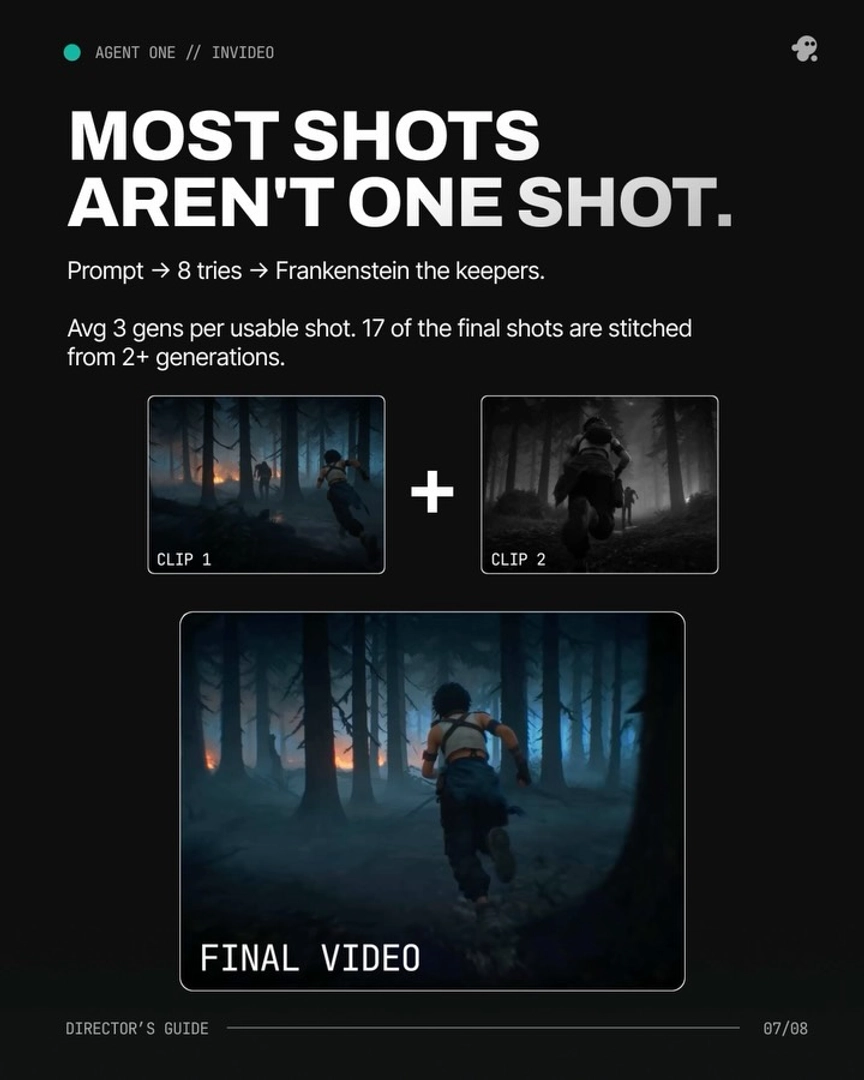
MOST SHOTS AREN'T ONE SHOT. Prompt → 8 tries → Frankenstein the keepers.
— Hridaye, invideo's creative director