Is it better to generate AI video in short chunks or longer segments?
Last updated July 27, 2026
Generate in short chunks — roughly 5-15 seconds each — and stitch them. Current video models cap clip length there for a reason: coherence, motion, and temporal logic degrade fast beyond that window. In one documented 3-minute episode, 164 short clips were generated and only ~5 seconds of each 15-second clip made the cut.
Treat each chunk as one shot, not one scene. The invideo agent is an agentic video tool that routes generations across the current model roster (Seedance 2.0, Veo, Kling, Runway) and holds your project context, so you direct shot-by-shot instead of trying to force one long take out of a model that can't hold it.
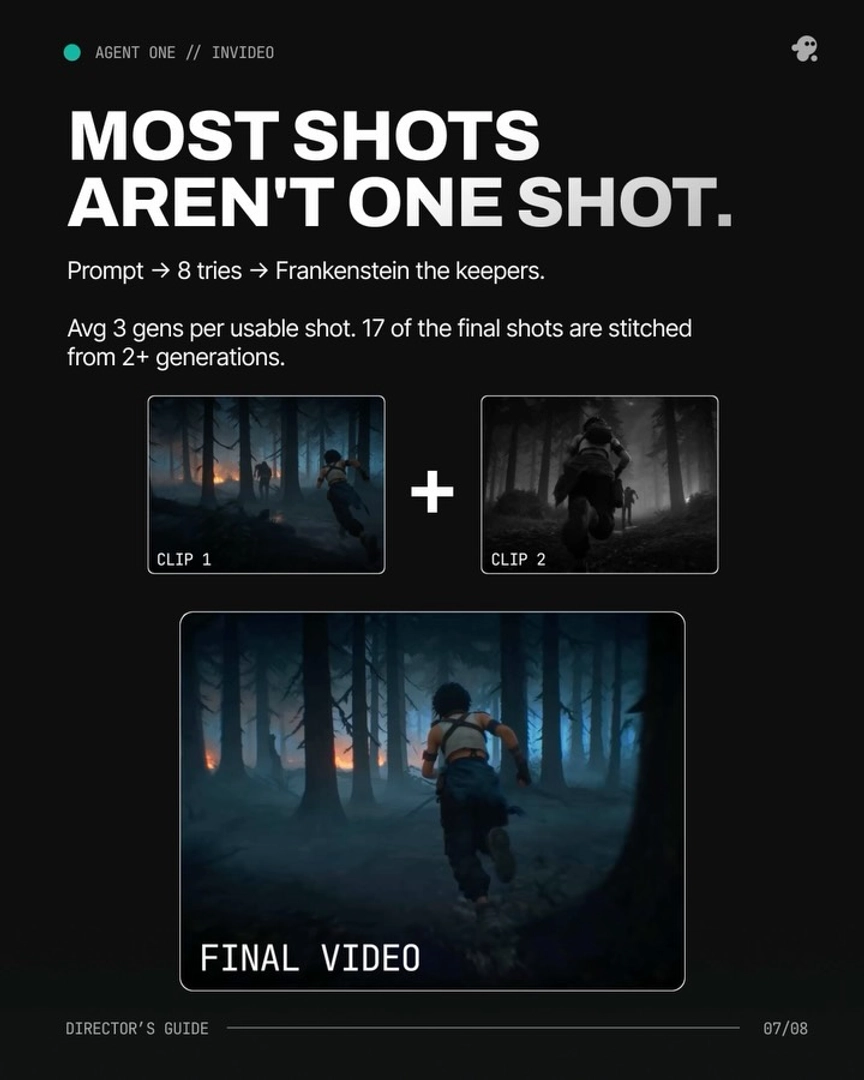
Why short chunks win in practice. Each 15-second Seedance 2.0 clip typically contains 4-7 usable shot candidates — you pick the strongest 3-5 seconds and discard the rest. On one 3-minute animated episode, the team generated 164 clips and used 41 (~25% selection rate), averaging only 5 seconds per clip in the final cut. Average 3 generations per usable shot, and 17 of the final shots were stitched from 2+ generations — a technique called Frankenstein Shot Assembly: combining the strongest seconds from multiple takes of the same prompt into one composite shot. Long continuous generations don't give you that selection surface, and quality drifts toward the end of the clip. Industry data backs this — most AI-generated videos sit between 15-60 seconds total, assembled from shorter chunks (Genra AI).
When you actually need a continuous take, chain — don't stretch. For one-take sequences, generate a short segment, clip the final frame range, re-upload it, and feed it into Seedance 2.0 reference-to-video along with your character and location references. The model takes context from the end of the prior video — camera movement, lighting, framing — and continues seamlessly. This beats start-frame/end-frame extension, which only sees one still and loses motion context. The extend feature works similarly but accepts fewer references. As Hridaye, invideo's creative director, puts it: "Because you're uploading the entire video, Seed Dance seemingly takes some more context from the end of that video to continue the next shot. So even in terms of camera movement, stitching and things like that, it just feels way more seamless compared to the older way of doing the one-take with AI."
A practical chunk-and-stitch workflow. Break your script into shots, not scenes. Generate each shot as a single chunk in your film's delivery format. Use shot-by-shot approval before spending credits — the invideo agent's always-ask mode lets you review each prompt and reference attachment before generating. Plan for ~3 generations per usable shot and budget overgeneration as a deliberate line item, not waste. Then assemble in your NLE: pick the best seconds from each generation, stitch composite shots where one take didn't land the full beat, and chain reference-to-video only for the sequences that genuinely need a continuous camera.
The cost math at chunk-level. Across documented productions, costs land in a tight band when you generate in short chunks and select aggressively: $315/finished minute on a 3-minute episode (~$950 total, 164 clips), ~$580/min on a 90-second horror short (~$870, ~400 video gens), $750/min on a 70-second short (~$750 total, 3,000 credits), and $750/min on a 2-minute brand promo (~$1,500, 6,000-6,500 credits). Range: $315-$750 per finished minute. The selection rate (~25%) is the unifying number — overgeneration of short chunks is the budget, not the bug.
Beyond the chunk-vs-segment call itself: if a scene is too dense for one chunk (e.g. 18 cuts in 15 seconds), split it across two chunks at the natural beat break rather than trying to compress everything into one generation. The invideo agent will flag that limitation and recommend the split before you waste credits.
Watch some of these to see what works for you:
Because you're uploading the entire video, Seed Dance seemingly takes some more context from the end of that video to continue the next shot. So even in terms of camera movement, stitching and things like that, it just feels way more seamless compared to the older way of doing the one-take with AI.
— Hridaye, invideo's creative director