Should I lock my storyboard before starting AI video production?
Last updated July 27, 2026
Yes — lock the storyboard before you generate, but 'lock' means something looser in AI workflows than in traditional production. Lock the spine (shot order, characters, world, style, first frame of each scene) and leave the per-shot framing flexible. That's what protects continuity, saves wasted credits, and keeps you in the director's seat.
Start by separating what to lock hard from what to keep flexible. Lock hard: the script, the shot order, character sheets, world/location references, the visual style block, and the first/anchor frame of each scene. Keep flexible: exact camera moves, alternate takes per shot, and shot length — because AI clips return 4–7 usable candidates per generation and you'll want to pick in the edit.
The invideo agent is built around this split: you upload your script and references once, it holds them across every shot, and you direct shot by shot from that locked spine. Use a layered storyboard structure when you set it up: goal of the scene → sequence beats → individual shots → prompt per shot → continuity checks against your locked references. The Seedance multi-layer framework and SnapVee's first-frame approval principle both point the same way — approve your anchor frame for a scene before triggering motion, so drift gets caught before it propagates.
The pre-production pass that actually pays off is answering four questions before generating a single asset: what does the character look like, what's the antagonist/entity reference, what's the prop specification, and what's the deliverable format. These four answers change every frame downstream — lock them and the agent stops guessing. Then generate four options per character sheet and environment reference, pick one, and lock it. Across documented productions, that asset-locking step is what made character consistency work without LoRA fine-tuning — a 70-second short held two characters consistent across every scene that way.
For the storyboard itself, work act by act rather than locking all 100 shots upfront. Fully storyboard, generate, and rough-edit act one before starting act two. This prevents agent context loss on longer projects and lets you adjust the spine if act one teaches you something. As one director put it: "I'm not overworking the AI where it kind of loses context down the line. I like to lock in on something and then move forward. Like do 25%, 25%, and then move on."
Decide how tight to lock based on the job:
Lock tightly — client work, brand films, multi-character narrative, multi-scene continuity, anything with a deliverable spec. A 2-minute brand promo ran on a fully locked storyboard and shot breakdown across 8 parallel sub-agents, finished in 3 days for ~$1,500 vs. a $100K–$500K traditional shoot.
Lock the spine, stay loose on shots — short narrative films, music videos, animated episodes. A 3-minute animated episode locked style (64 reference frames), characters (5 generations each, ~$9.78/character), and shot order — then generated 164 clips and selected 41 (~25%) in the edit. Total: ~$950, $315/finished minute.
Stay loose — solo experimentation, rapid social content, style tests. Storyboard the beats in your head, generate, see what comes back.
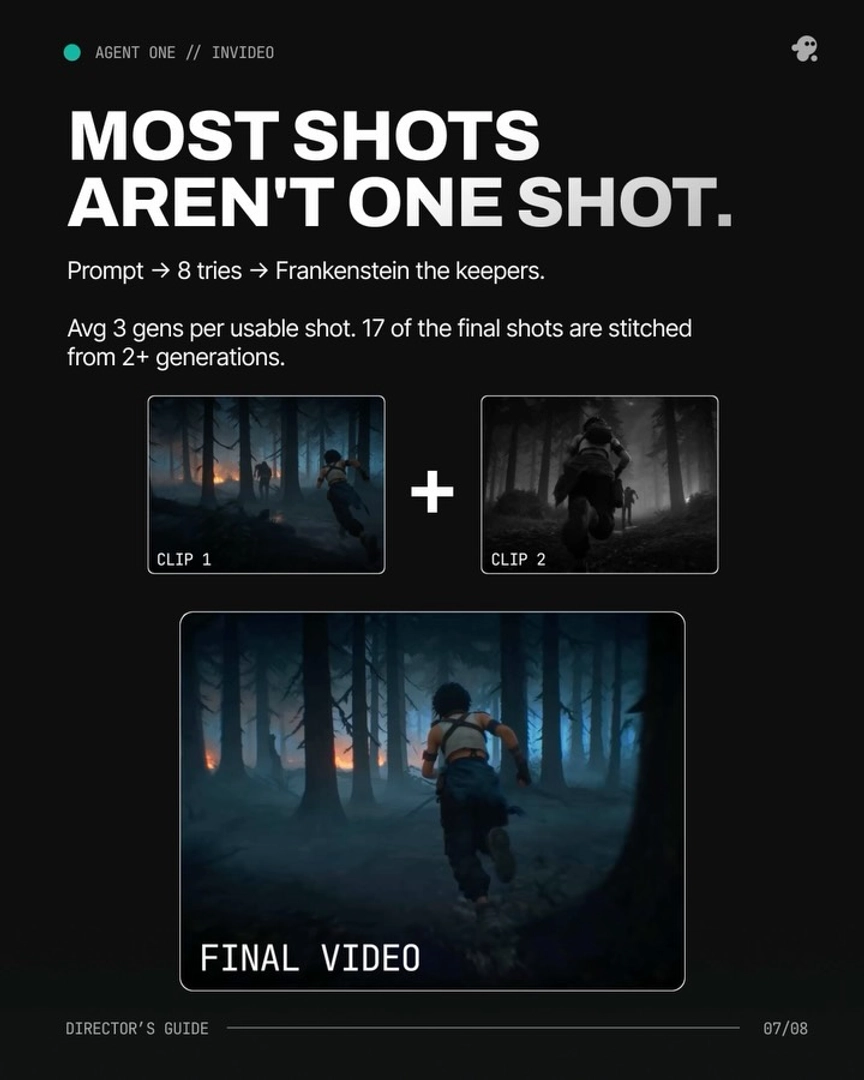
The through-line: across documented productions ($750–$5,000, 2–5 days, 1–4 person teams), every one of them locked characters, world, and style before generation. None of them locked every shot's exact framing — that's where the iteration budget goes. Plan for an average of 3 generations per usable shot and price your credits accordingly.
One caveat on traditional storyboard lock: if you're working with an external client or agency, you still produce and approve a traditional storyboard lock for sign-off — that's a contract artifact, not a production constraint. Internally, you direct from the spine.
Watch some of these to see what works for you:
I'm not overworking the AI where it kind of loses context down the line. I like to uh lock in on something and then move forward. Like do 25%, 25%, and then move on.
— invideo's creative team, on act-by-act production methodology