What are the hidden costs of DIY AI video production that brands overlook?
Last updated July 27, 2026
The hidden costs of DIY AI video are overgeneration (only ~25% of generated clips make a final cut), pre-production asset locking, editorial stitching labor, a post-production realism pass, and skilled direction time. Across documented productions, finished AI video ran $315–$750 per finished minute — most of that spend invisible in the headline subscription price.
Budget for raw generations, not finished runtime — that is the single biggest line brands miss.
Overgeneration is a planned budget line, not waste. One documented 3-minute animated episode generated 164 clips and used 41 — a 25% selection rate — with an average of only 5 seconds kept from each 15-second clip and roughly 3 generations per usable shot. A 90-second horror short needed ~400 video generations. Plan your generation budget at 3–4x what the finished runtime implies, or the credits run out mid-production.
Consistency work happens before any video is generated — and it costs generations. Locking one character's visual identity took about 5 generation attempts (~$9.78 per character) in one production; another generated 4 options per character sheet and environment reference and selected the best before rolling a single video clip. Skipping this step doesn't save money — it moves the cost into endless regenerations when characters drift between shots.
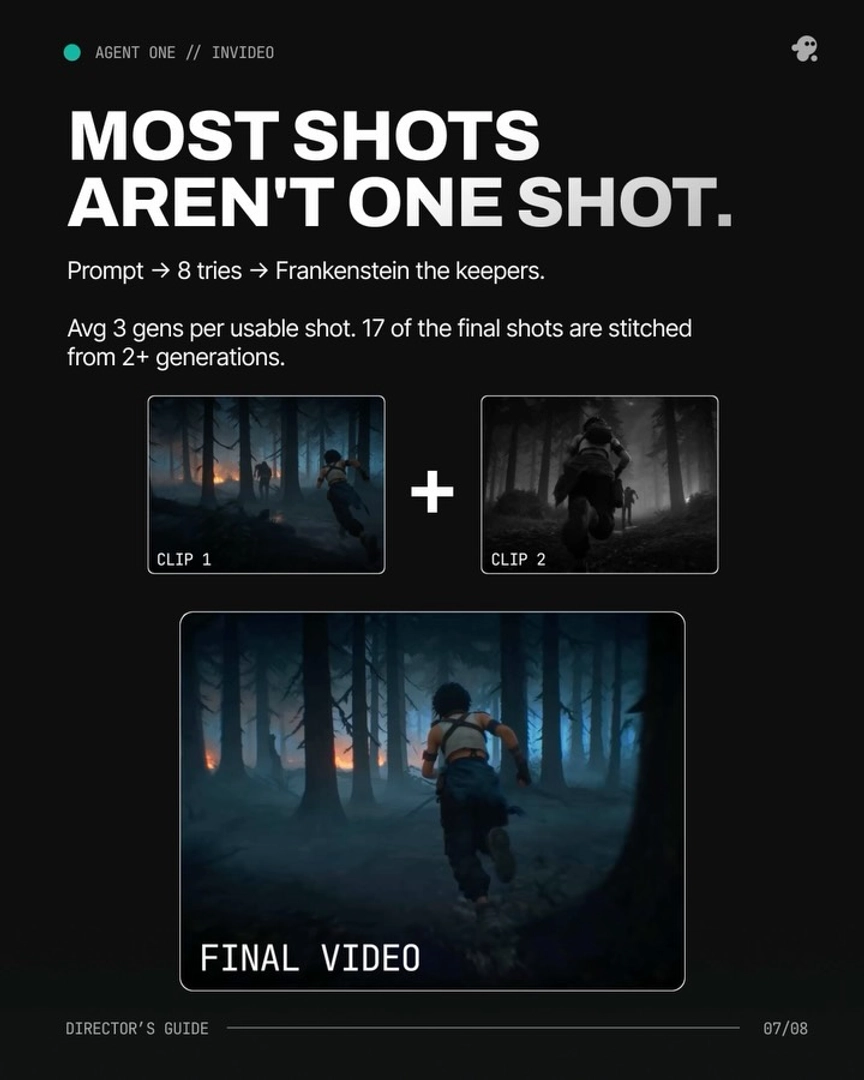
The finished video is assembled, not generated. In the same episode, 17 of the final shots — over 40% — were Frankenstein shots, stitched from 2 or more generations of the same prompt. Someone on your team is doing that selection and compositing work, and it isn't priced into any generation tool.
Raw AI footage needs a post pass before it's brand-ready. Footage straight out of video models tends toward an over-sharp, plasticky look; documented teams add slight blur, grain, and a color grade — plus an upscale pass (Topaz Astra runs on invideo) — before output looks close to live action. Treat post-production as a standing line item, not an exception.
Direction time is the labor cost nobody quotes. A 2-minute brand promo took one experienced director 3 days; the same project via manual shot-by-shot prompting was estimated at a week or more, and a traditional shoot at roughly 2 months. Running the production through the invideo agent — which holds script, character, and style context across every shot instead of requiring per-shot re-prompting — is what compressed direction time into that 3-day range.
The honest total — hidden costs included. Documented productions landed between $750 and $5,000 all-in: a 70-second short at $750 (3,000 credits), a 90-second horror short at $870 (4,100 credits), a 3-minute animated episode at $950, a 2-minute brand promo at $1,500 (6,000–6,500 credits), and a 4-day multi-location short at $5,000 (20,000 credits) — $315–$750 per finished minute depending on team and approach. Even with every hidden cost counted, that 2-minute promo's $1,500 compares against a $100,000–$500,000 traditional production estimate for the same film. The hidden costs are real; they don't erase the gap — they define what you actually need to budget.
Watch some of these to see what works for you:
Here's the thing no one talks about, the post on AI films. If you want your film to look closer to live action, there's a whole bunch of things you have to do after you finish your generations.
— invideo's creative team