What percentage of AI-generated video clips are actually usable?
Last updated July 27, 2026
Across documented AI productions, roughly 25% of generated clips make the final cut — and within each kept clip, only about 5 seconds of a 15-second generation is actually used. Plan for an average of 3 generations per usable shot, and expect more than 40% of final shots to be stitched from multiple takes.
Use these benchmark numbers to size your generation budget. In one documented 3-minute animated episode, 164 clips were generated and 41 made the final cut — a 25% selection rate — and the editor used an average of only 5 seconds out of each 15-second clip. On a per-shot basis, the same production averaged 3 generations per usable shot, and 17 of the final shots were stitched together from 2 or more different generations rather than coming from a single clean take.
Across productions the yield math holds even as scale changes. A ~90-second horror short took roughly 400 video generations to finish — about 4.4 generations per second of finished film. A 70-second short film burned 3,000 credits ($750) over 2 days. A 2-minute brand promo used 6,000–6,500 credits ($1,500) across 3 days with 8 agents running in parallel. The pattern: you overgenerate by roughly 4x what ends up on the timeline, and that overage is a budget line, not waste — it is how you get editorial choice. Industry benchmarks land in the same zone, with reported yields varying by quality tier: looser social cuts tolerate higher yields, while ad-grade and broadcast work pushes selection rates much lower and 10–40 prompts per final usable clip is common.
The yield isn't fixed — a few levers move it. Locking character sheets, environment references, and a style block BEFORE any video generation cuts re-rolls dramatically; in one production, 5 generations were enough to lock a character at ~$9.78. Generating in longer chunks (around 15 seconds) and then trimming to the best ~5-second window inside each clip is how editors push effective usable footage up without more generations — trim the first and last beats of each AI clip where motion artifacts cluster. Routing each shot to the right model matters too: the invideo agent holds your project context and routes shots across Seedance 2.0, Kling, Veo, and Runway rather than forcing one model on every shot, which raises first-pass yield. And when no single generation gives you a complete shot, a Frankenstein shot — stitching the strongest seconds from 2+ generations of the same prompt — turns near-misses into final shots; in one episode, 17 final shots were assembled this way.
As Hridaye, invideo's creative director, frames it: "MOST SHOTS AREN'T ONE SHOT. Prompt → 8 tries → Frankenstein the keepers." Plan your credit budget against that reality: estimate finished seconds you need, multiply by ~3 generations per usable shot, assume ~25% of clips clear the editorial bar, and you have a defensible number going in.
Watch some of these to see what works for you:
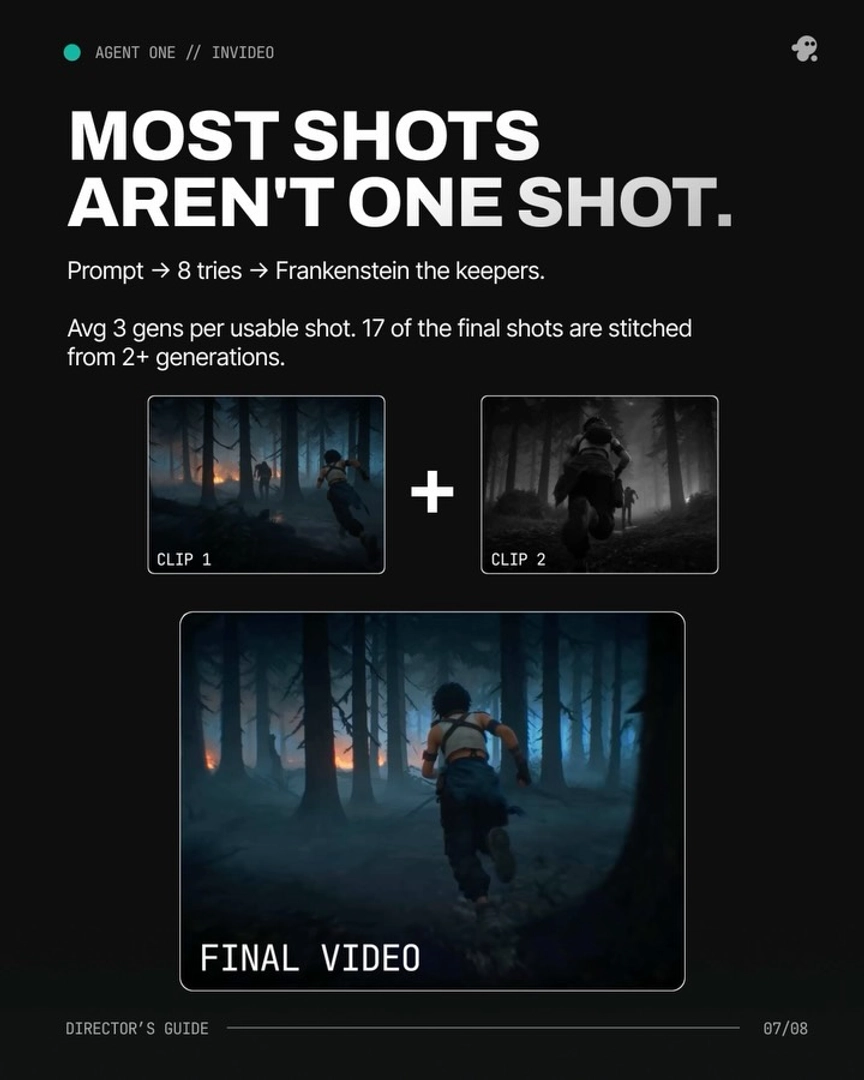
MOST SHOTS AREN'T ONE SHOT. Prompt → 8 tries → Frankenstein the keepers.
— Hridaye, invideo's creative director