Why do AI video models almost always need multiple generation attempts before producing a usable shot?
Last updated July 27, 2026
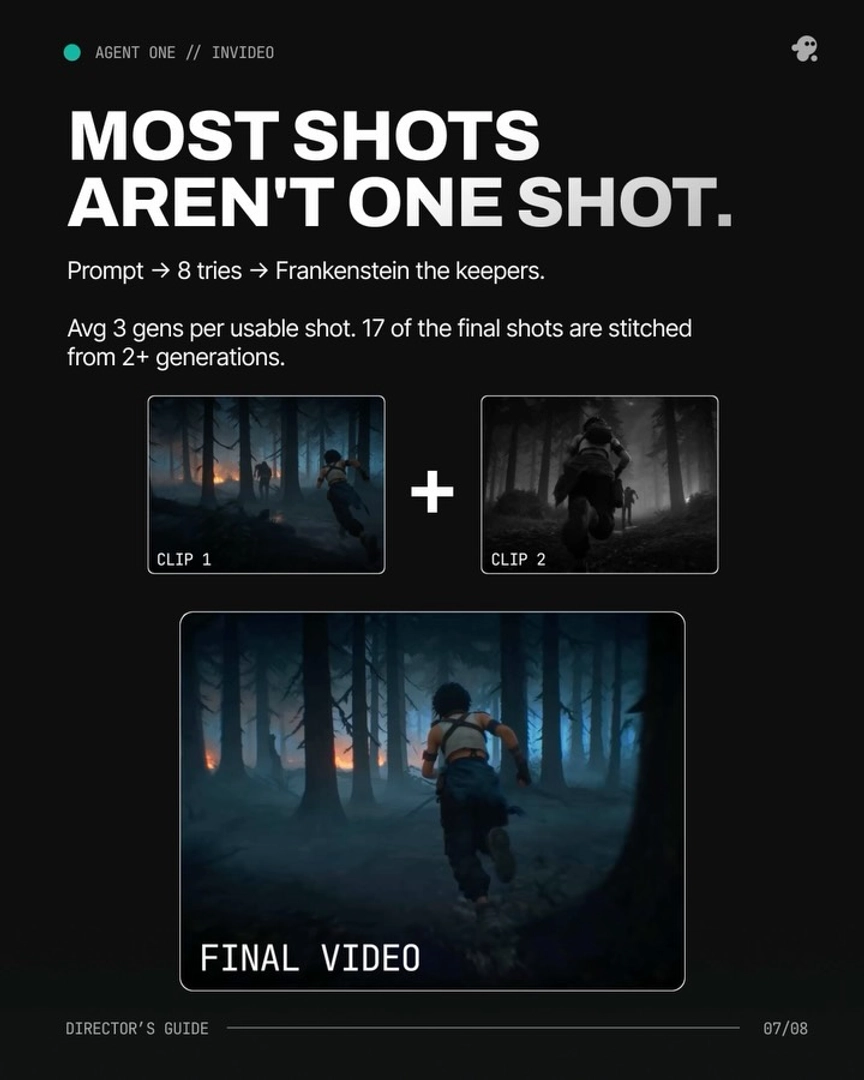
AI video models are probabilistic samplers — each run draws a different output from a learned distribution, so the same prompt produces meaningfully different frames every time. Layered on top: identity drifts across clips, motion coherence degrades past a few seconds, and complex physical interactions break the model. Plan on roughly 3 generations per usable shot.
Treat iteration as a budget line, not a failure. Across one documented 3-minute animated episode, the team logged an average of 3 generations per usable shot, generated 164 clips total, and only 41 (~25%) made the final cut — with about 5 seconds used out of every 15-second clip. That ratio is the realistic planning number for a serious production, not an edge case.
Three specific things drive that ratio:
Generative variance run-to-run. Video models sample from a learned distribution, so identical inputs return different outputs each time — framing shifts, micro-expressions change, motion paths diverge. You're not debugging a prompt; you're rolling a weighted die and selecting the roll that clears your quality bar. This is why directors generate options rather than aim for one perfect take, and why image-grid pre-visualization (3 grids per round) is cheaper than chasing a single hero frame.
Identity and detail drift. Without persistent identity scaffolding, faces, costumes, and small props (scars, accessories, a worn trinket) warp across clips — especially in shots longer than a few seconds, where entropy accumulates frame to frame. The fix is upstream of generation: lock multi-angle character sheets and environment plates BEFORE any video runs. One production needed ~5 generations to lock a single character (~$9.78 per character lock) — that upfront cost is what keeps the per-shot iteration count down later.
Coherence breakdowns on hard shot types. Models hold attention well on simple coverage and fall apart on specific categories: POV shots, multi-character physical contact (ropes, props, bodies touching), unusual top-downs, and over-the-shoulder framings. Hridaye, invideo's creative director, puts the multi-character case bluntly: "Multi-character consistency (ropes, props, bodies in contact) breaks models faster than anything else." These shots routinely take far more than 3 attempts and often need a different model, a reference video, or a stitched composite to land at all.
Model choice changes the iteration count. invideo is an agentic video creation tool with every current video model — Runway, Veo, Kling, Seedance 2.0 — available behind one agent that routes each shot to the model best suited to it. Reference-to-video models (Seedance 2.0) carry character and location context across segments and reduce drift on continuous takes; multi-shot-native models hold coherence across cuts in one generation. Routing your hardest shots to the right model up front cuts wasted generations more than any prompt tweak.
Plan the budget, then over-generate deliberately. Budget 3–5 generations per shot, expect ~25% editorial yield, and accept that roughly 40% of your final shots may be stitched from 2+ generations rather than landing as single takes. With a clear pre-production lock and the right model per shot, one documented 70-second short cleared 3,000 credits ($750), a 3-minute animated episode landed at $950 (~$315/finished minute), and a 90-second horror short hit ~$870 across 400 video generations — variance you absorb by planning for it, not by hoping the first roll lands.
Watch some of these to see what works for you:
Multi-character consistency (ropes, props, bodies in contact) breaks models faster than anything else.
— Hridaye, invideo's creative director