Why does AI filmmaking still require directing skills and not just prompt engineering?
Last updated July 27, 2026
Prompts describe; directing decides. AI models can render almost any frame you describe, but a film needs emotional logic, pacing, blocking, continuity, and shot selection across hundreds of generations — judgment calls a prompt can't encode. The skill ceiling in AI filmmaking is directorial, which is why on-set experience translates directly into better output.
Start from the gap: a well-prompted clip looks good in isolation but stacks into something visually coherent and emotionally flat — wrong pace, wrong eyeline, wrong tonal register for the beat. That's the recurring failure mode practitioners describe across AI shorts, and it's exactly what directing fixes. As invideo's creative director Hridaye puts it: "The real unlock isn't the tech. It's that the skill that makes this work isn't prompting — it's directing. And that doesn't come from a tutorial. It comes from being on set."
Three directing skills change AI output more than any prompt rewrite:
Shot composition and visual grammar. Knowing eyeline, lens language, blocking, and what to withhold lets you specify the frame the way a DOP would — "hold on him until he lunges, no cutting" — instead of guessing adjectives. In one documented production, the agent was challenged on calling a lens anamorphic when the reference director shoots spherical; it corrected to 2.40:1 hard matte. A prompt-only operator wouldn't have caught that, and the whole film's bokeh and flare grammar would have drifted.
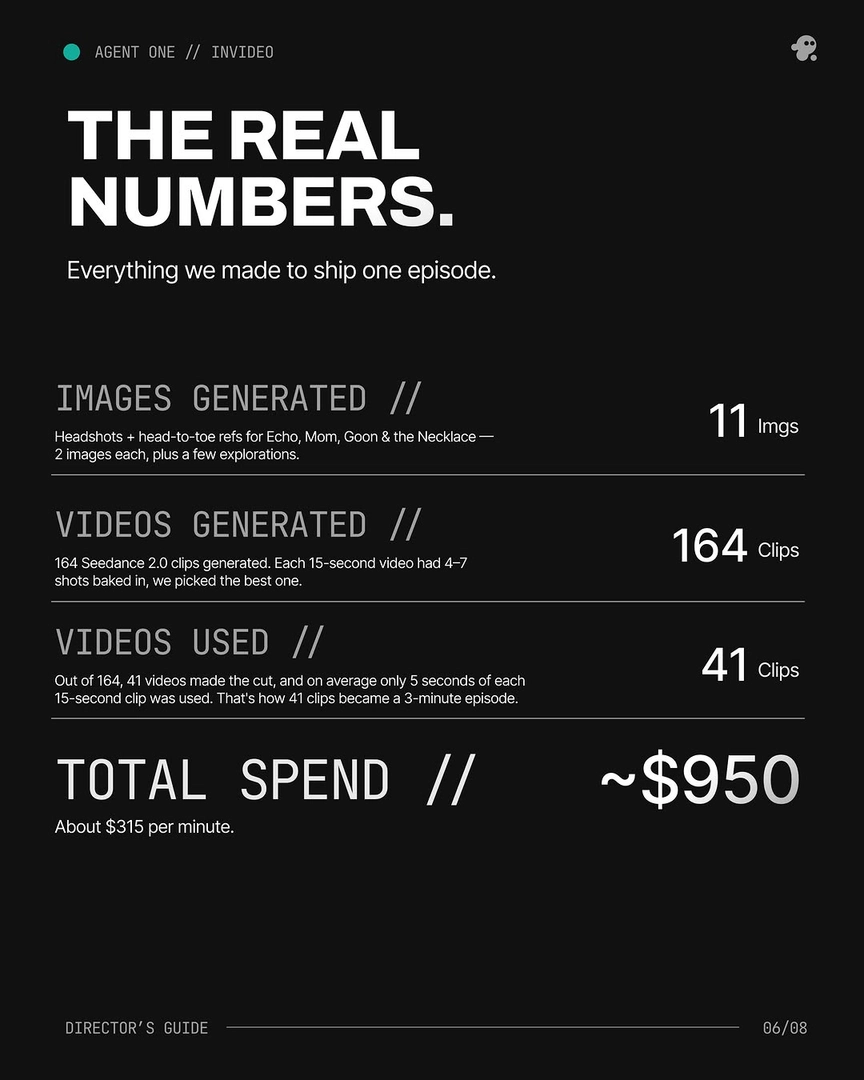
Pacing and editorial selection. Generation is overproduction by design. Across one 3-minute animated episode, 164 clips were generated and 41 made the cut — roughly a 25% selection rate — with only about 5 seconds used from each 15-second clip. Choosing which seconds carry the beat, which shot lands the cut, and where to hold versus break is editorial judgment, not prompt skill. The same production caught an entity-reveal shot running at the wrong emotional stage register during a rough-cut review — a structural call a prompt has no way to make.
Continuity and worldbuilding discipline. Wardrobe, geography, lighting source, and prop logic have to hold across hundreds of generations. That's why directors lock character sheets, world references, and a style block up front and reuse them on every prompt — and why a 70-second short held two consistent characters across every scene with no fine-tuning. Continuity is enforced by the director's process, not by the model.
Where the invideo agent fits. invideo is an agentic video tool with the current generation models (Runway, Veo, Kling, Seedance 2.0) and upscalers available in one place, so you direct rather than platform-hop. You give the invideo agent your script and references once; it holds context across shots and routes each generation to the right model. You can spin up a creative producer agent to hold the vision, DOP agents per scene for cinematography, and a storyboard agent to visualize before you direct — directorial roles, not prompt slots. As Hridaye says: "Pretty much exactly like how I would talk to my DOP on set or how I would talk to my DA on set."
What this means for set veterans. Years of on-set experience are an advantage, not a liability. Composition instincts, pacing, talking to a crew in shot language, knowing when a take is wrong before you can articulate why — all of it transfers. Documented productions range from $750 to $5,000 and 2–5 days end to end; the people getting those results are directing the agent like crew, not engineering prompts.
Treat the AI as a crew you direct, not a machine you program. The frame is a prompt problem; the film is a directing problem.
Watch some of these to see what works for you:
The real unlock isn't the tech. It's that the skill that makes this work isn't prompting — it's directing. And that doesn't come from a tutorial. It comes from being on set.
— Hridaye, invideo's creative director