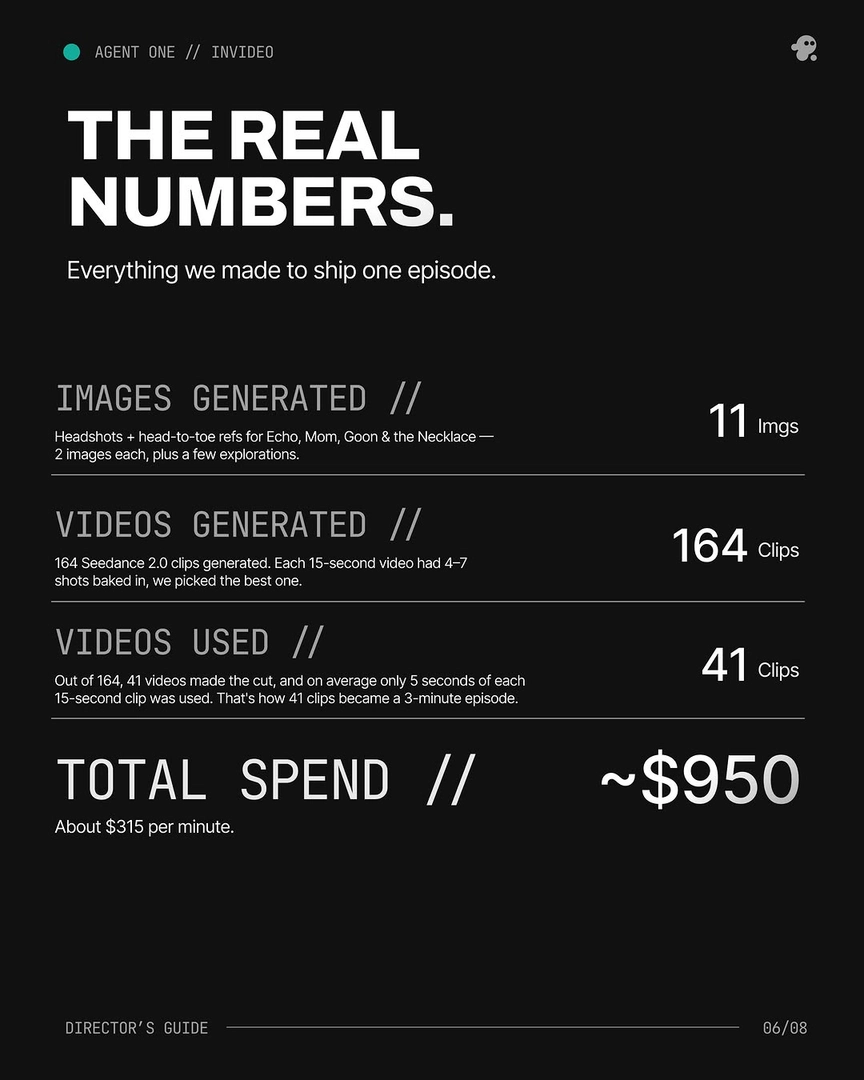
Editing social media videos takes so long because it is a decision-dense process, not a technical one: every cut, caption, pacing choice, and continuity check is a judgment call, and finished video is filtered down from far more raw material. Creators report editing consumes roughly 95% of total production time — in one documented production, only 41 of 164 generated clips survived the edit.
Editing dominates production time for one structural reason: the number of decisions per finished second is enormous, and most of them can't be batched. Three factors drive the hours.
Micro-decision volume. Every second of a social video carries multiple choices — where to cut, what caption goes where, how fast the pacing runs, which take to keep. Short-form compresses this further: the densest sequence in one documented short film required 18 cuts in 15 seconds, each one an individual placement decision. Multiply that density across a full video and the timeline work alone runs into hours.
The selection ratio. You never edit the footage you have — you edit it down. In one documented AI-animated production, 164 clips were generated and only 41 made the final cut, a 25% selection rate, with an average of just 5 seconds used from each 15-second clip. It took roughly 3 generations to get one usable shot, and 17 of the final shots were Frankenstein shots — stitched together from the best seconds of two or more generations. Even when the footage is AI-generated, the reviewing, selecting, and stitching is human editorial time, and it scales with how much raw material you produce.
The review layers. After assembly, a cut still needs continuity checks (props, color grade, and wardrobe matching across shots), pacing review, and sound passes — traditionally a manual frame-by-frame job at the end of production. This layer is also where automation now bites hardest: the invideo agent — an agentic video creation tool that holds your whole project's context — can read an uploaded rough cut, map it against your shot list to report which shots are done and which are pending, and automatically flag continuity errors like color-grade inconsistencies and prop changes between shots. You can also send the draft back with an open-ended "what's working, what's not" prompt; in one documented production this pass caught a pacing and emotional-register error the director had missed. That removes the mechanical review hours, but the judgment layer — which take, which cut point, which pacing — stays with you, which is why editing remains the core creative act rather than a task you fully outsource.
The practical takeaway: editing time shrinks when you cut the mechanical layer (automated continuity audits, shot-list tracking, AI-generated b-roll instead of manually sourcing stock) and when you generate less unusable material to sift through in the first place — but the decision density per finished second is the part no tool removes, because those decisions are the video.
Watch some of these to see what works for you:
editing takes up all the time, maybe 95% of the time when it comes to not only YouTube content, but TikTok and Facebook and LinkedIn and Instagram and X and across the whole social media platform ecosystem.
— a creator running a multi-channel YouTube content business