Why do professional AI filmmakers generate video in 15-second segments instead of one long take?
Last updated July 27, 2026
Professional AI filmmakers generate in 15-second segments because short clips maximize editorial control: each 15-second generation yields 4–7 usable shot candidates, only ~5 seconds of each clip survives the final cut on average, and per-segment approval controls credit spend — while reference-to-video chaining preserves continuity whenever a genuinely long take is needed.
Generate in 15-second segments and treat each one as a menu of shots, not a single shot. In a documented production — a 2-person team that produced a 3-minute animated episode in 2 days for ~$950 — each 15-second Seedance 2.0 clip contained 4–7 usable shot candidates; the team generated 164 clips, kept 41 (a ~25% selection rate), and used an average of only 5 seconds from each. Finished films cut every few seconds anyway, so most of a long take is footage you would discard.
The iteration math only works on short units. That production averaged 3 generations per usable shot, and 17 of its final shots were Frankenstein shots — the strongest seconds from 2 or more generations of the same prompt stitched into one composite. Re-rolling a 15-second segment costs a fraction of re-rolling a long take, and stitching keepers is only possible when the units are short.
Per-segment approval controls spend. invideo is an agentic video creation tool with all the current video models available, and running the invideo agent in Always Ask mode lets you approve each segment's prompt and attached references before credits are spent. With only ~25% of generated clips making the cut, overgeneration is a deliberate budget line — the episode above landed at $315 per finished minute — but that approach is only manageable when you gate spend shot by shot.
Models hold consistency better in short windows. The longer a single generation runs, the more character appearance, lighting, and spatial logic drift. In one production the invideo agent flagged this before any credits were spent: a scene scripted with 18 cuts inside 15 seconds exceeded what the model could hold, and splitting it into two segments produced a sharper result than the original script intended.
Continuity across segments is a solved workflow, so segmentation costs you nothing. When you need a continuous long take, chain segments with reference-to-video: clip the final seconds of each generated segment, re-upload it to the invideo agent, and it feeds that clip into Seedance 2.0 reference-to-video alongside your character and location references. Because the model reads camera movement, framing, and atmosphere from the end of the prior clip, the stitch stays seamless — unlike start/end-frame methods or extend, which can't carry character and location references across the boundary. One distributed 3-person team built a multi-city continuous sequence this way inside a 2.5-hour window.
Longer native generation doesn't change the discipline. Kling 3.0 generates multi-shot sequences natively and Veo keeps raising per-generation caps, but selection still happens at the shot level — you still pick the best seconds and approve each beat. Inside invideo, Veo, Kling, and Seedance 2.0 are all available, and the invideo agent routes each shot to the right model, so segment length becomes a per-shot directorial decision rather than a platform constraint.
Watch some of these to see what works for you:
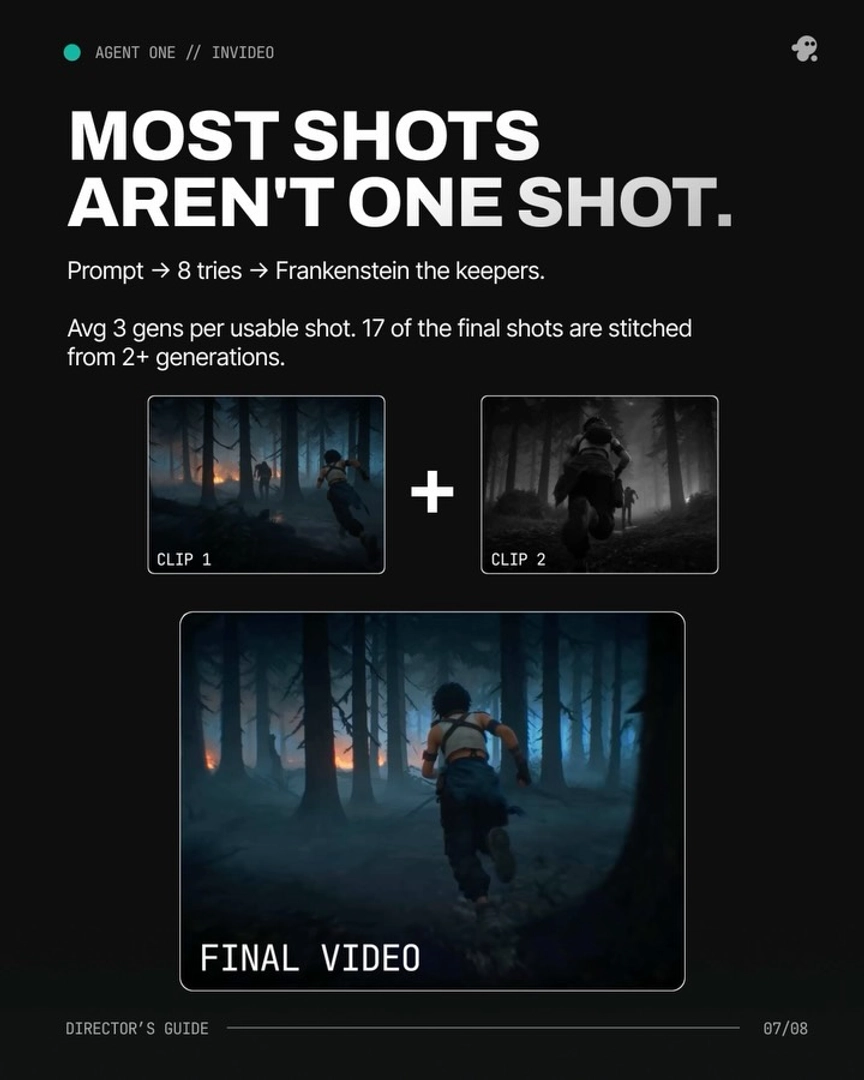
Out of 164, 41 videos made the cut, and on average only 5 seconds of each 15-second clip was used. That's how 41 clips became a 3-minute episode.
— invideo's creative team