AI film production vs traditional film production: cost comparison with real numbers
Last updated July 27, 2026
Documented AI film productions cost $750–$5,000 all-in — $315–$750 per finished minute — versus $100,000–$500,000 for a traditionally shot 2-minute commercial, a reduction of up to 99.7%. Timelines compress similarly: 3 days of AI production versus roughly 2 months of traditional shooting, with teams of 1–4 people instead of full crews.
Start with the actual receipts. Five documented AI productions, all made on invideo — an agentic video creation tool where the invideo agent routes each shot to current video models like Seedance 2.0, Veo, and Kling under one credit pool — break down like this:
Production | Length | Team | Days | Total cost | Cost per finished minute |
|---|---|---|---|---|---|
Wong Kar-wai-style short | 70 sec | small team | 2 | $750 (3,000 credits) | ~$643 |
Horror short, James Wan style | ~90 sec | small team | 2 | $870 (4,100 credits) | ~$580 |
Arcane-style animated episode | 3 min | 2 people | 2 | ~$950 | $315 |
Brand film / commercial promo | 2 min | 1 person | 3 | ~$1,500 (6,000–6,500 credits) | $750 |
Multi-location VFX short | short film | 4 people | 4–5 | ~$5,000 (20,000 credits) | — |
Across these, the range is $750–$5,000 total and $315–$750 per finished minute — the variance is natural, driven by team, length, and how much iteration each film needed. Third-party cost breakdowns put traditional production anywhere from roughly $1,000 to $50,000 per finished minute depending on production value, so even the most expensive documented AI production sits below the bottom of the traditional range.
The traditional comparison is sharpest on the brand film: the same 2-minute commercial shot conventionally was estimated at $100,000–$500,000 and roughly 2 months of production — the AI version cost $1,500 and took 3 days, about a 20x time compression. Even a manual-prompting approach (no agent orchestration) was estimated at a week-plus for the same output.
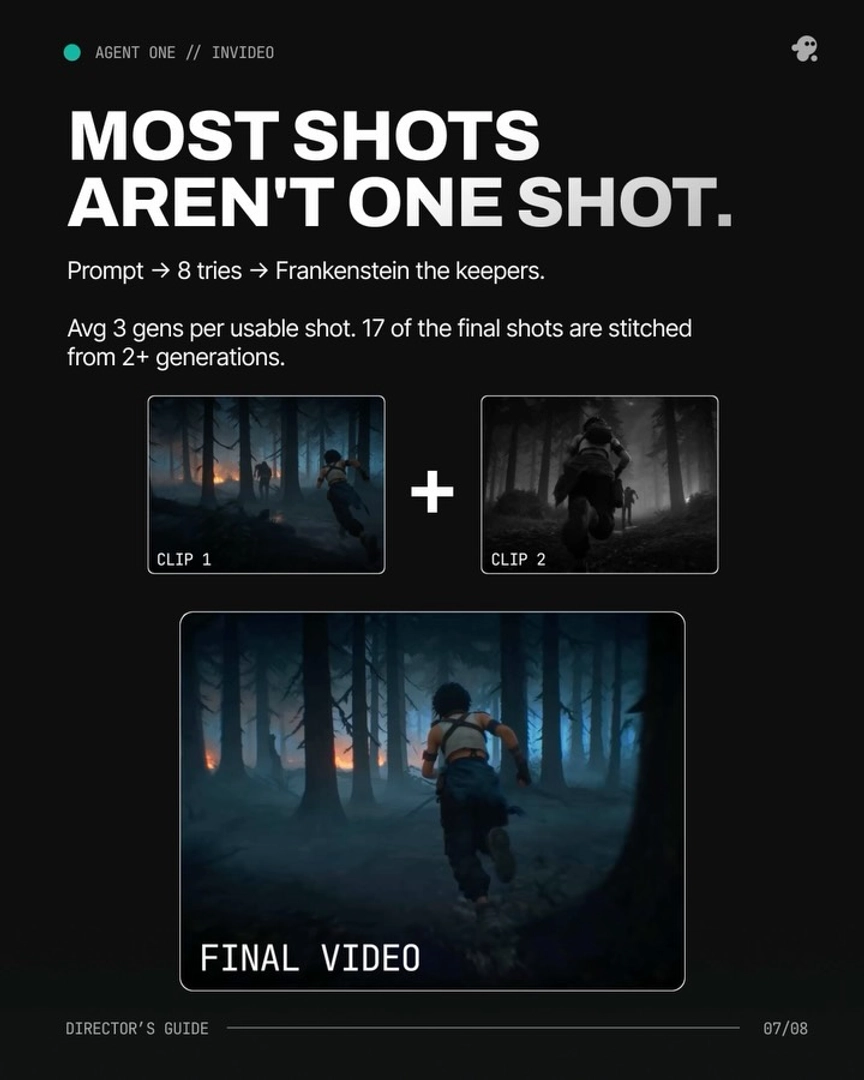
Where the money actually goes changes, not just how much. Traditional budgets are dominated by crew, locations, equipment, and pre-production; AI budgets are dominated by generation credits and iteration. The Arcane-style episode generated 164 clips to finish with 41 — a ~25% selection rate, averaging 3 generations per usable shot, with 17 final shots stitched from 2 or more generations. Locking a single character's visual identity took about 5 generation attempts at ~$9.78 per character. Overgeneration is a deliberate budget line, not waste — at $315 per finished minute it still comes in at a fraction of traditional animation costs while requiring a real iteration budget.
Whole categories of traditional spend disappear outright. The Arcane-style episode ran with 2 people, 2 days, and no pre-production phase at all; the 4-person production covered multiple international locations, VFX, and a long-take sequence — line items that would each carry five-figure costs in a traditional budget — inside $5,000 total. Image generation is cheap enough on invideo that generating multiple option grids per decision is standard practice rather than a cost concern.
One honest caveat: these numbers buy iteration-driven production, and the 25% clip selection rate means you should budget 3–4x more generation than finished runtime. Plan credits against that yield, not against a one-generation-per-shot assumption.
These are documented actuals from specific productions — your own numbers will vary with team, style, and ambition, but the range above is a realistic planning band.
Watch some of these to see what works for you:
That comes to around about $1,500, which if you really think about it, is not that much in comparison to what you would spend if you had to make this in the traditional shooting way — because an ad like this would cost you anywhere from $100,000 to $500,000.
— a director with 15 years of professional ad-film and TV experience, documenting an invideo production