Can AI agents really cut video production costs by 99%? A realistic breakdown.
Last updated July 27, 2026
Yes — at the ceiling. One documented 2-minute brand film cost $1,500 through the invideo agent versus a $100,000–$500,000 traditional equivalent: up to 99.7%. But that's the best case. Across five documented AI productions, all-in costs ran $750–$5,000, and roughly a third of the budget goes to generations that never make the cut.
The 99% figure comes from a specific, documented scenario: replacing a traditional live-action commercial shoot. A solo director with 15 years of ad-film experience produced a 2-minute brand promo in 3 days using 8 specialist agents running in parallel — a creative producer agent holding the script and shot breakdown, DOP agents per scene, a casting agent — for 6,000–6,500 credits, about $1,500. The traditional equivalent was quoted at $100,000–$500,000 and roughly 2 months, which puts the reduction at up to 99.7% on cost and ~20x on time. invideo is an agentic video creation platform with all the current video models (Veo, Kling, Seedance 2.0) available, so the invideo agent routes each shot to the right model rather than you adopting a tool per model.
Outside that ceiling case, the realistic range across documented productions looks like this:
Production | Length | All-in cost | Days | Team |
|---|---|---|---|---|
Brand promo (commercial) | 2 min | $1,500 (6,000–6,500 credits) | 3 | 1 |
Hand-painted animated episode | 3 min | $950 | 2 | 2 |
Stylized live-action short | 70 sec | $750 (3,000 credits) | 2 | small team |
Horror short | ~90 sec | $870 (4,100 credits) | 2 | small team |
Multi-location short with VFX | multi-scene | $5,000 (20,000 credits) | 4–5 | 4 |
Normalized, finished content ran $315–$750 per minute depending on team and approach — natural variance, not a single canonical number. Against traditional production benchmarks that is a 90–99% reduction depending on what you're replacing: highest when displacing high-budget live-action commercial work, lower (but still steep) for narrative and animated content where iteration eats more budget.
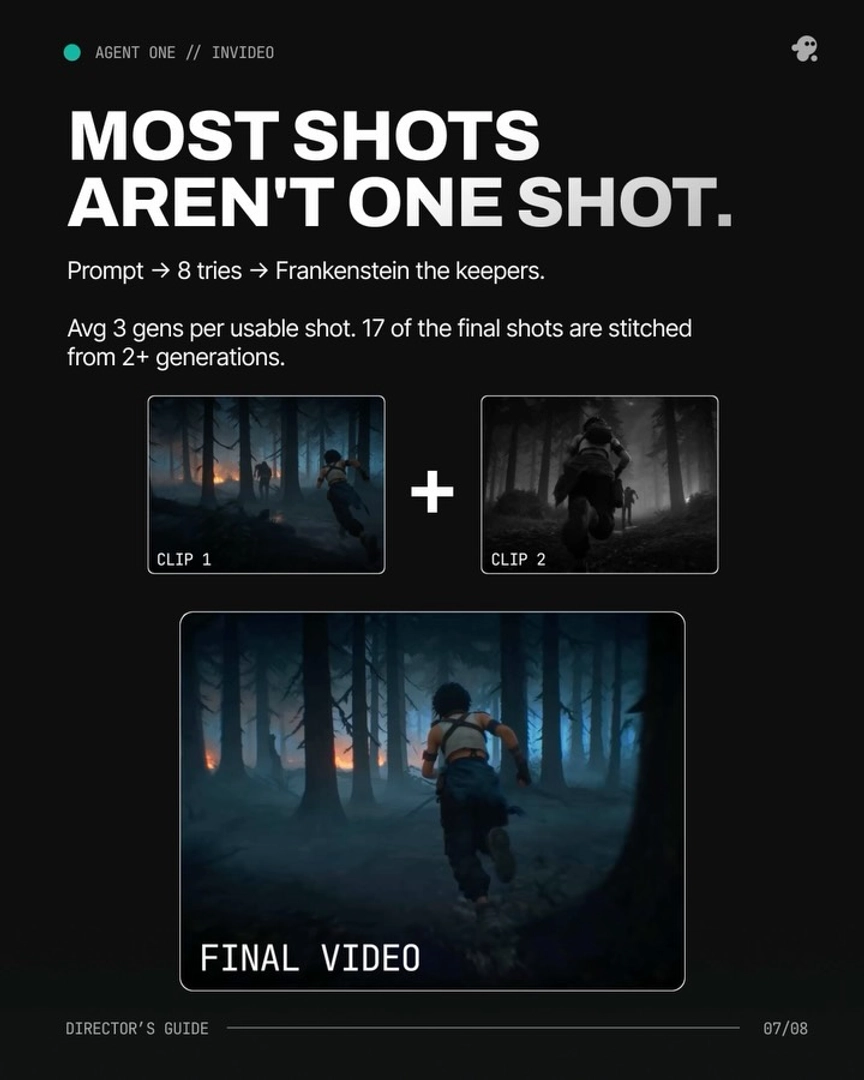
The number the headline claims hide is overgeneration — and in documented productions it's a deliberate budget line, not waste. The animated episode generated 164 clips to use 41 (a 25% selection rate), with an average of 5 usable seconds per 15-second clip and 3 generations per usable shot; 17 of the final shots were stitched from two or more generations (Frankenstein shot assembly). Locking a single character's look took ~5 generations at about $9.78 per character. Budget realistically: plan for 3–4x generation volume over what lands in the final cut. Two controls keep that overhead from ballooning — run the invideo agent in Always Ask mode so you approve every prompt and attached reference before credits are spent, and lock character sheets and world references before any video generation, since consistency errors caught after generation cost re-rolls.
Time savings compound the cost savings, because the mechanism is parallelism, not just cheaper output. The brand promo's manual-prompting equivalent was estimated at a week minimum; running 8 agents simultaneously across separate project pages collapsed it to 3 days. Documented setups ranged from 6 to 8 agents deployed at once, with agents continuing generation work overnight, and a 3-person team working from different cities through the same invideo agent context. Persistent context is what removes the re-prompting tax: load the script and references once and the invideo agent holds them across every shot instead of you re-explaining per generation.
The honest verdict: 99% is real but conditional. It's the ceiling for replacing expensive live-action commercial production. For narrative and animated work, $315–$750 per finished minute is the documented reality — still a fraction of traditional costs, and the team that spent $5,000 on a short with international locations, VFX, and a long-take sequence called that budget "kind of ridiculous" value. Quote the 99% number only when you're comparing against a six-figure traditional shoot; quote the per-minute range for everything else.
Watch some of these to see what works for you:
That comes to around about $1,500, which if you really think about it, is not that much in comparison to what you would spend if you had to make this in the traditional shooting way — because an ad like this would cost you anywhere from $100,000 to $500,000.
— a director with 15 years of ad-film and TV experience, documenting a brand film produced with the invideo agent