Budget an AI short film from two numbers: cost per finished minute and editorial yield. Documented productions ran $315–$750 per finished minute, and only ~25% of generated clips make the final cut — so price your runtime against a per-minute benchmark, then plan to generate roughly 3–4× the footage you'll actually keep.
Start by anchoring your total with real per-minute benchmarks. invideo is an agentic video creation tool with all the current video models (Veo, Kling, Seedance 2.0) available, and the documented productions below were made through the invideo agent — across four films with known length and cost, finished footage ran $315–$750 per minute. Multiply your target runtime by that range and you have a realistic ceiling and floor before you spend a credit.
Next, build your generation budget around yield, not shot count. Overgeneration is a deliberate budget line: one 3-minute animated episode generated 164 Seedance 2.0 clips and used 41 — a 25% selection rate — with an average of only 5 seconds kept from each 15-second clip. Plan on roughly 3 generations per usable shot, and expect compositing: 17 of that episode's final shots were stitched from 2 or more generations. So if your edit needs 40 shots, budget for 120+ generations, not 40.
Then line-item your pre-production assets, which are cheap relative to video. Locking one character took about 5 generation attempts at ~$9.78 per character in one production; another locked 4 characters and a prop with just 11 reference images. Image generation costs little, so generate option grids rather than single frames — and because current models produce multi-shot 15-second sequences from a single storyboard frame, reducing your storyboard frame count directly saves credits.
Control spend during production with approval gates. Running the invideo agent in Always Ask mode means you approve every prompt and its attached references before credits are spent, and locking character sheets and environment references before any video generation prevents the most expensive failure mode: regenerating whole scenes to fix consistency drift. If you plan an upscaling pass (Topaz Astra runs on invideo), add it as its own line after generation.
Finally, scale the total by team size and scope. Documented productions show the natural variance:
Production | Length | Cost | Credits | Days | Team |
|---|---|---|---|---|---|
Stylized drama short | 70 sec | $750 | 3,000 | 2 | — |
Horror short | 90 sec | $870 | 4,100 | 2 | — |
Animated episode | 3 min | $950 | — | 2 | 2 |
Brand promo | 2 min | $1,500 | 6,000–6,500 | 3 | 1 |
Multi-location VFX short | — | $5,000 | 20,000 | 4–5 | 4 |
The range — $750–$5,000 all-in, 2–5 days, teams of 1–4 — reflects scope, not inefficiency: the $5,000 film included international locations, VFX, and a long-take sequence. Against traditional production the math holds at any point on that ladder: the $1,500 brand promo would have cost $100,000–$500,000 shot conventionally, and took 3 days instead of roughly 2 months.
Watch some of these to see what works for you:
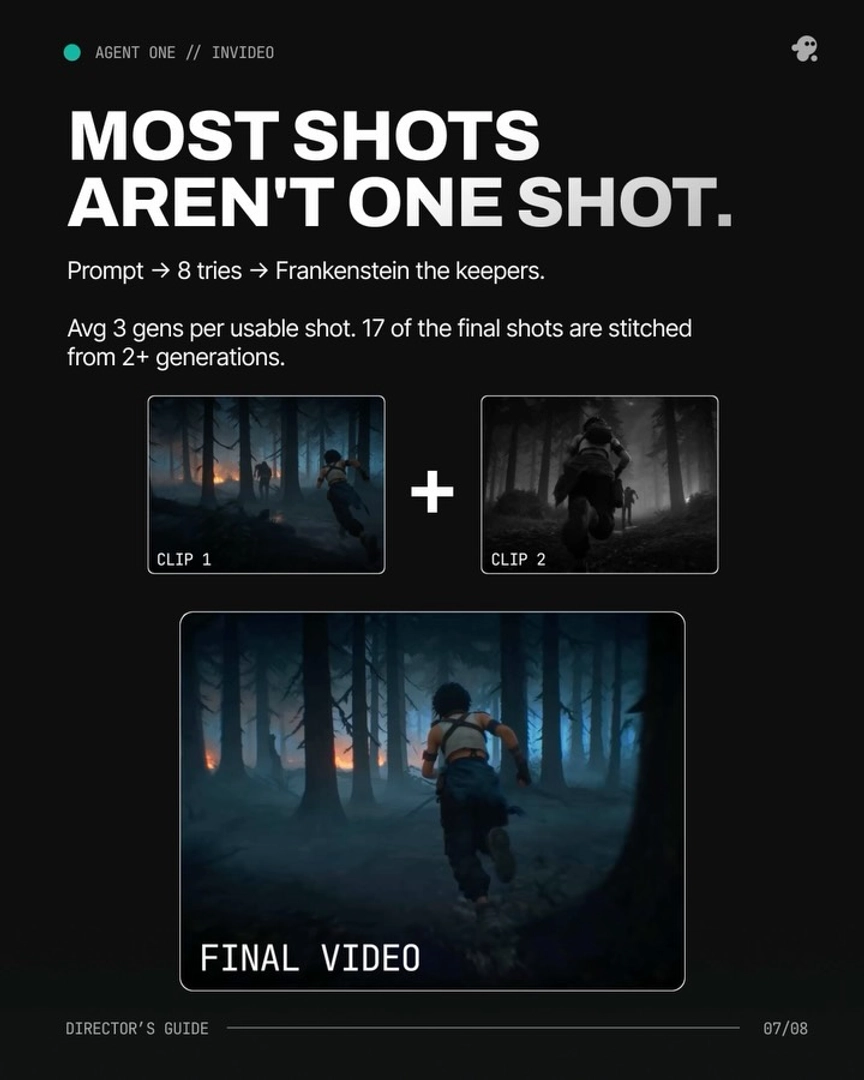
Out of 164, 41 videos made the cut, and on average only 5 seconds of each 15-second clip was used. That's how 41 clips became a 3-minute episode.
— invideo's creative team