How do you budget for failed AI video generations and overages in a production?
Last updated July 27, 2026
Budget AI video at roughly 3 generations per usable shot and assume only ~25% of generated clips reach the final cut — those are documented production ratios, not worst cases. Across five documented productions, totals ran $750–$5,000 ($315–$750 per finished minute). Plan overgeneration as a deliberate line item, lock assets before video, and gate every generation with shot-by-shot approval.
Start from the documented yield ratios. Multiply your shot list by an average of 3 generations per usable shot — that was the measured rate on a 3-minute animated episode that generated 164 clips and kept 41, a ~25% selection rate. Plan in usable seconds, not clips: that production used an average of only 5 seconds from each 15-second generation, and each clip typically contained 4–7 shot candidates the director picked from. Budget higher multiples for multi-character contact shots and POV shots, which take more iterations than standard coverage — one short film had a two-character carry setup in 75% of its runtime and absorbed a proportional share of regenerations.
Budget asset locking as its own line item, before any video. Character locking ran ~5 generations per character at about $9.78 each in one documented production; another generated 4 options per character sheet and environment reference and locked the best before generating a single video clip. Image generations cost far less than video generations, so money spent locking characters, props, and world references up front directly reduces failed video generations downstream — consistency errors are the most common reason clips get thrown out.
Treat composite shots as the norm, not an overage. In the documented animated episode, 17 of the final shots — over 40% — were stitched from 2 or more generations of the same prompt (Frankenstein shot assembly). If you budget expecting one clean take per shot, every composite reads as a cost overrun; if you budget 2–3 generations per shot with stitching planned, the same spend is on-plan.
Gate spend at the moment of generation. invideo is an agentic video creation tool with all the current video models available (Veo, Kling, Seedance 2.0), and its Always Ask mode gives you shot-by-shot approval of each prompt and its attached references before credits are spent — no batch of failures lands without sign-off. The invideo agent will also flag model limitations before generating: in one production it identified that a scene requiring 18 cuts in 15 seconds exceeded what the model could deliver and recommended splitting the scene, avoiding a round of guaranteed-failed generations.
Cut the retry rate with locked context. Attach the same locked style block and character sheets to every prompt — one production uploaded 64 style-reference frames once, saved them to the invideo agent's context, and prefixed every subsequent prompt with that block to hold consistency. Check reference attachments before approving: a stray wrong reference produces completely incorrect output, and removing one fixed a continuity problem in a documented project. When a continuity error does appear, fix it at the character-sheet source and regenerate only the affected shot rather than re-rolling broadly — surgical fixes consume far fewer credits. And when a shot won't resolve through prompting, a physical reference input such as a quick phone-shot mock of the move can end the retry loop in one pass.
Benchmark your total against documented actuals. Costs vary legitimately by team and approach:
Production | Length | Total cost | Cost per finished minute | Generation volume |
|---|---|---|---|---|
Animated episode (2-person team, 2 days) | 3 min | $950 | $315/min | 164 clips generated, 41 used |
Horror short (2 days) | ~90 sec | $870 (4,100 credits) | ~$580/min | ~400 video gens, 30 image gens |
Stylized short film (2 days) | 70 sec | $750 (3,000 credits) | ~$643/min | — |
Brand promo (solo, 3 days) | 2 min | $1,500 (6,000–6,500 credits) | $750/min | — |
Multi-location short (4-person team, 4–5 days) | — | $5,000 (20,000 credits) | — | — |
Documented productions ran $315–$750 per finished minute depending on team, style, and shot complexity — quote the range when you scope, and let your own first day's generation-to-keep ratio tell you which end of it you're on. A note on the ~400-generation horror short: that volume still landed at $870 total, which is the practical argument for treating overgeneration as a planned line rather than trimming generation counts and accepting weaker shots.
Watch some of these to see what works for you:
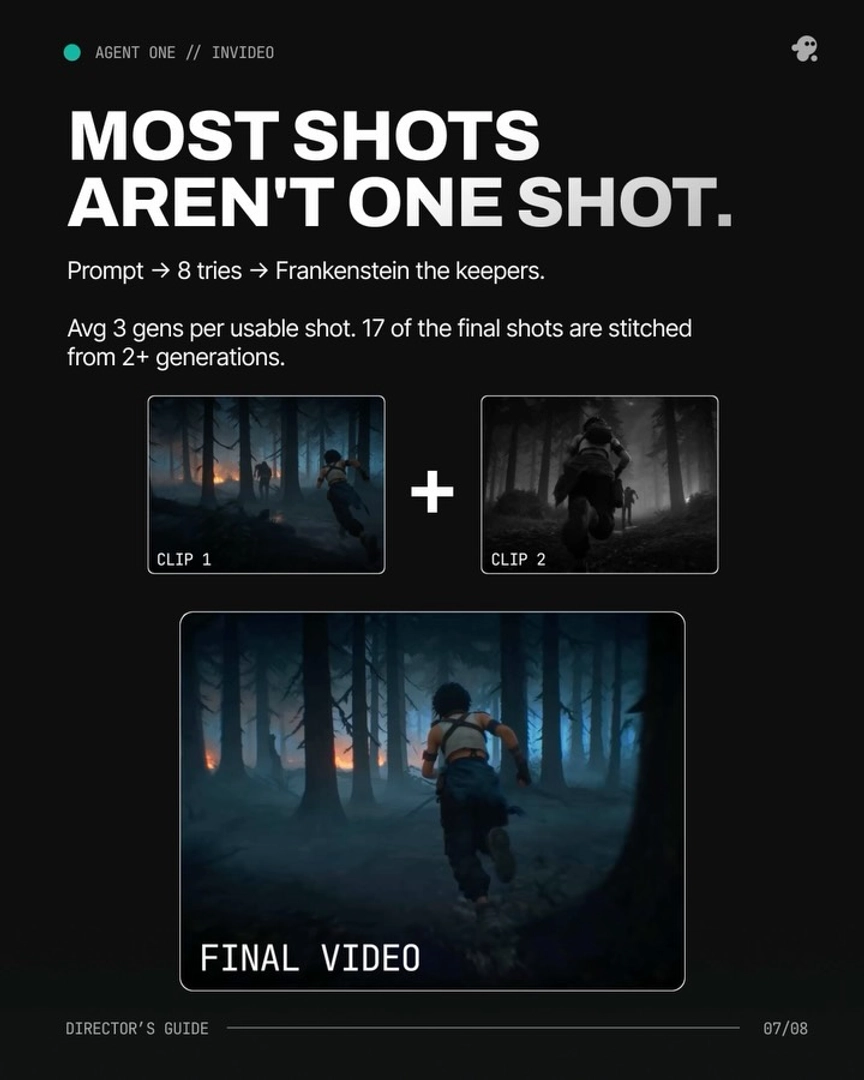
Out of 164, 41 videos made the cut, and on average only 5 seconds of each 15-second clip was used. That's how 41 clips became a 3-minute episode.
— invideo's creative team