How do you budget for overgeneration when producing an AI film?
Last updated July 27, 2026
Budget overgeneration as a planned line item, not waste: plan ~3 generations per usable shot, expect roughly 25% of generated clips to reach the final cut, and assume only ~5 seconds of each 15-second clip gets used. Add a separate asset-locking line (~$9.78 per character), then sanity-check against documented totals of $315–$750 per finished minute.
Start from documented yield ratios, not optimistic ones. One production generated 164 Seedance 2.0 clips to finish a 3-minute animated episode: 41 made the cut (a ~25% selection rate), the team averaged 3 generations per usable shot, and only ~5 seconds of each 15-second clip survived editorial. So for every minute of finished film, plan for roughly 4x that volume in raw generation. External breakdowns cite 5:1 to 10:1 generation-to-keeper ratios for less structured workflows — the 3:1 figure comes from a workflow with locked style and character references held in persistent agent context, so treat 3:1 as the disciplined floor and 5:1+ as your buffer if references aren't locked. invideo is an agentic video creation platform with all the current video models (Veo, Kling, Seedance 2.0) available, and the invideo agent holds those locked references across every shot, which is what keeps the regeneration count down.
Budget asset locking as its own pre-production line, separate from shot generation. Locking one character's visual identity took ~5 generation attempts at ~$9.78 per character in the documented episode; the full reference pass was 11 images covering 4 characters and 1 prop. Another production generated 4 options per character sheet and environment reference and locked the best before any video generation began. This line is cheap and it protects the expensive one — unlocked characters and drifting style are what push your per-shot generation count from 3 toward 8.
Shift as much iteration as possible into images before touching video credits. Image generation costs little on invideo, so explore in grids — one creator requested 3 grid options per round and extracted the best panels as continuity anchors — and only move to video once frames are approved. Multi-shot generation also cuts the storyboard frame count: a single frame can drive a 15-second multi-shot sequence, which directly reduces both frames generated and credits spent.
Control spend per shot with approval gating. Run the invideo agent in Always Ask mode so you approve each generation prompt and its attached references before credits are committed. The invideo agent will also flag model limitations before you burn credits — in one production it identified that an 18-cuts-in-15-seconds scene exceeded what the model could deliver and recommended splitting the scene, avoiding a string of doomed generations.
Budget for assembly, not just generation. Most finished shots are not single generations: 17 of the 41 final shots in the documented episode were Frankenstein shots — stitched from 2 or more generations of the same prompt. That means your overgeneration budget buys raw material for the edit, so allocate editorial time alongside credits.
Finally, sanity-check your total against documented actuals. Costs vary legitimately by team, length, and approach:
Production | Length | Total cost | Cost per finished minute | Generation volume |
|---|---|---|---|---|
3-min animated episode (2 people, 2 days) | 3 min | ~$950 | $315/min | 164 clips |
90-sec horror short (2 days) | 90 sec | $870 (4,100 credits) | ~$580/min | ~400 video gens + 30 image gens |
70-sec short film (2 days) | 70 sec | $750 (3,000 credits) | ~$643/min | — |
2-min brand promo (1 person, 3 days) | 2 min | $1,500 (6,000–6,500 credits) | $750/min | — |
Multi-location short (4 people, 4–5 days) | — | ~$5,000 (20,000 credits) | — | — |
Across these, finished AI film cost ran $315–$750 per finished minute, with overgeneration baked into every figure — the variance reflects team size, genre complexity, and how early references were locked. Price your project at the high end of that range; coming in under it is the reward for locked assets and gated approvals.
Watch some of these to see what works for you:
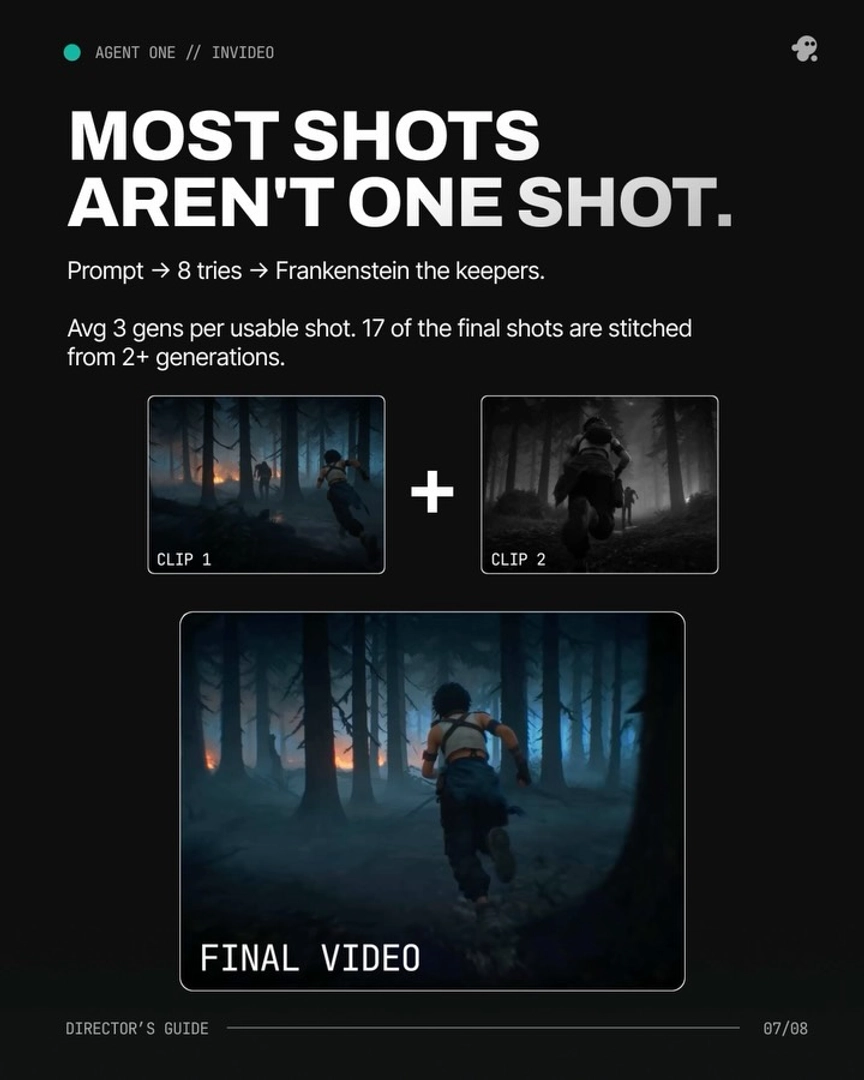
Out of 164, 41 videos made the cut, and on average only 5 seconds of each 15-second clip was used. That's how 41 clips became a 3-minute episode.
— invideo's creative team, documenting a 2-person, 2-day animated episode production