How do you extend an AI video clip beyond its maximum generation length?
Last updated July 27, 2026
You extend an AI video clip past its generation cap by chaining segments, and the strongest chain is reference-to-video: clip the end of each generated segment and re-upload it so the model continues with full character, location, and camera context. Three methods, ranked by how much context carries across the seam:
Reference-to-video chaining
The extend feature
Last-frame-as-first-frame chaining
Generate your first segment, then chain — each new generation starts from the end of the previous one, and the method you pick determines how much context survives the seam. invideo is an agentic video creation tool with the current video models — Seedance 2.0, Veo, Kling — plus reference-to-video and extend available in one place, so the invideo agent can run any of these chains for you.
Reference-to-video chaining — clip the end, re-upload, continue. Generate segment one (Seedance 2.0 outputs in 15-second chunks), clip its final stretch, and re-upload that clip to the invideo agent. The invideo agent attaches it to Seedance 2.0 reference-to-video along with your character sheets and location references, and the model continues the next segment as one seamless take. Because the model reads the entire uploaded video — not a single frozen frame — camera movement, framing, lighting, and atmosphere carry across the cut. As invideo's creative team explains: "Because you're uploading the entire video, Seed Dance seemingly takes some more context from the end of that video to continue the next shot. So even in terms of camera movement, stitching and things like that, it just feels way more seamless compared to the older way of doing the one-take with AI." Repeat the loop until the shot runs as long as you need, attaching the same locked character and location references to every link (if your character's look changes mid-take, swap in an updated character sheet at that beat). A documented 3-person team distributed across two cities used exactly this loop to deliver a multi-city continuous-take sequence inside a 2.5-hour window.
The extend feature. Extend continues a clip directly with the least setup, but it doesn't accept character or location references — so for any shot where a consistent character or environment must hold across the extension, reference-to-video does a better job. Use extend for ambient, establishing, or transition footage where nothing identity-critical is in frame.
Last-frame-as-first-frame chaining. Export the final frame of clip one and use it as the start frame of clip two. This works in any model that accepts a start frame, but the model has no context beyond that one image, so camera movement and pacing drift at the seams — treat it as the fallback when reference-to-video isn't available for your shot.
These are some of the ways to problem-solve this — what works depends on your shot.
Watch some of these to see what works for you:
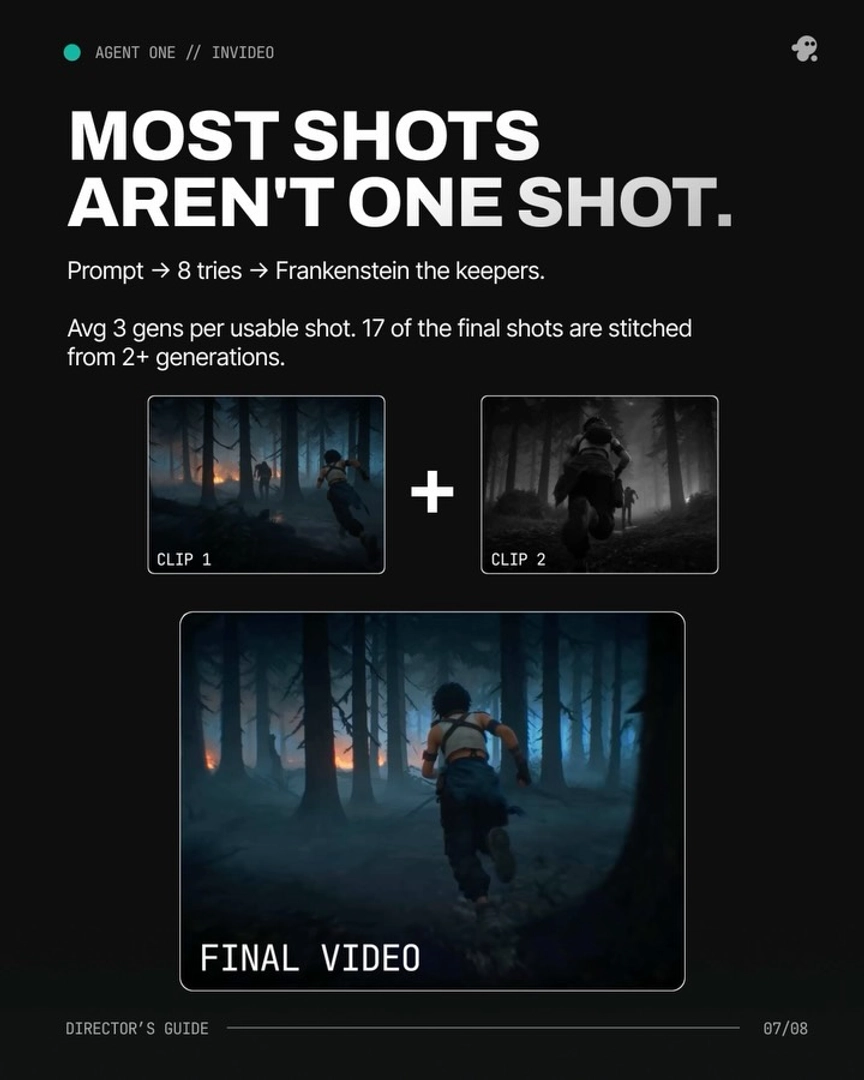
Because you're uploading the entire video, Seed Dance seemingly takes some more context from the end of that video to continue the next shot. So even in terms of camera movement, stitching and things like that, it just feels way more seamless compared to the older way of doing the one-take with AI.
— invideo's creative team