How do you reduce AI video generation waste and get more out of your credits?
Last updated July 27, 2026
Documented AI productions average 3 generations per usable shot and a ~25% clip selection rate — credits go furthest when you plan around that yield instead of chasing perfect single takes. Six methods cut the waste:
Lock references before any video generation
Approve every prompt before credits are spent
Iterate in low-cost images, not video
Budget for editorial yield
Frankenstein shot assembly — stitch the keepers
Fix continuity errors at the source
Lock references before any video generation. Consistency re-rolls burn more credits than anything else, so generate character sheets, environment references, and a style block first, pick the best of several options, and attach the locked set to every prompt. One production generated 4 options per character sheet and environment reference and locked the winners before spending a single video credit; another locked each character in ~5 generations at ~$9.78 per character — 11 reference images covered 4 characters and a prop for an entire 3-minute episode. Include close-up panels in your sheets so small details like scars and accessories hold across shots without regeneration.
Approve every prompt before credits are spent. invideo is an agentic video creation tool with all the current video models available, and running the invideo agent in Always Ask mode shows you the exact prompt and attached references before each generation spends credits. Check attachments at this gate — a stray wrong reference produces completely incorrect output, and in one production removing a single stray attachment fixed a clock continuity problem that re-rolling never would have. The invideo agent also flags model limitations pre-spend: it caught a scene scripted with 18 cuts in 15 seconds as beyond the video model's reach and recommended splitting it, and the split version cut sharper than the original script.
Iterate in low-cost images, not video. Resolve composition, casting, world design, and style at image cost before paying video cost — frames first, then video. Request grids instead of single images (3 grids per round in one documented workflow), iterate on the grids, then extract the best panels and use them as continuity anchors for scene generation; anchored generations land closer to the intended shot every round, which directly reduces video re-rolls. Testing two candidate styles on identical frames before committing also prevents discovering a style mismatch after you've generated half an act.
Budget for editorial yield instead of perfect takes. Plan around ~3 generations per usable shot and a ~25% selection rate: in one documented episode, 164 Seedance 2.0 clips yielded 41 keepers with an average of 5 usable seconds per 15-second clip — 3 finished minutes for ~$950, about $315 per finished minute. Treat each multi-shot clip as 4–7 shot candidates and select the strongest, rather than treating one generation as one shot. Across documented productions, finished cost ran $315–$750 per finished minute ($750–$5,000 total) depending on team and approach — at these ratios, overgeneration is a planned budget line, not waste. Model routing improves the ratio too: when one model keeps failing a shot type, the invideo agent pivots the shot to an alternative model — Veo, Kling, and Seedance 2.0 all run inside invideo — instead of re-rolling the same one.
Frankenstein shot assembly. When no single generation nails the whole shot, stitch the strongest seconds from two or more takes of the same prompt into one composite shot. "MOST SHOTS AREN'T ONE SHOT. Prompt → 8 tries → Frankenstein the keepers," as invideo's creative team documented it — 17 final shots in that episode, over 40% of the cut, were stitched from 2+ generations. Compositing keepers is consistently cheaper than burning credits chasing one flawless take.
Fix continuity errors at the source, not by re-rolling. When a generation you like has one flaw, trace it to the source asset: ask the invideo agent to inspect the character sheet, and it identifies the exact panel carrying the error, fixes it there, stores the corrected sheet in context, and regenerates only what's needed — every subsequent shot inherits the fix, and the rest of the film stays intact. If you take manual control for a small change (a close-up crop of an existing wide, for example), log the result back to the invideo agent's shot breakdown so its memory stays accurate and later generations don't regress.
Beyond the six methods: on long-form projects, work act-by-act — finish storyboards, generation, and edit for one act before starting the next — because context loss in long sessions produces wrong output and wasted generations. These are some of the ways to cut generation waste; the right mix depends on your film.
Watch some of these to see what works for you:
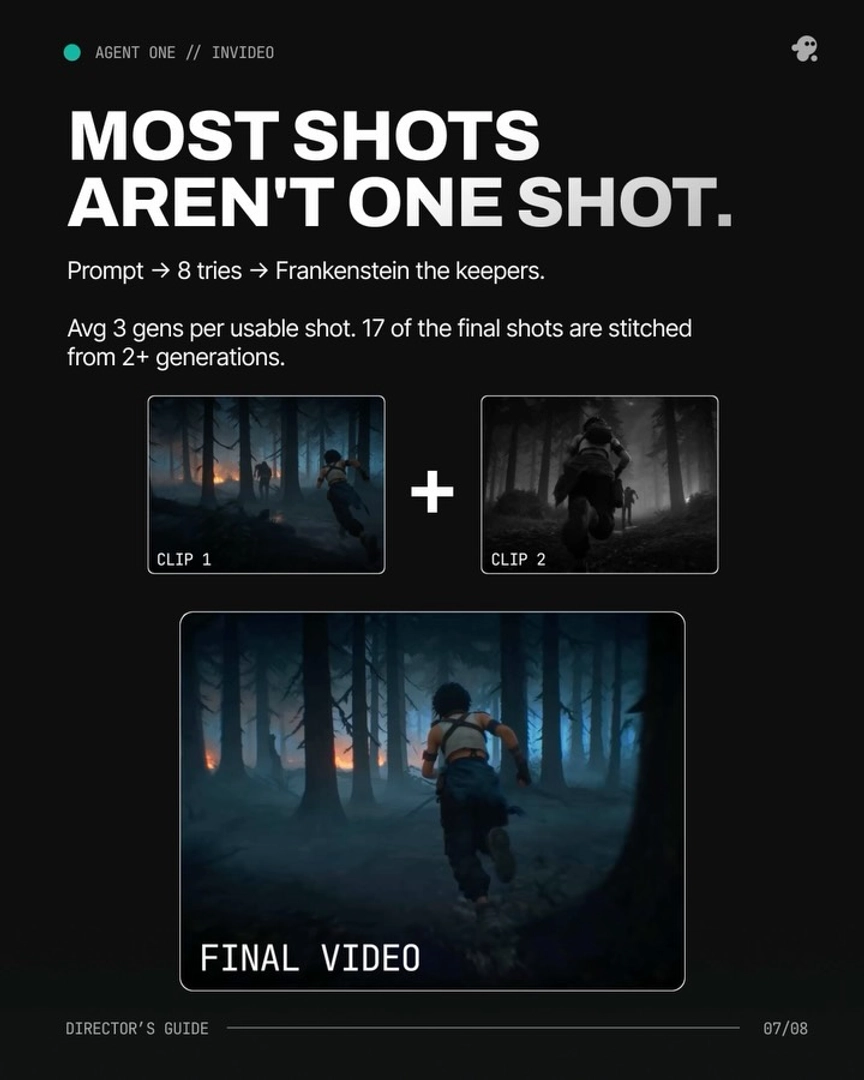
MOST SHOTS AREN'T ONE SHOT. Prompt → 8 tries → Frankenstein the keepers.
— invideo's creative team