How do you stitch together the best parts of multiple AI video generations into one shot?
Last updated July 27, 2026
You build a Frankenstein shot by generating the same prompt several times with identical style and character references, harvesting only the usable seconds from each take — on average 5 of every 15 — and cutting them together in your editor. In one documented 3-minute production, 17 of the final shots were stitched from 2 or more generations.
Start by generating multiple takes of the same shot, not one: documented productions average 3 generations per usable shot, so plan that into your budget rather than treating re-rolls as failure. invideo is an agentic video creation tool with all the current video models — Seedance 2.0, Kling, Veo — available, and running the invideo agent in Always Ask mode lets you approve each prompt and its attached references before credits are spent.
Keep the inputs identical across every take so the segments match later. Attach the same style block and the same character references to every generation of the shot — in one animated episode, every single prompt opened with the locked style block, which is what made footage from different generations cut together as one shot. If the lighting, palette, or character spec drifts between takes, no edit will hide the seam.
Then review each generation as a reel of candidates, not a single answer. Each 15-second clip typically contains 4–7 usable moments; log the exact seconds that work in each take — for example, seconds 2–6 from one generation and 8–12 from another. Across a full production, only about 5 seconds of each 15-second clip survived, and 41 of 164 generated clips made the final cut — a 25% selection rate, which is why overgeneration is a deliberate line item, not waste.
Assemble the harvested segments in your editor — Adobe Premiere Pro or DaVinci Resolve are the documented choices. Cut at moments of motion or framing change so the join reads as an intentional edit rather than a patch, and trim each segment to its strongest beats only. A light unifying pass over the assembled shot — a touch of blur, grain, and a shared grade — helps segments from different generations read as one continuous piece.
The approach scales: in the documented production above, a 2-person team used it to finish a 3-minute animated episode in 2 days for ~$950 (about $315 per finished minute), with more than 40% of the final shots composited from multiple generations.
Watch some of these to see what works for you:
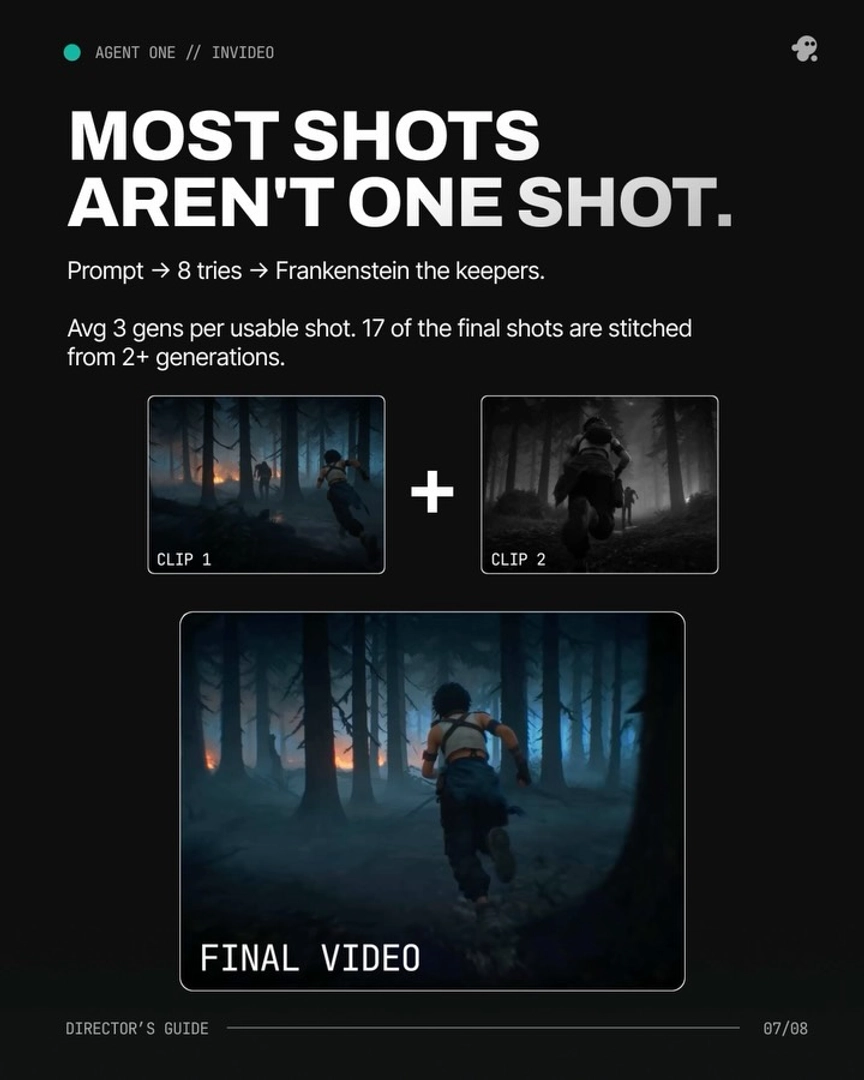
MOST SHOTS AREN'T ONE SHOT. Prompt → 8 tries → Frankenstein the keepers.
— invideo's creative team