How do you use visual tension as a hook strategy in UGC ads?
Last updated August 1, 2026
Visual tension means opening your UGC ad on something that looks wrong or contradictory, then resolving it as a product win — all inside the 1.5-second scroll-stopping window. Three formats work reliably:
Built-in product contradiction
Match-cut before/after
Selective color contrast
Put an unresolved visual contradiction in your first frame — the viewer's brain flags 'that doesn't look right' and holds attention until you resolve it. This is a pattern-interrupt hook, and it works even on muted autoplay because the tension is entirely visual, not verbal. Sequence the resolution as emotion first, product second: the creator visibly wins before anything gets explained.
Built-in product contradiction. Audit your product for something that looks visually wrong but pays off in use — in one documented supplement ad, dark green gummy bears that taste like strawberry carried the whole hook: 'wait, that doesn't look right' → 'oh it actually tastes like strawberry.' Open on the contradiction in close-up, let the creator react, then reveal the payoff.
Match-cut before/after. Cut hard between two contrasting states of the same frame — in one home-services ad, a hand snaps and the location cuts from messy to spotless. The tension lives in the impossible jump. Keep the resolution as a clean cut, not a morph: transformations are unreliable in AI UGC generation, so favor a single one-take reaction on either side of the cut.
Selective color contrast. Render the opening scene in black and white with only the hero product in full color. The chromatic mismatch is the tension; the eye goes straight to the product. This is achievable in a single AI video generation pass when you prompt it explicitly.
To produce these, describe the hook to the invideo agent in precise directorial language — invideo is an agentic video creation tool that plans, generates, and assembles the ad from one conversation. Write the hook as a shot ('a hand comes in from frame, snaps, and the location cuts from messy to spotless'), then pause and check whether the invideo agent can visualize the timing and framing from text alone; for complex tension hooks like a match cut, upload a reference video, because the invideo agent may not fully infer timing from description.
Lock the hook before any generation. It is the first of five assets to finalize — hook, script, voiceover, shot breakdown, duration — before moving to production. Give the tension room to resolve: in one documented production, the invideo agent pushed back on a 15-second request and recommended 20 seconds specifically to preserve the hook beats and the promo register time. Then stress-test the resolution by having the invideo agent write three script variations in different tonal registers — enthusiastic reaction, quiet and understated, skeptic — against the same visual hook, and pick the one where the tension lands hardest. Keep the whole thing looking phone-shot rather than professionally lit; polished footage signals 'ad' and defuses the tension before it registers.
Watch some of these to see what works for you:
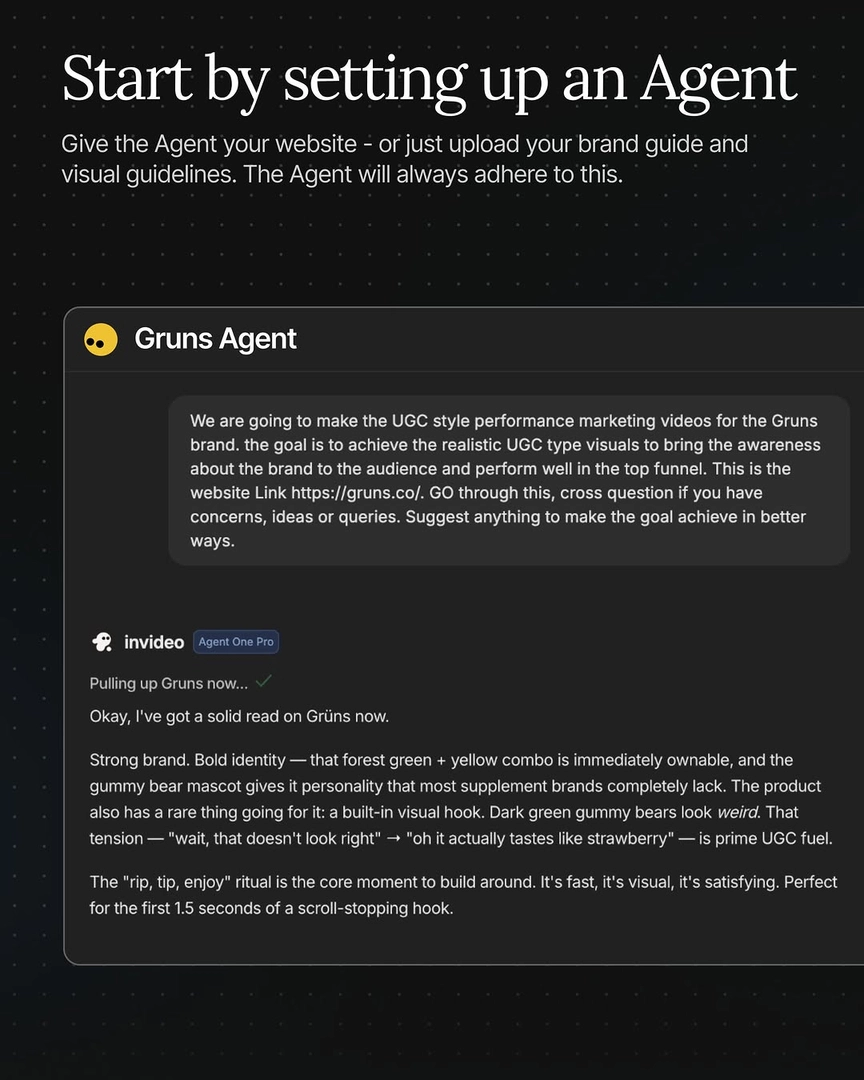
The product also has a rare thing going for it: a built-in visual hook. Dark green gummy bears look weird. That tension — 'wait, that doesn't look right' → 'oh it actually tastes like strawberry' — is prime UGC fuel.
— invideo's creative team