How do you write an AI video prompt in the style of a specific cinematographer or film look?
Last updated July 27, 2026
Write the prompt as five layers a cinematographer actually controls — lens and focal length, lighting quality and direction, color grade, camera movement, grain and texture — then attach a named DP or film title as a style anchor ("shot like Roger Deakins", "in the style of In the Mood for Love"). Load this as a reusable style block the invideo agent applies to every shot, not a one-off prompt.
Build the prompt in this fixed order so nothing drifts between shots: (1) Lens / focal length — "anamorphic 35mm, shallow depth of field, slight barrel distortion" or "flat 40mm telephoto, centered framing". (2) Lighting — name the source and direction, not a vibe: "motivated practical light, warm shadow fill, soft bounce from camera-left" beats "warm lighting" every time. (3) Color grade — hex values or named tonal modes if you have them, otherwise "desaturated midtones, lifted blacks, teal-orange palette". (4) Camera movement — "slow dolly-in", "handheld drift", "long uncut take". (5) Grain / texture — "visible 35mm grain, slight halation, chromatic aberration". Close with your film's aspect ratio and a negative prompt ("no photorealism, no digital sharpness") so the model knows what to suppress.
Map the named DP or film to its signature cluster before you write the block. Roger Deakins = motivated practicals + warm shadow fill + subtle lens distortion. Emmanuel Lubezki = long takes, natural available light, wide-angle intimacy. David Fincher / Darius Khondji = desaturated cold tones, deep shadows, controlled symmetry, 85:15 dark-to-light ratio. Wong Kar-wai = split-toned amber and emerald, slow shutter motion smear, 2.40:1 hard matte. Wes Anderson = flat telephoto, centered symmetry, pastel palette. Naming the DP only does ~20% of the work — the technical cluster does the other 80%, which is why models that haven't ingested the director still hit the look.
For a named director, encode the full visual language as a treatment document and load it into the invideo agent once. One documented horror short ran on a 25-page Wong Kar-wai style guide split into 14 sections (camera, angles, color tone, atmosphere, mood, lighting, composition, movement, palettes, prompt templates, negative prompts, quick-reference card); a James Wan production encoded a 9-step shot design process, an 8-step color grading process, and the 85:15 dark-to-light ratio. The invideo agent reads it once and gates every generation against it — you write directorial intent ("hold on the feral guy, no back-and-forth cutting"), it assembles the 9-element prompt (camera spec, lens & aspect ratio, lighting source, palette, composition, atmosphere, mood register, film/DP attribution, negative prompt) in the same order across every shot.
For color specifically, encode tonal modes as named presets with hex values — "Mode A — Split-toned amber and emerald, #C4923D / #2E5D4F" — rather than adjectives. Reproducible across shots, debuggable when one frame drifts. Add a section on what to NEVER do per emotional stage ("Stage A: no neutral gray shadows, shadows must lean warm") so the invideo agent self-corrects when a generation comes back wrong. In one production the agent flagged blue-green shadows leaning against a Stage A rule the director never asked it to check.
Reference images carry the look more reliably than adjectives when the style is illustrated or animated. Don't drop the reference straight into the prompt — instruct the invideo agent to read the colors and textures of the reference and prompt for those in photoreal language. One Arcane-style episode fed 64 frames into context with "deeply understand this art style and save it into context", then every prompt downstream started with that locked style block including hard negatives ("not live action, not photorealistic, hand-painted brushstroke texture").
Model choice changes how the prompt lands, and the invideo agent routes between them so you don't pick a platform per shot. Veo and Runway respond best to named DP and film-title references ("in the style of Blade Runner 2049") because they've absorbed more director-tagged training data. Kling and Seedance 2.0 reward technique descriptors over proper names — strip "Roger Deakins" and write the cluster ("motivated practical key, warm shadow fill, 2.40:1") instead. Seedance 2.0 Reference-to-Video carries character and location context across clips when you need the same DP look across a continuous take.
As told by Hridaye, invideo's creative director: "IT ISN'T A LOOK. IT'S A LANGUAGE. Color as diagnosis. Subliminal dollies. Dread before dialogue." That's the test — if your style block reads like adjectives, it'll drift; if it reads like a grammar, it holds.
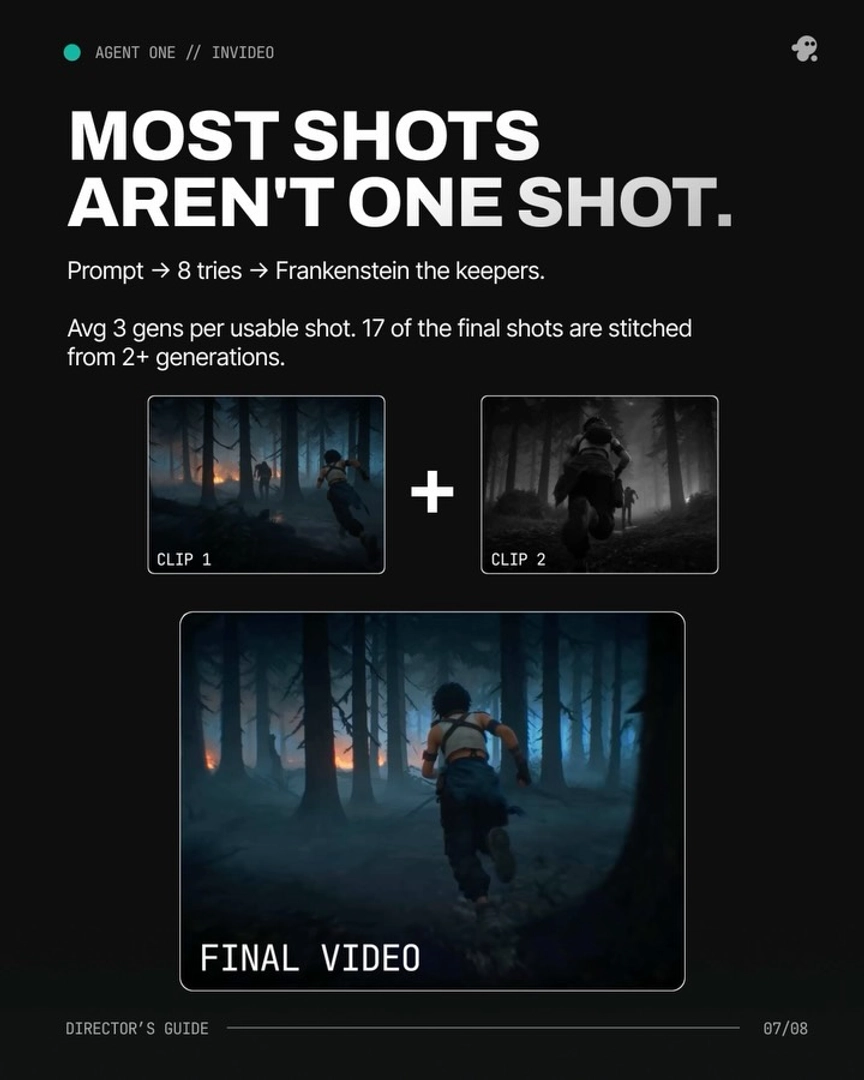
Documented productions using this approach landed at $750 for a 70-second Wong Kar-wai short (3,000 credits, 2 days, 12 key parameters per shot), $870 for a 90-second James Wan horror short (4,100 credits, ~400 video generations), and $950 for a 3-minute Arcane-style episode ($315 per finished minute). Across the four productions with known length and cost, finished-minute cost ran $315–$750 depending on shot complexity and iteration budget.
A copy-paste scaffold to start from:
[SUBJECT + ACTION]. Shot on [LENS, FOCAL LENGTH, APERTURE]. [LIGHTING SOURCE, DIRECTION, QUALITY]. [COLOR GRADE: tonal mode + hex or palette]. [CAMERA MOVEMENT]. [GRAIN/TEXTURE]. In the visual style of [DP NAME or FILM TITLE]. [ASPECT RATIO]. Negative: [what to suppress].
Fill the slots, load it into the invideo agent as your project's style block, and every subsequent shot inherits it without re-prompting.
Watch some of these to see what works for you:
IT ISN'T A LOOK. IT'S A LANGUAGE. Color as diagnosis. Subliminal dollies. Dread before dialogue.
— Hridaye, invideo's creative director