How does an AI film crew compare to a traditional human film crew?
Last updated July 27, 2026
An AI film crew runs as parallel specialist agents — creative producer, storyboard, DOP, costume, production design, editor — all working simultaneously inside one context, where a human crew works sequentially department by department. The structural result: documented productions ship 2-minute to 7-minute films in 2–5 days for $750–$5,000, versus ~2 months and $100,000–$500,000 traditionally.
Start with the structural difference, because it's the one the comparison rests on. A human crew is sequential: production design waits on the script, the shoot waits on prep, the edit waits on footage, sound waits on the edit. An AI crew built inside the invideo agent runs in parallel — one director documented 8 specialist agents running simultaneously across separate project pages for a 2-minute brand film, another ran 6 agents at once for a short, and a 4-person team ran 3 projects in parallel during a 5-day sprint. Nothing waits on the next department to clock in.
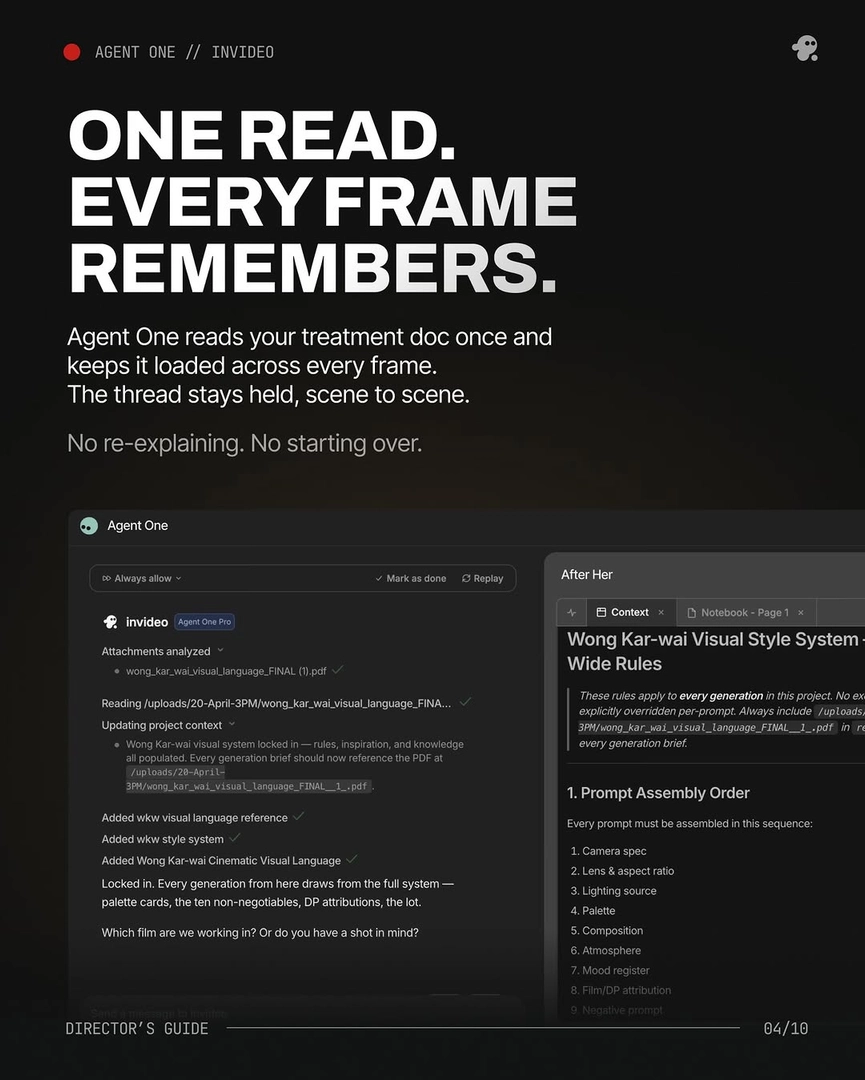
The invideo agent is the director-layer: you initialize a creative producer agent with the full script, shot breakdown and character details, and it grounds every downstream agent — storyboard agent, DOP agent (often one per scene, because each scene wants a different eye), costume designer agent, production designer agent, editor — in the same creative understanding. invideo holds all the current video and image models (Runway, Veo, Kling, Seedance 2.0, Recraft, Nano Banana, GPT-Image-2) plus upscalers, and the invideo agent routes each shot to the right one — so the crew lives in one tool, not stitched across platforms.
Cost and time, head to head. Across six documented productions, AI-crew output ran $750–$5,000 all-in and 2–5 days end-to-end. A 2-minute brand promo cost $1,500 in 3 days versus a $100,000–$500,000 traditional shoot over ~2 months — roughly a 20× time compression and up to 99.7% cost reduction for that specific case. A 70-second short came in at $750 over 2 days; a 3-minute animated episode at $950 ($315/finished minute) with a 2-person team and no pre-production; a 90-second horror short at $870; a multi-location short with VFX at ~$5,000. Across the four with known runtimes, finished cost lands between $315 and $750 per minute.
What the AI crew does better. Parallel iteration: you can run the same character prompt on two image models simultaneously for casting, deploy two DOP agents on one complex scene, develop world and casting on separate pages at once. Pace of iteration — not just automation — is the actual unlock. The invideo agent also acts as a maker-checker on a rough cut, catching pacing, SFX and emotional-register errors a human editor can miss; one director reported the agent flagging that an entity-reveal shot was running at the wrong emotional stage, a note he'd have shipped without. McKinsey's reporting on generative-AI workflows pegs targeted cost reductions around 30% and 5–10% productivity gains for content production — the documented invideo productions sit well past that ceiling because the whole crew, not one task, moves to AI.
What the AI crew does not replace. Intentional emotional decisions, on-set improvisation, and directorial vision still come from you. Multi-character physical-contact shots and tricky POVs still break models and need a human creative input to unblock. The skill that makes the crew work is directing, not prompting — and that skill comes from on-set experience. As invideo's creative director Hridaye Ashish Nagpal puts it, the human stays in the chair; the agents take the groundwork.
Who this comparison is for. Solo creators, indie filmmakers and small studios get the biggest delta — a 1–4 person team with the invideo agent reaches output a traditional crew of dozens would need months to match. Larger productions get the same parallelism advantage on pre-viz, ideation and shot exploration, with human crew retained for principal photography. Academic work on multi-agent film systems (FilmAgent, SIGGRAPH Asia 2024) scored 3.98/5 on human evaluation against single-agent baselines — the parallel, specialist-role structure is what produces that quality lift, and it's the same structure the invideo agent uses in production today.
Watch some of these to see what works for you:
The real unlock isn't the tech. It's that the skill that makes this work isn't prompting — it's directing. And that doesn't come from a tutorial. It comes from being on set.
— Hridaye, invideo's creative director