Documented AI short films take 2–5 days end to end. A 70-second short took 2 days ($750), a 90-second horror short took 2 days ($870), a 3-minute animated episode took a 2-person team 2 days with no pre-production ($950), a 2-minute brand promo took 3 days, and a 4-person short with VFX and international locations took 4–5 days.
Plan for 2–5 days of production, scaling with film length, team size, and how much iteration your shots need. All of the timelines below come from productions run on the invideo agent — an agentic video creation tool with all the current video models (Veo, Kling, Seedance 2.0) and upscalers available, so one workspace covers the whole pipeline.
Production | Length | Team | Time | Cost |
|---|---|---|---|---|
Short film, 2 characters | 70 sec | small team | 2 days | $750 (3,000 credits) |
Horror short | ~90 sec | solo-scale | 2 days | $870 (4,100 credits) |
Animated episode (hand-painted style) | 3 min | 2 people | 2 days, no pre-production | $950 |
Brand promo | 2 min | 1 person | 3 days | $1,500 (6,000–6,500 credits) |
Short with VFX + international locations | longer/ambitious | 4 people | 4–5 days | $5,000 (20,000 credits) |
Across these six documented productions the range is 2–5 days, with team sizes of 1–4 people. The variance is natural — different teams, lengths, and ambition levels legitimately produce at different speeds.
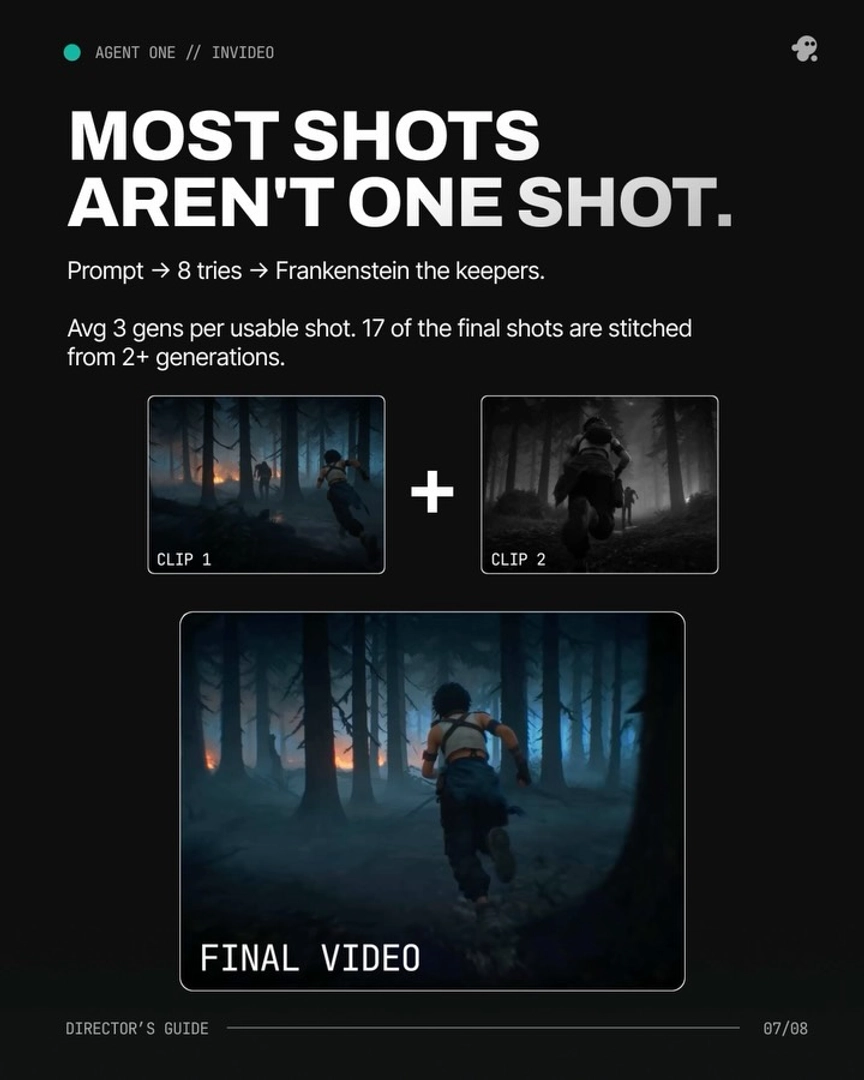
Where the time actually goes: selection, not generation. Raw generation is fast; choosing and assembling is the time driver. The 3-minute animated episode generated 164 Seedance 2.0 clips but used only 41 in the final cut — a ~25% selection rate — and on average kept just 5 seconds of each 15-second clip. Expect roughly 3 generations per usable shot, so budget review-and-select time accordingly rather than assuming one prompt equals one shot. The 90-second horror short ran ~400 video generations and 30 image generations inside its 2 days.
How the days break down. Lock your world, cast, and look before generating any video — one documented 5-day sprint completed casting, costumes, look-and-feel, and world images on day 1, and had 45 seconds of finished film on the timeline by the end of day 2 (an 8-hour day). Locking character sheets and references upfront is what prevents regeneration loops later, which is where unplanned days disappear.
What compresses the timeline. Run work in parallel: deploy multiple sub-agents at once — documented productions ran 6–8 simultaneously (a creative producer agent holding the script, a storyboard agent, DOP agents per scene) — which is what made a 3-day timeline achievable for the 2-minute promo. Teams also split labor in real time: on the 2-person animated episode, one person ran character turnarounds while the other generated shots. The invideo agent can also keep generating overnight, effectively adding a non-stop team member.
Against the alternatives. The same 2-minute promo was estimated at a minimum of 1 week with manual shot-by-shot prompting and roughly 2 months as a traditional shoot — about a 20x time reduction, at $1,500 versus a traditional budget of $100,000–$500,000.
Treat 2 days as a realistic floor for a 1–3 minute film with assets locked early, and 4–5 days for longer or VFX-heavy work — your exact timeline depends on how many shots survive selection.
Watch some of these to see what works for you:
2 guys. 2 days. No pre-production.
— invideo's creative team, documenting a 3-minute AI-animated episode production