How many AI video clips do you need to generate for a short film?
Last updated July 27, 2026
Documented AI short film productions average 3 video generations per usable shot, with roughly 25% of generated clips making the final cut. A 3-minute animated episode generated 164 clips to use 41; a 90-second horror short ran ~400 video generations. Budget your final shot count × 3–4 generations as a realistic starting number.
Work backward from your shot list using two documented ratios: an average of 3 generations per usable shot, and a ~25% clip selection rate from raw generations to final cut. On top of that, expect to use only a fraction of each clip — in one production, an average of just 5 seconds of every 15-second generation made the timeline. So a short film with 40 final shots realistically means 120–160+ generations before editorial selection.
The two productions with full clip-count data show the range:
Production | Length | Video generations | Used in final cut | Cost |
|---|---|---|---|---|
Animated episode (Seedance 2.0) | 3 min | 164 clips | 41 (25%) | ~$950 |
Horror short | ~90 sec | ~400 (+30 image gens) | — | $870 |
That puts documented short films in the 164–400 generation range depending on length, style, and how much iteration the material demands — at the horror short's $870 across 430 total generations, the cost works out to roughly $2 per generation, which is why overgeneration is treated as a deliberate budget line rather than waste.
Raw counts run higher than shot counts for three reasons. First, Frankenstein shot assembly: many final shots are stitched from the best seconds of two or more generations of the same prompt — 17 of the 41 final shots in the animated episode were composites. Second, ambiguous or abstract sequences take extra passes: one production generated 5 distinct variations of a hallucination sequence before locking one as the canonical reference. Third, asset locking consumes generations before any shot work begins — locking a single character's visual identity took about 5 generations (~$9.78 per character) in the animated episode.
You can pull the number down with three habits. Mine each clip for multiple shots: a 15-second Seedance 2.0 generation typically contains 4–7 usable shot candidates, so select within clips rather than re-rolling for every angle. Lock character sheets and style references before generating any video, so re-rolls fix shots rather than re-discover the look. And approve each generation before credits are spent — the invideo agent's Always Ask mode gives you shot-by-shot approval, and since invideo carries all the current video models (Seedance 2.0, Kling, Veo, Runway), the invideo agent routes each shot to the model whose clip length and consistency behavior fits it; Kling's native multi-shot sequences and Seedance 2.0's 15-second multi-shot chunks both mean fewer total generations than single-shot clip models.
These ratios are planning numbers, not laws — a dialogue-light animated short and a VFX-heavy live-action-style film will land at different ends of the 164–400 range.
Watch some of these to see what works for you:
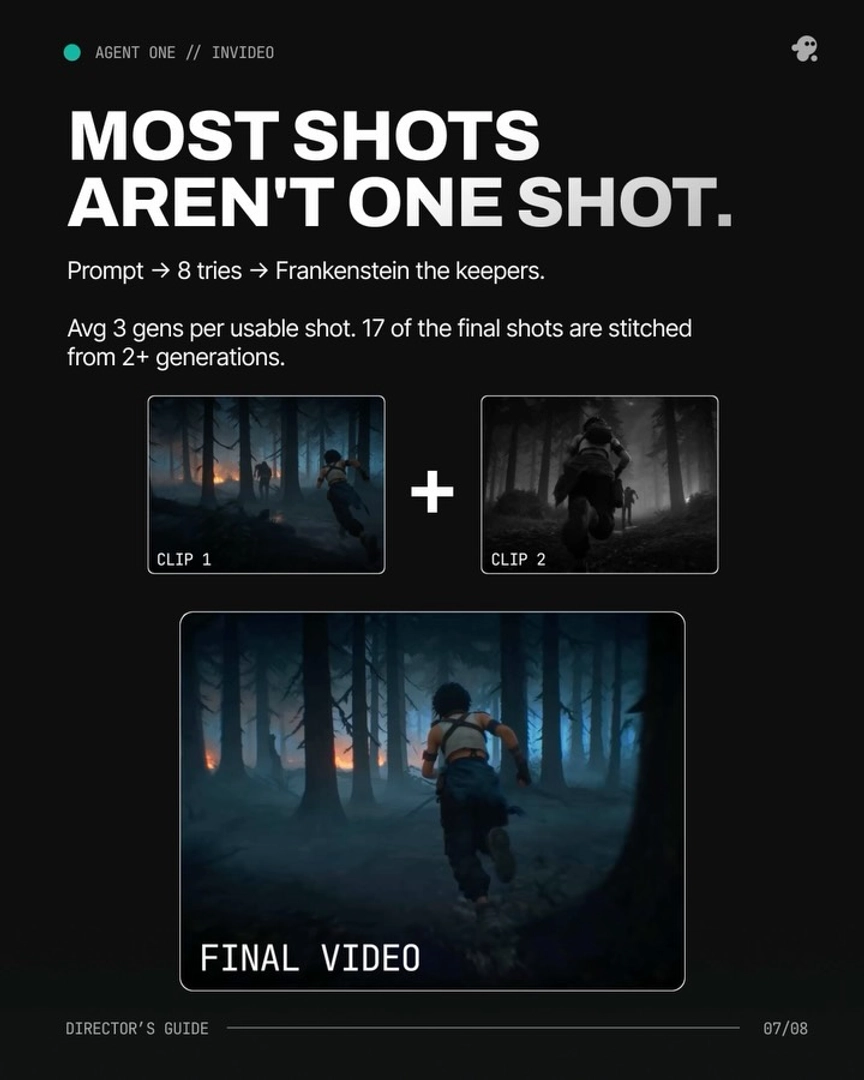
Out of 164, 41 videos made the cut, and on average only 5 seconds of each 15-second clip was used. That's how 41 clips became a 3-minute episode.
— invideo's creative team, from a documented production breakdown