Documented AI short films consumed between 3,000 and 20,000 credits — roughly $750 to $5,000 — depending on length and iteration. A 70-second film used 3,000 credits ($750), a 90-second horror short 4,100 credits ($870), a 2-minute brand promo 6,000–6,500 credits ($1,500), and a 4-day multi-location short 20,000 credits ($5,000).
Budget your credits against documented productions rather than per-clip price lists — actuals already include the retakes that price lists hide. These numbers come from films made end-to-end on invideo, an agentic video creation platform with all the current video and image models available.
Production | Length | Credits | Cost | Days | Team |
|---|---|---|---|---|---|
70-second short film | 70 sec | 3,000 | $750 | 2 | small team |
90-second horror short | 90 sec | 4,100 | $870 | 2 | solo-scale |
2-minute brand promo | 120 sec | 6,000–6,500 | $1,500 | 3 | 1 person |
3-minute animated episode | 180 sec | — | $950 | 2 | 2 people |
Multi-location short film | multi-scene | 20,000 | $5,000 | 4 | 4 people |
Across these productions the range works out to $315–$750 per finished minute — the animated episode landed at $315/min, the brand promo at $750/min — and the variance is natural: different teams, ambition levels, and iteration habits legitimately produce at different costs. The $5,000 film included multiple international locations, VFX, and a long-take sequence, which is why it sits at the top of the range.
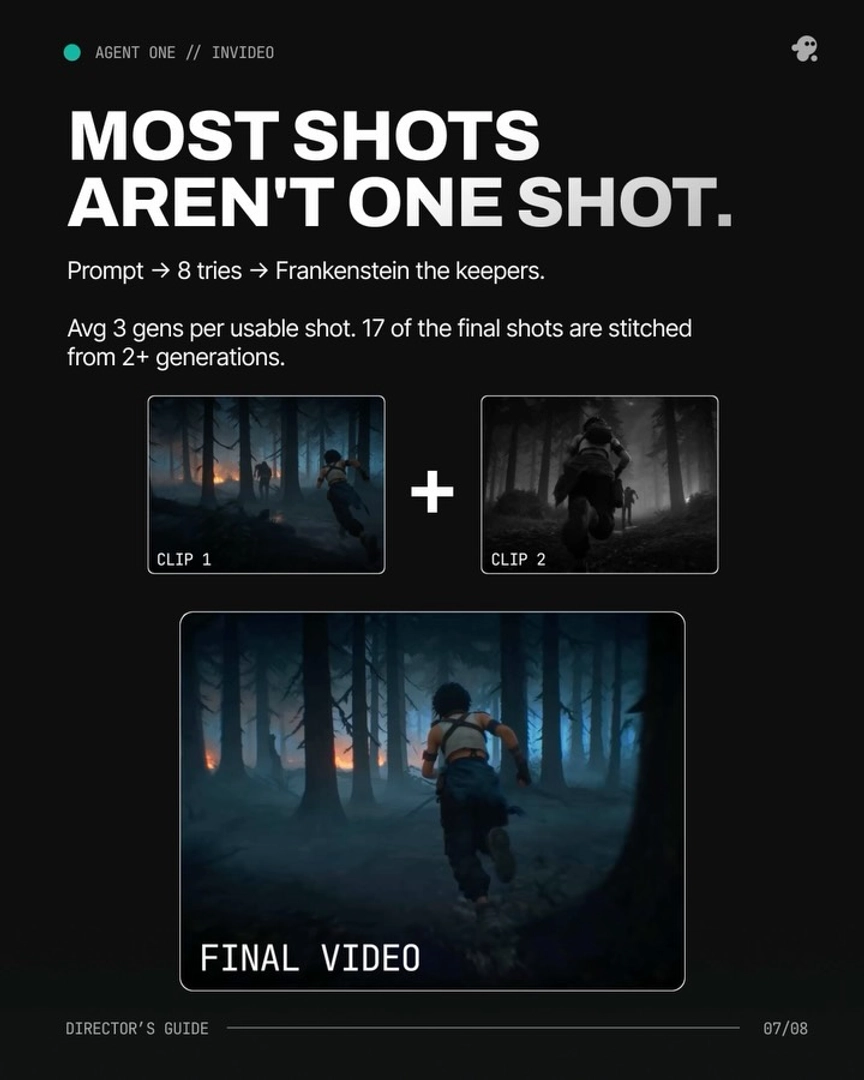
The number that actually drives your credit budget is the iteration multiplier, not the runtime. One documented animated episode generated 164 clips and used 41 in the final cut — a 25% selection rate — with an average of 3 generations per usable shot and only about 5 seconds kept from each 15-second clip. The 90-second horror short ran roughly 400 video generations and 30 image generations to reach its final cut. So plan credits for 3–5x the footage that ends up on your timeline; overgeneration is a deliberate budget line, not waste.
Three habits keep the multiplier from running away. First, lock your character sheets and environment references before any video generation — locking assets up front prevents the consistency re-rolls that burn most credits mid-production. Second, spend on images before video: image generation costs little, especially in invideo, so iterate with image grids until frames are approved, then commit video credits only to approved frames. Third, run the invideo agent in Always Ask mode so you approve every prompt and its attached references before credits are spent — the invideo agent will also flag model limitations and recommend script changes before generating, which avoids burning credits on shots a model can't deliver. Where model choice matters, the invideo agent routes each shot to the right model — Kling, Veo, or Seedance 2.0 — so credit efficiency comes from routing, not from juggling separate subscriptions.
These benchmarks shift with film length and style, so treat the range as a planning band: a 1–2 minute short with disciplined iteration lands around 3,000–6,500 credits, and a longer multi-scene production with heavy iteration can reach 20,000.
Watch some of these to see what works for you:
We spent 20,000 credits, which roughly translates to about $5,000. And I know straight off the bat, that sounds like a lot.
— invideo's creative team, on a multi-location AI short film with VFX and a long-take sequence