How many AI video generations does it take to produce a 3-minute episode?
Last updated July 27, 2026
One documented 3-minute AI animated episode took 164 video generations, of which 41 made the final cut — a ~25% selection rate, averaging 3 generations per usable shot. Editors kept only ~5 seconds of each 15-second clip. For comparison, a ~90-second short ran ~400 generations, so plan a range, not one number.
Budget roughly 3 generations per usable shot — that ratio held across a fully documented 3-minute animated episode produced by a 2-person team in 2 days: 164 Seedance 2.0 clips generated, 41 in the final cut. invideo is an agentic video creation tool with all the current video models — Seedance 2.0, Kling, Veo — available, and the production ran entirely through the invideo agent.
The math works differently than a simple clips-to-runtime calculation. Each generation was a 15-second clip, but on average only 5 seconds of each kept clip reached the timeline — each 15-second generation contains 4–7 usable shot candidates, and you select the best moment rather than treating each generation as one shot. That is how 41 clips became 3 minutes of finished film. The ~25% selection rate is not waste: only a quarter of generated clips being editorially usable makes overgeneration a deliberate budget line you plan for upfront.
A significant share of finished shots will be composites, not single generations. In that episode, 17 of the 41 final shots — over 40% — were Frankenstein shots: the strongest seconds from 2 or more generations of the same prompt stitched into one shot. Counting on single-take perfection underestimates your generation budget; counting on stitching keeps the 3:1 ratio realistic.
Generation count scales with shot complexity, not just runtime. A ~90-second AI horror short required ~400 video generations plus 30 image generations — more than double the 3-minute episode's total at half the length — because its shot design demanded heavier iteration. So treat the documented range as 164 generations for a straightforward 3-minute episode up to several hundred when sequences are dense or abstract; one production needed 5 distinct variations just to lock the reference for a single hallucination sequence, and 5 generations to lock each character's visual identity (~$9.78 per character) before shot production began.
In dollars, the 3-minute episode's 164 generations landed at ~$950 all-in — about $315 per finished minute — while the 400-generation 90-second short cost $870 (4,100 credits). Across documented productions, finished AI film content ran $315–$750 per minute depending on team and approach.
Two levers keep the count near the low end. First, run the invideo agent in Always Ask mode so you approve every prompt and attached reference before credits are spent — shot-by-shot approval control instead of blind batch generation. Second, lock your visual style and character references in the invideo agent's context once before generating video (the episode ingested 64 style frames in a single message), so generations fail on motion or staging, not on style drift you then have to re-roll.
Watch some of these to see what works for you:
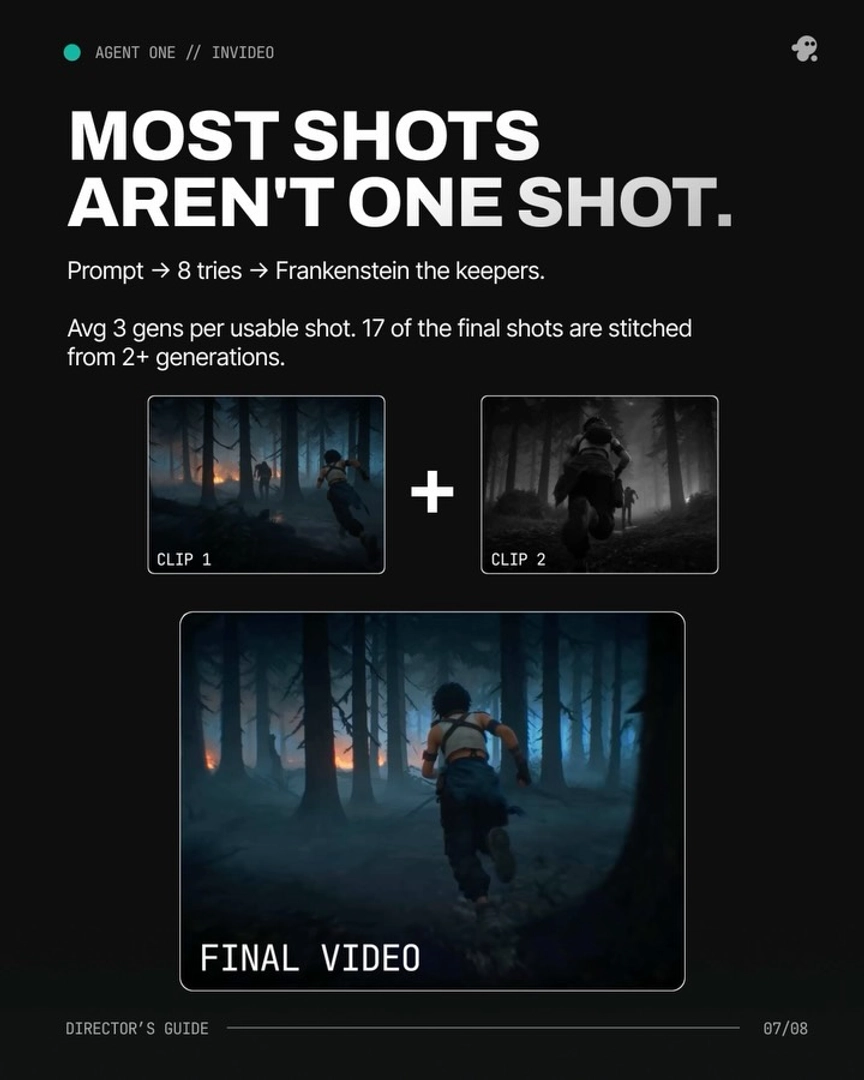
Out of 164, 41 videos made the cut, and on average only 5 seconds of each 15-second clip was used. That's how 41 clips became a 3-minute episode.
— invideo's creative team