How many reference images do you need to lock a consistent style in AI video generation?
Last updated July 27, 2026
You need 3–5 multi-angle images to lock a single character and up to 64 frames to lock a whole project's visual style. Documented productions ran one 4-angle character sheet per character — 11 images covered four characters and a prop — and a 64-frame batch saved to agent context locked an entire episode's aesthetic.
The count depends on what you're locking: a character needs one multi-angle sheet, a project-wide style needs a broader sample of the aesthetic, and in both cases persistence — keeping the references loaded across every generation — matters more than the raw number. invideo is an agentic video creation tool with all the current video models (Veo, Kling, Seedance 2.0) available, and the style lock comes from the invideo agent's persistent context rather than from re-attaching images to every prompt.
Project-wide style: one large batch saved to context. One documented production uploaded 64 frames from its target aesthetic in a single message with this exact instruction: "I want you to deeply understand this art style and save it into context for further generations. All of these attached images are the art style that I want for this entire project." The invideo agent distilled that batch into a style block, and every subsequent generation prompt opened with it — including explicit negative constraints ("not live action, not photorealistic") to prevent drift. That single ingestion held the look across 164 generated clips, and a 2-person team finished the 3-minute episode in 2 days for ~$950.
Per-character lock: one multi-angle sheet, roughly 5 generation rounds. Generate a turnaround character sheet with 4 angles plus face and mid-angle close-ups at high resolution — close-up panels matter because small details like scars and accessories drift first across models. Across one production, 11 images total covered four characters and one prop, at roughly 5 generation rounds per character (~$9.78 each in that production). Another production generated 4 options per asset — character sheets and environment references — picked the best of each, and locked them all before any video generation began.
Why count alone doesn't lock anything. Every AI video clip is generated independently, so style drift is structural — references only compensate if they're present at every generation. Per-generation reference slots are also capped: Veo accepts up to 3 reference images per shot, while Seedance 2.0's reference-to-video takes up to 9, assignable across character, environment, and style functions. Saving references into the invideo agent's context sidesteps the cap, because the invideo agent attaches the right references to each shot automatically — one 70-second film kept 2 characters visually identical across every scene this way for $750 total, with no LoRA fine-tuning. LoRA remains the heavy-duty alternative at 30–50 training images, but documented short-film productions never needed it.
Beyond the count itself: how you prepare and feed references — angle coverage, clean consistent backgrounds, batching by theme with explicit take-and-leave instructions — is its own workflow, as is encoding a style in a written director's visual-language document instead of images.
Watch some of these to see what works for you:
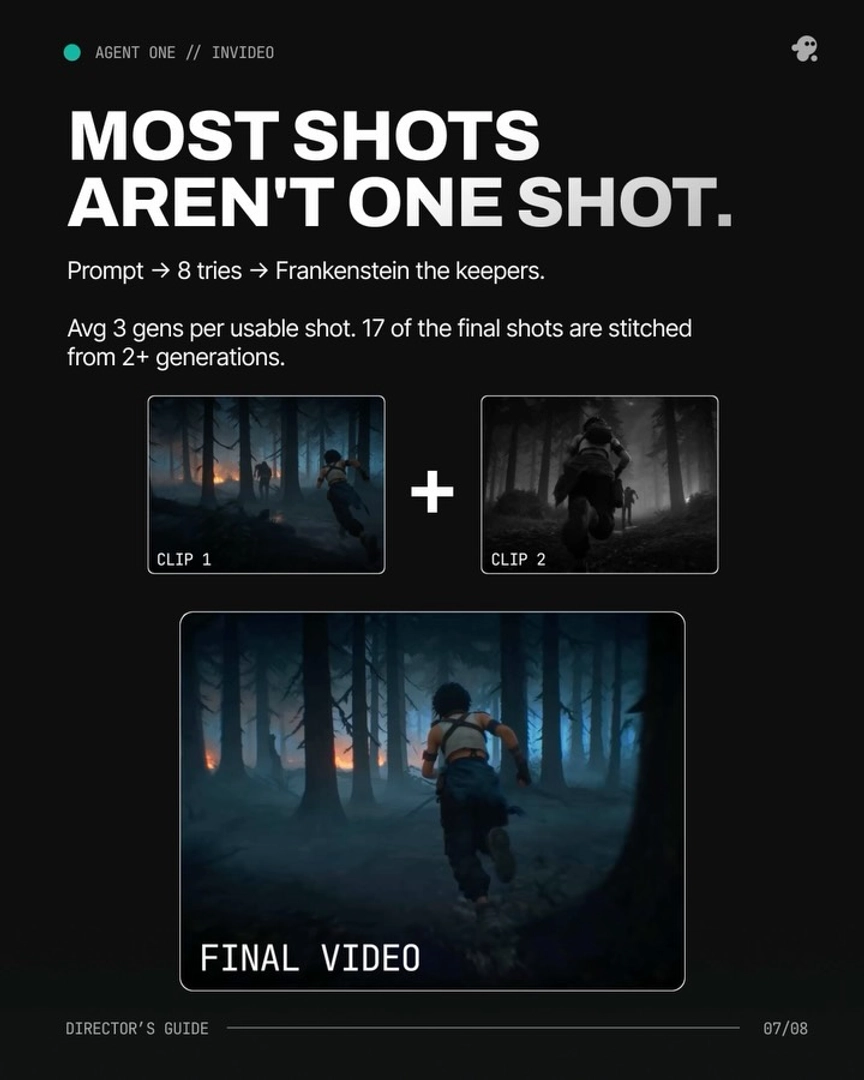
I want you to deeply understand this art style and save it into context for further generations. All of these attached images are the art style that I want for this entire project.
— invideo's creative team, exact style-ingestion prompt from a documented production