How much cheaper and faster is using an AI agent for video production compared to manual prompting?
Last updated July 27, 2026
An AI agent workflow runs roughly 2–3x faster than manual prompting on the same project — one documented 2-minute brand film took 3 days through the invideo agent versus an estimated week-plus of manual prompting — and it cuts cost per usable shot because persistent context reduces wasted generations: documented productions averaged 3 generations per usable shot and $315–$750 per finished minute.
The documented head-to-head. The clearest apples-to-apples comparison comes from a 2-minute brand promo: one director, working alone, finished it in 3 days through the invideo agent and estimated the same project would have taken at least a week with manual prompting — and roughly 2 months as a traditional shoot, at $100,000–$500,000 versus the $1,500 (6,000–6,500 credits) it actually cost. invideo is an agentic video creation tool with all the current video models — Veo, Kling, Seedance 2.0 — available in one place, so the invideo agent routes each shot to the right model instead of you managing that choice prompt by prompt. Another creator pegs the overall pipeline gain at 5x faster once groundwork like storyboarding and reference management is delegated to agents.
Where the speed comes from: parallelism and persistence. Manual prompting is sequential — write a prompt, wait, review, rewrite. An agent workflow runs as a crew: initialize a creative producer agent with the script and shot breakdown, then deploy DOP agents, a casting agent, and a storyboard agent simultaneously. Documented productions ran 6–8 agents in parallel, and the brand promo's 3-day timeline was achievable specifically because multiple agents worked different sections of the shot breakdown at once. Agents also continue generating autonomously overnight, which manual prompting cannot do by definition.
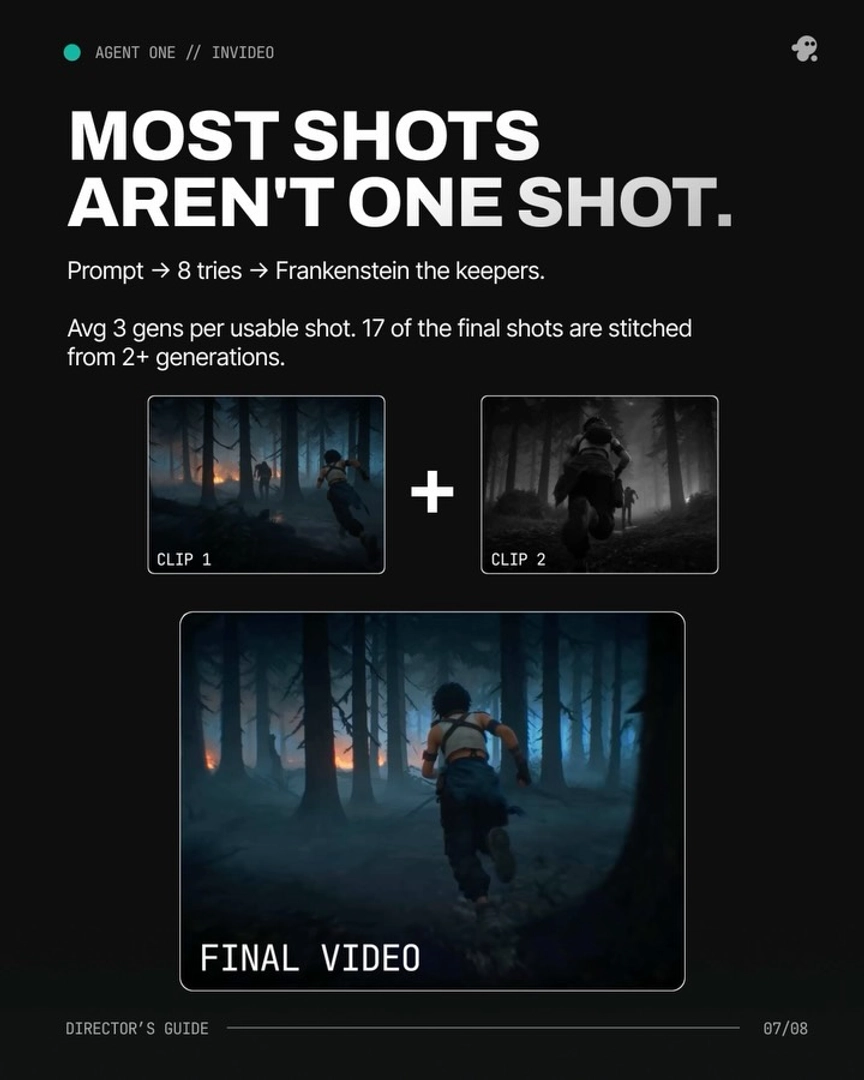
Fewer wasted generations. Because the invideo agent holds style, character, and scene context across the whole project, you stop re-establishing everything in every prompt — the main source of drift and re-rolls in manual workflows. In one documented case, a complex top-down shot that manual prompting had failed to produce was achieved on the first generation attempt after switching to the agent-directed workflow. Production data shows an average of 3 generations per usable shot, and a 25% clip selection rate treated as a planned budget line rather than waste; locking one character's visual identity took about 5 generations, roughly $9.78 per character. Always Ask mode adds a cost control manual prompting lacks: you approve each prompt and its attached references before any credits are spent.
The cost picture across productions. Documented agent-directed films ran $750–$5,000 all-in depending on length, team, and ambition — a 70-second short at $750, a 90-second horror short at $870 (about 400 video generations and 30 image generations over 2 days), a 3-minute animated episode at $950 by a 2-person team in 2 days, the 2-minute promo at $1,500, and a multi-location short with VFX at $5,000. Normalized, that is $315–$750 per finished minute — variance that reflects team size and approach, not the tool.
Where manual control still wins. For minor variations on an existing shot — a close-up crop of an approved wide, for example — taking manual control of the image prompter and making the change directly is faster than delegating, as long as you log the result back to the invideo agent so its shot breakdown stays accurate. The agent advantage is at the production level, not every individual edit.
Watch some of these to see what works for you:
If I had to do this manually and actually prompt, I would be mentally wrecked. This did not feel much different than just being on set.
— invideo's creative team