How much cheaper is AI video production compared to traditional filmmaking?
Last updated July 27, 2026
Documented AI productions run $315–$750 per finished minute — against six-figure traditional budgets, that's a reduction of up to 99.7%. One 2-minute AI brand film cost $1,500 and 3 days; the same ad shot traditionally would cost $100,000–$500,000 and take roughly 2 months — about 20x longer.
Use cost per finished minute as your comparison unit — it normalizes productions of different lengths and is the number you can actually plan against. Across documented AI productions made with the invideo agent (invideo is an agentic video creation tool with all the current video models — Veo, Kling, Seedance 2.0 — available in one place), the actuals look like this:
Production | Length | Total cost | Cost per finished minute | Days | Team |
|---|---|---|---|---|---|
Animated episode, hand-painted style | 3 min | $950 | $315 | 2 | 2 people |
Horror short | ~90 sec | $870 (4,100 credits) | ~$580 | 2 | — |
Cinematic short film | 70 sec | $750 (3,000 credits) | ~$643 | 2 | — |
Brand film / commercial promo | 2 min | $1,500 (6,000–6,500 credits) | $750 | 3 | 1 person |
Short film with international locations and VFX | — | $5,000 (20,000 credits) | — | 4–5 | 4 people |
The range is $315–$750 per finished minute depending on team, style, and ambition — that variance is natural, not noise. Set the traditional side against it: the documented brand film is the cleanest like-for-like, because its director priced both paths — $1,500 via AI agents in 3 days, versus $100,000–$500,000 and roughly 2 months for a traditional shoot of the same ad. That is a cost reduction of up to 99.7% and a time compression of about 20x. Even the most expensive documented AI production — $5,000 for a short featuring multiple international locations, VFX, and a long-take sequence — buys things a traditional budget at 100x that figure would struggle to cover.
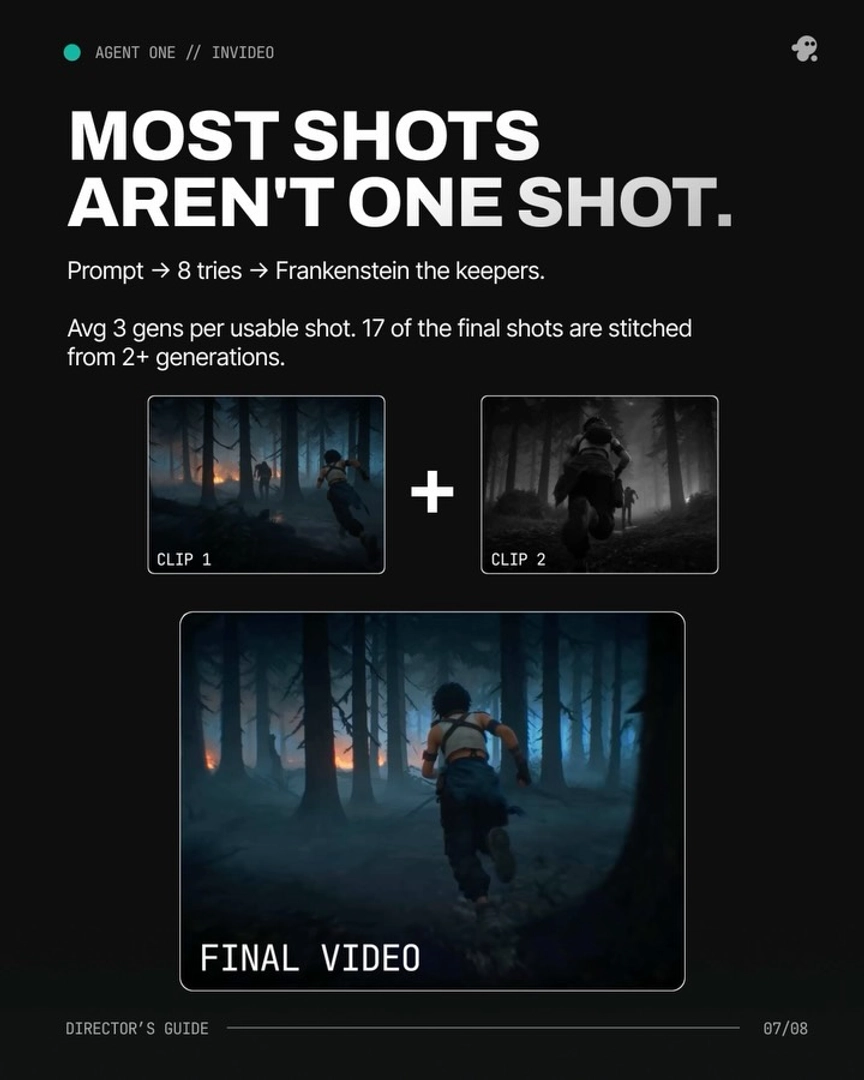
Three structural drivers create the gap. Team compression: documented productions ran with 1–4 people; crew roles become sub-agents you spin up inside the invideo agent — a creative producer agent holding the script, DOP agents per scene, a costume designer agent — with 6–8 agents running simultaneously in the larger productions. Timeline compression: 2–5 days across six documented productions, with no pre-production phase in the fastest case (2 people, 2 days, zero pre-production for the 3-minute episode). Iteration economics replace reshoot economics: regenerating a shot costs credits, not a crew day, so overgeneration becomes a deliberate budget line. The 3-minute episode generated 164 clips to keep 41 — a ~25% selection rate — averaging 3 generations per usable shot and ~$9.78 to lock one character's look across the film. Budget for that yield rate up front and the totals above still hold.
One honest caveat: the money doesn't disappear, some of it converts into iteration time. A 25% clip selection rate means most of what you generate gets cut, and the documented productions describe multi-day sprints of continuous generation and review. The savings are real and enormous, but plan your credit budget around overgeneration rather than assuming one generation per shot.
Watch some of these to see what works for you:
That comes to around about $1,500, which if you really think about it, is not that much in comparison to what you would spend if you had to make this in the traditional shooting way — because an ad like this would cost you anywhere from $100,000 to $500,000.
— a director with 15 years of professional ad-film and TV directing experience, documenting an invideo production