How much does it cost to produce one minute of AI-generated video in 2025?
Last updated July 27, 2026
Documented AI productions in 2025 ran $315–$750 per finished minute, all-in. A 3-minute animated episode cost ~$950 ($315/min) with a 2-person team in 2 days; a 2-minute brand promo cost ~$1,500 ($750/min). The same brand film shot traditionally would have cost $100,000–$500,000.
Budget $315–$750 per finished minute for AI-generated video in 2025 — that range comes from documented productions with known length and cost, and where you land inside it depends on style complexity, iteration rate, and runtime. All of these productions ran on invideo, an agentic video creation platform where the invideo agent routes each shot to video models like Veo, Kling, and Seedance 2.0, so the figures below are all-in costs covering image generation, video generation, and iteration on one platform.
Documented per-minute costs across five productions:
Production | Length | Total cost | Cost per finished minute | Days | Team |
|---|---|---|---|---|---|
Animated episode (hand-painted Arcane-style, Seedance 2.0) | 3 min | ~$950 | $315 | 2 | 2 |
Horror short (James Wan directorial style) | 90 sec | $870 (4,100 credits) | ~$580 | 2 | — |
Stylized short (Wong Kar-wai visual style) | 70 sec | $750 (3,000 credits) | ~$643 | 2 | — |
Brand promo / commercial | 2 min | ~$1,500 (6,000–6,500 credits) | $750 | 3 | 1 |
Multi-location short with VFX and a long-take sequence | — | ~$5,000 (20,000 credits) | — | 4–5 | 4 |
Takeaway: across the four productions with known length, finished-minute cost ranged $315–$750. Longer runtimes amortize fixed setup costs — the 3-minute episode is the cheapest per minute, while the polished 2-minute commercial sits at the top of the range. Credits converted to roughly $0.25 each across these projects (3,000 credits ≈ $750; 20,000 credits ≈ $5,000).
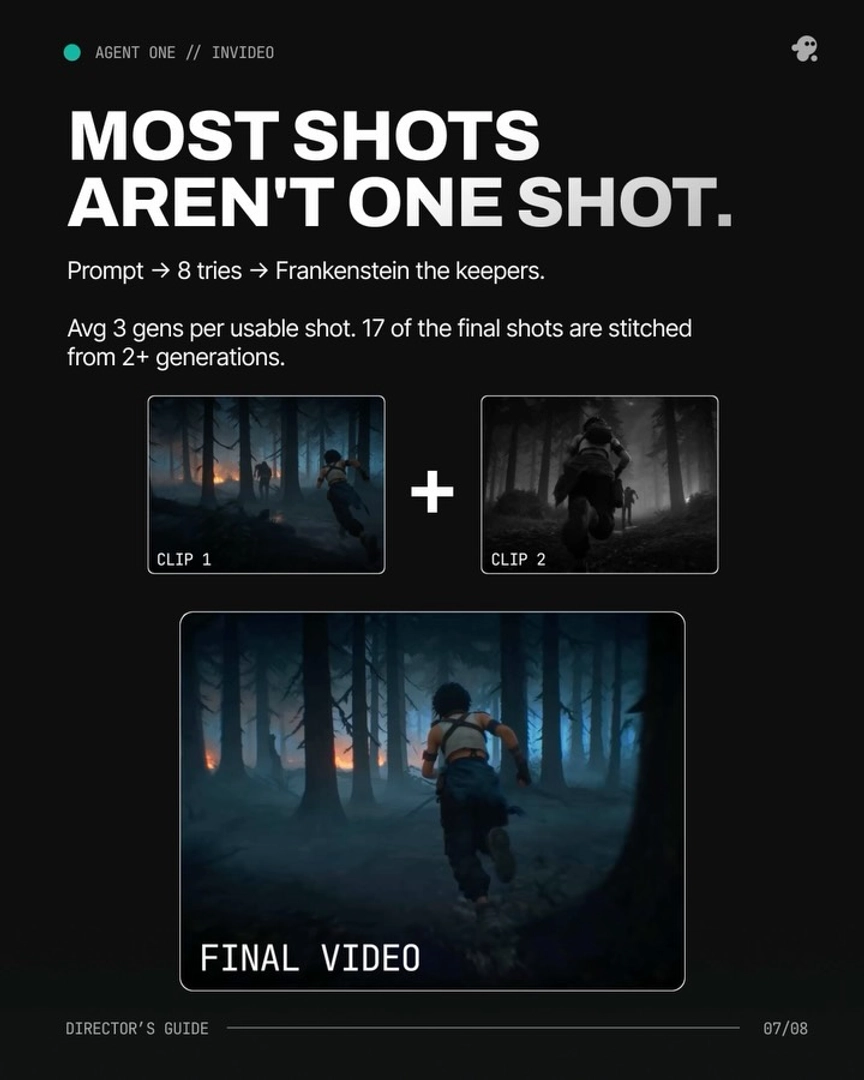
Raw generation cost is not finished-minute cost. The number that matters for budgeting is what a usable minute costs after editorial selection, because overgeneration is a deliberate budget line, not waste. The animated episode generated 164 clips and used 41 — a 25% selection rate — with an average of only 5 seconds kept from each 15-second clip. Plan on roughly 3 generations per usable shot, and expect compositing: 17 of that episode's final shots were stitched together from 2 or more generations. Asset locking has its own measurable cost — about 5 generations (~$9.78) to lock one character's visual identity before any video generation begins. The horror short followed the same pattern at a different scale: ~400 video generations and 30 image generations to produce 90 finished seconds.
Against traditional production, the gap is two to three orders of magnitude. The 2-minute brand promo cost ~$1,500 and took 3 days with one person running 8 parallel sub-agents; the director estimated a traditional shoot of the same ad at $100,000–$500,000 over roughly 2 months — up to a 99.7% cost reduction and a ~20x time reduction. Even the most expensive documented project, the $5,000 short with international locations and VFX, comes in far below the entry price of a single day of conventional production.
To control your own per-minute cost: lock characters and world references before generating video (consistency errors are the main source of wasted generations), generate image grids rather than single frames during pre-production since image generation costs little — especially in invideo — and use the invideo agent's Always Ask mode so you approve each prompt and its attached references before credits are spent. Budget for a 25% clip selection rate rather than assuming every generation ships.
Watch some of these to see what works for you:
That comes to around about $1,500, which if you really think about it, is not that much in comparison to what you would spend if you had to make this in the traditional shooting way — because an ad like this would cost you anywhere from $100,000 to $500,000.
— a director with 15 years of professional ad-film and TV directing experience, on producing a 2-minute brand film with the invideo agent