How much faster is AI video production than traditional film production?
Last updated July 27, 2026
Documented AI productions run roughly 20x faster than traditional film production: a 2-minute brand film finished in 3 days on the invideo agent versus an estimated 2 months for a traditional shoot. Across six documented productions, complete films — 70 seconds to 7 minutes long — finished in 2 to 5 days, several with zero pre-production.
The clearest documented comparison is a 2-minute brand promo: 3 days with AI agents, versus an estimated 1 week with manual prompt-by-prompt generation and roughly 2 months with a traditional shoot — about 20x faster than the shoot and more than twice as fast as manual prompting. invideo is an agentic video creation tool with all the current video models (Seedance 2.0, Kling, Veo) available, and the timelines below come from productions made on it.
Documented AI production timelines
Production | Finished length | Team | AI timeline | Traditional equivalent |
|---|---|---|---|---|
Brand film / commercial promo | 2 min | 1 person | 3 days | ~2 months (est.) |
Hand-painted-style animated episode | 3 min | 2 people | 2 days, no pre-production | — |
Horror short (director-style protocol) | ~90 sec | — | 2 days | — |
Drama short (director-style protocol) | 70 sec | — | 2 days | — |
Multi-location VFX short | — | 4 people | 4–5 days | — |
The pattern across these: 2–5 days from zero to finished cut, with team sizes of 1–4 people. One creator working act-by-act on a 7-minute animated short put the pipeline speedup at 5x even without the parallel-agent setup.
Where the time compression comes from. Pre-production collapses first: in one 5-day sprint, a 3-person team locked cast, costumes, look and feel, and world images in a single day — work that traditionally spans weeks of casting, wardrobe, and location scouting. Production then parallelizes: documented setups ran 6–8 specialist agents simultaneously — a creative producer agent holding the script, separate DOP agents per scene, a storyboard agent visualizing shots first — which is what makes a 3-day timeline achievable for a 2-minute film. The invideo agent also keeps working overnight as a non-stop additional team member, and geographic distribution stops mattering: one 3-person team across multiple cities collaborated in real time through the same agent interface. Finally, revision cycles compress — a fix is a regeneration or a chat instruction, not a reshoot.
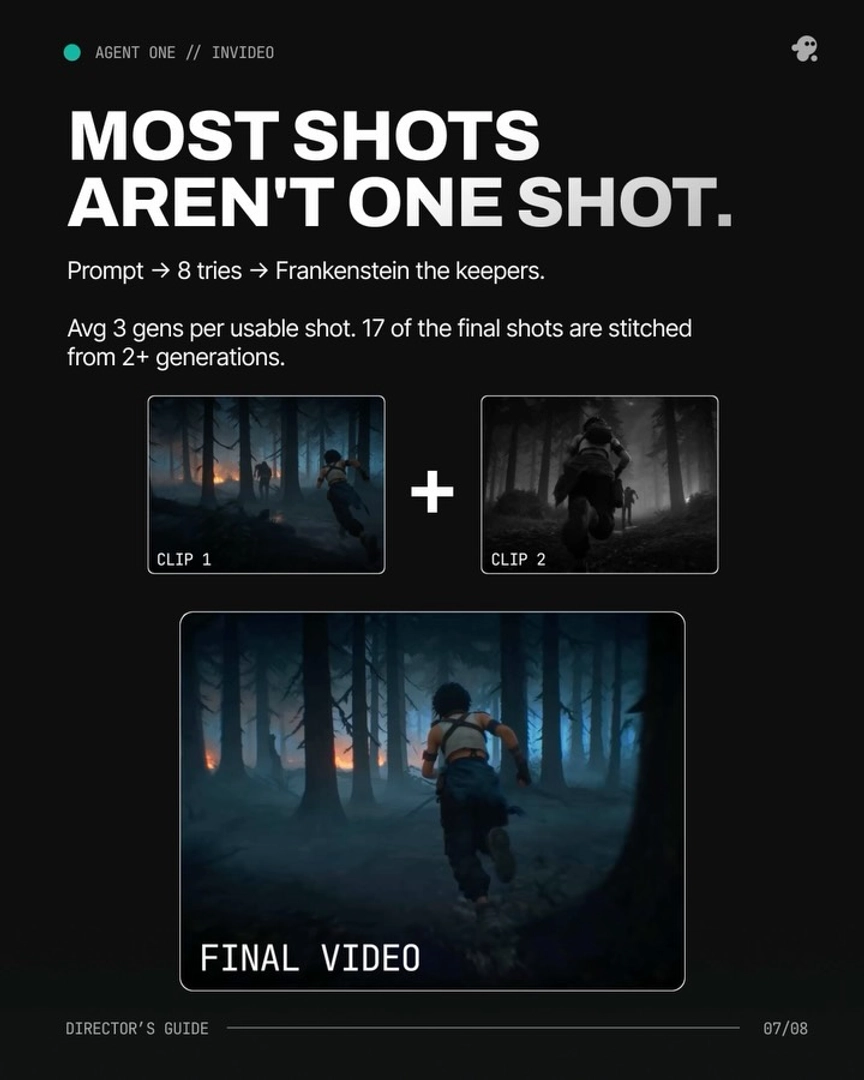
The honest caveat: speed still includes heavy iteration. AI's timeline advantage comes with overgeneration built in. One 3-minute animated episode required 164 generated clips, of which 41 made the final cut — a 25% selection rate — with an average of 3 generations per usable shot and only ~5 seconds used from each 15-second clip. Another team logged 45 seconds of finished film on their timeline by the end of day 2 of a 5-day sprint. The days are short, but they are dense: you generate several times more footage than you keep.
Beyond the timeline itself: cost compresses on the same curve. Documented productions ran $750–$5,000 all-in depending on team and approach, while the 2-minute brand film's traditional equivalent was estimated at $100,000–$500,000 — up to 99.7% lower, alongside the 20x time reduction.
Watch some of these to see what works for you:
That comes to around about $1,500, which if you really think about it, is not that much in comparison to what you would spend if you had to make this in the traditional shooting way — because an ad like this would cost you anywhere from $100,000 to $500,000.
— a director with 15 years of professional ad-film and TV directing experience, on a 3-day AI brand-film production