Is AI storyboarding replacing traditional storyboards in film and video production?
Last updated July 27, 2026
No — storyboarding as a planning discipline is not being replaced, but the one-panel-per-shot workflow is. Multi-shot AI video models now generate 15-second sequences from a single storyboard frame, so productions board fewer frames, generate those frames as image grids instead of hand drawings, and keep the shot-sequencing discipline fully intact.
Treat the change as two separate questions: who draws the frames, and how many frames you need. AI has clearly taken over the drawing step — frames are generated from the script rather than sketched. The deeper shift is the frame count: earlier first-frame/last-frame AI video workflows assumed one boarded frame per shot, but multi-shot generation breaks that assumption. A single 15-second Seedance 2.0 clip typically contains 4–7 usable shot candidates, so one storyboard frame now covers what previously required several panels — which saves both time and generation credits.
In practice, the boarding step itself is now run as a generation workflow. invideo is an agentic video creation tool with all the current video and image models available, so you can set up a dedicated storyboard agent: load it with your script and have it visualize each shot before you direct anything, giving every downstream decision a visual brief. Instead of single panels, request image grids — one documented workflow asked for 3 grid options per round, iterated on the preferred grids, then extracted the best individual panels. Those extracted panels do double duty: they are your storyboard, and they become continuity anchors fed directly into video generation — a job a hand-drawn panel could never perform.
The planning discipline survives in a frames-first order: generate and approve static frames before any video generation begins, exactly as a board lock preceded a shoot. For ambiguous sequences, the board even improves — in one production, an abstract hallucination scene was visualized as 5 distinct interpretations before one was selected as the canonical reference, replacing a single artist's guess with directed options.
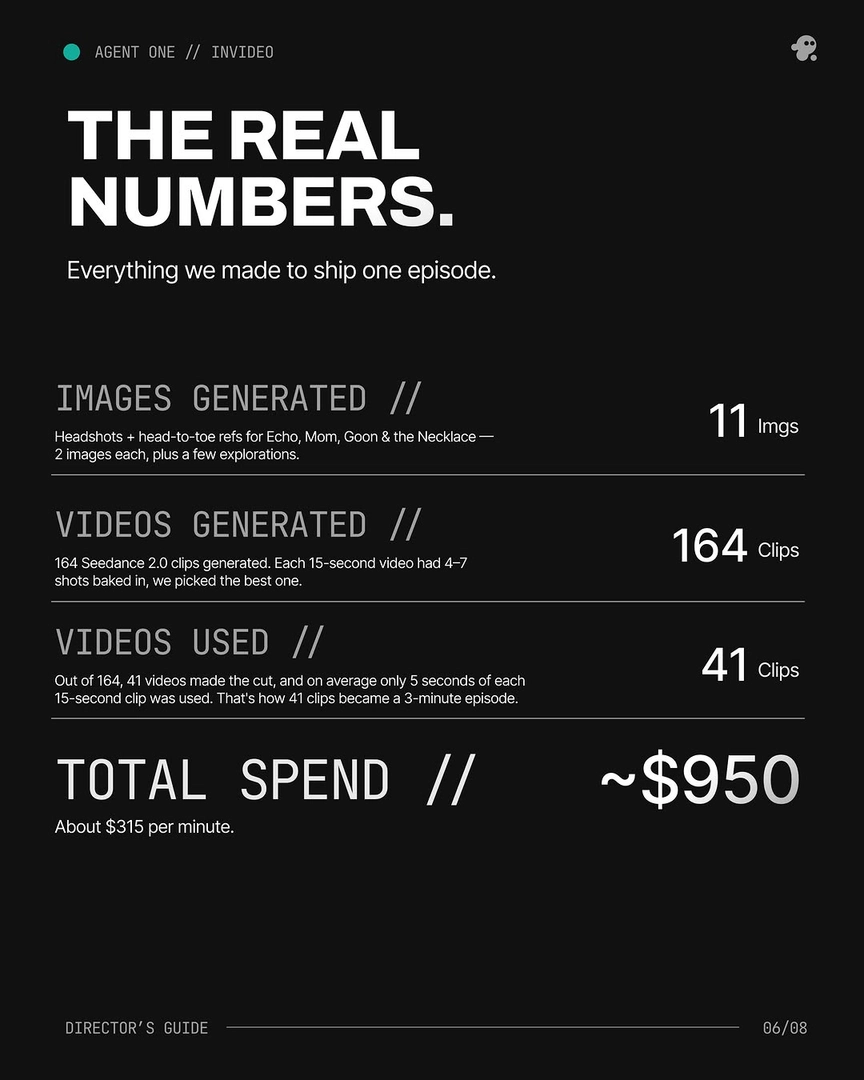
Where traditional storyboards still hold: client and agency work. A formal storyboard lock remains necessary when an external client needs to approve the film before production — but for internal AI-driven production it can be bypassed entirely. One documented production proves the point: a 2-person team produced a 3-minute animated episode in 2 days with no pre-production at all, for roughly $950 — the boarding, generation, and selection happened inside one continuous workflow. Another team of 3 people working with the invideo agent locked cast, costumes, look and feel, and world images in a single day, compressing what storyboard-driven pre-production traditionally spreads across weeks.
So the honest verdict: AI hasn't removed the storyboard's function — sequencing shots and agreeing on the film before spending money — it has removed the storyboard's form. Board fewer frames, generate them as grids, approve them before video, and keep a traditional locked board only when an external client requires one.
Watch some of these to see what works for you:
Rather than generating one, one, one, one, one images to generate grids. Image generation doesn't cost much, especially in invideo. Use that to your advantage.
— invideo's creative team