LoRA fine-tuning vs character sheets: which is better for consistent AI characters?
Last updated July 27, 2026
For most AI video production, character sheets win: a documented 70-second film kept two characters identical across every scene using multi-angle sheets held in the invideo agent's context — no LoRA, $750 total. LoRA fine-tuning still wins for a flagship character recurring across dozens of appearances in one locked style, at the cost of training time and GPU compute.
Character sheets — multi-angle reference grids attached to every generation through persistent agent context — deliver film-grade character consistency with zero training, while a LoRA trades a training run and GPU compute for the tightest possible lock on one character in one style. invideo is an agentic video creation tool with all the current generation models available, and its agent holds character sheets in project context so they ride along on every shot automatically.
The trade-off is setup cost vs. lock tightness, not right vs. wrong. A LoRA needs a curated training dataset, a training run (community guides cite 2–4 hours of setup), GPU access, and the weights are model-specific — when the underlying model updates, you retrain. Character sheets are generation-time inputs: one documented production locked each character's visual identity in about 5 generations at ~$9.78 per character; another covered 4 characters and 1 prop in 11 total images. The sheet itself is a 360-degree turnaround with close-up panels, generated in a few options and locked before video begins — but building one well is its own topic; for the comparison, what matters is that a sheet costs minutes and dollars where a LoRA costs hours and compute.
Video is where sheets pull ahead of LoRA. Most LoRA-vs-alternatives coverage is image- and comics-focused; in video, sheets plug directly into the models' native reference inputs — Seedance 2.0 reference-to-video accepts character and location references simultaneously, and Kling generates multi-shot sequences natively. A LoRA binds you to one trainable model; sheets travel across all of them. The invideo agent routes each shot to the right model and attaches the locked sheets from context every time, so you direct shots instead of re-uploading references. A 3-minute animated episode produced this way kept its cast consistent across 164 generated clips for $950 total — and held character against style bleed (the model bending faces toward the art style) by pairing the sheets with a locked style block prefixed to every prompt.
Sheets are repairable mid-production; LoRAs are not. When a continuity error appears in a shot, ask the invideo agent to inspect the character sheet — in one documented case it identified the exact panel containing the error, corrected it there, and stored the updated sheet so every subsequent shot inherited the fix while the rest of the film stayed intact. The LoRA equivalent of that fix is a retrain. Sheets also handle evolving characters: create a separate sheet per narrative beat — one production made a new sheet for each sequence because the character picked up a new trinket in every city — something a single trained LoRA can't represent.
When LoRA is the right call: a flagship character appearing across 50+ shots or episodes in a single, unchanging visual style, where you control the training pipeline and the model version won't churn under you. For that case the per-shot identity lock is tighter than any reference method. For everything else — multi-model video work, characters whose look evolves, tight timelines, mid-production fixes — character sheets in persistent agent context get you the same screen result without the training overhead.
Watch some of these to see what works for you:
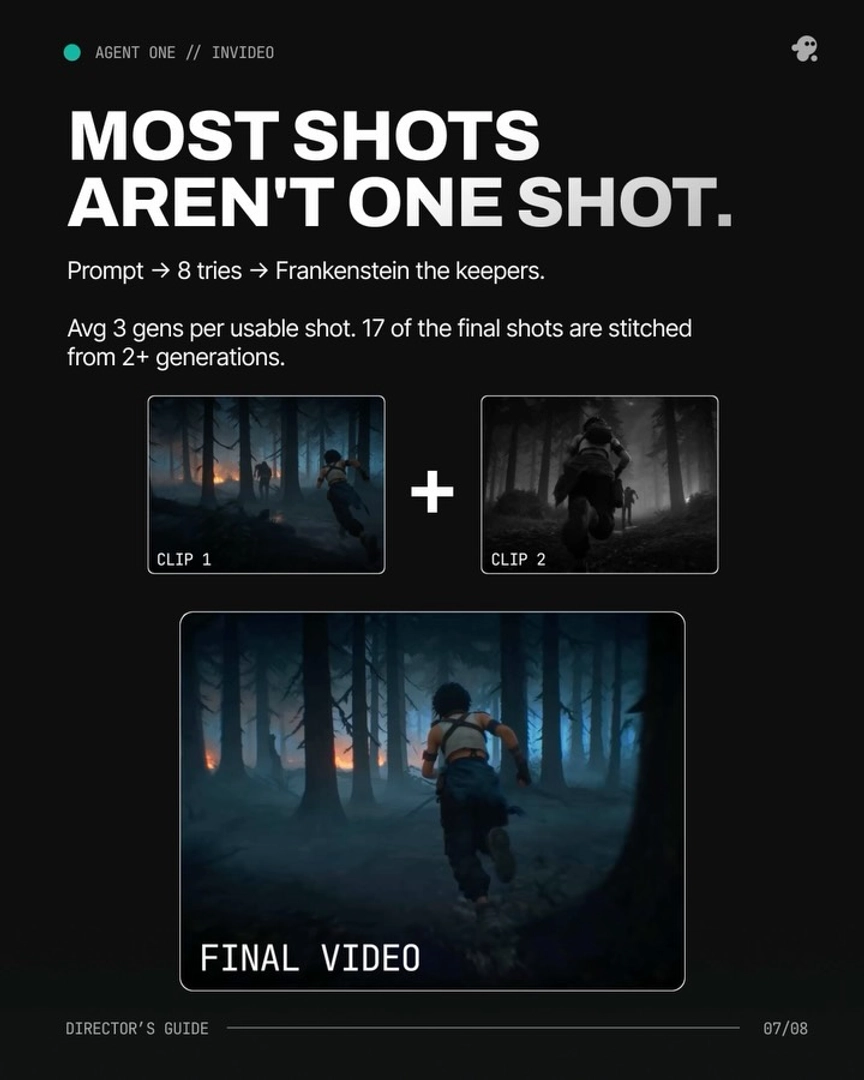
Seventy seconds. Two characters. The same person across every scene. No LoRA needed.
— invideo's creative team