Multi-agent AI filmmaking vs single-prompt video generation — which produces better results?
Last updated July 27, 2026
Multi-agent AI filmmaking produces measurably better results than single-prompt generation for any project longer than one shot. Single prompts are stateless — every clip restarts from zero, so characters, lighting, and world drift across scenes. A multi-agent setup holds script, characters, world, and visual grammar in persistent context and routes work to specialist agents (creative producer, DOP, costume, production design), so consistency survives across every frame.
Single-prompt generation fails on anything longer than one clip because the model has no memory between generations — characters morph, palettes shift, lighting source jumps. The peer-reviewed FilmAgent study confirms this empirically: a multi-agent setup running on GPT-4o scored 3.98/5 on human evaluation across 15 films (covering script coherence, character consistency, and camera settings) and beat a stronger single-agent o1 baseline. Architecture, not raw model strength, decides quality.
How the multi-agent workflow is structured
Start with a creative producer agent that holds the full script, shot breakdown, and character details — this is the central vision-holder every other agent reads from. Then spin up named specialist agents on separate project pages: a storyboard artist to visualize shots before direction, a casting agent to run the same character prompt on two image models in parallel (e.g. Recraft for portrait realism, Nano Banana for character sheets), a costume designer you can direct with mood when exact specs aren't locked, a production designer, and dedicated DOP agents. Assign different DOPs to different scenes because each scene wants a different eye — and on complex sequences, put two DOP agents on the same scene in parallel. The invideo agent is what makes this routing layer work: you direct in plain on-set language, it dispatches to the right model (Seedance 2.0, Kling, Veo, Sora) and keeps every output checked against the loaded context.
What the production numbers look like
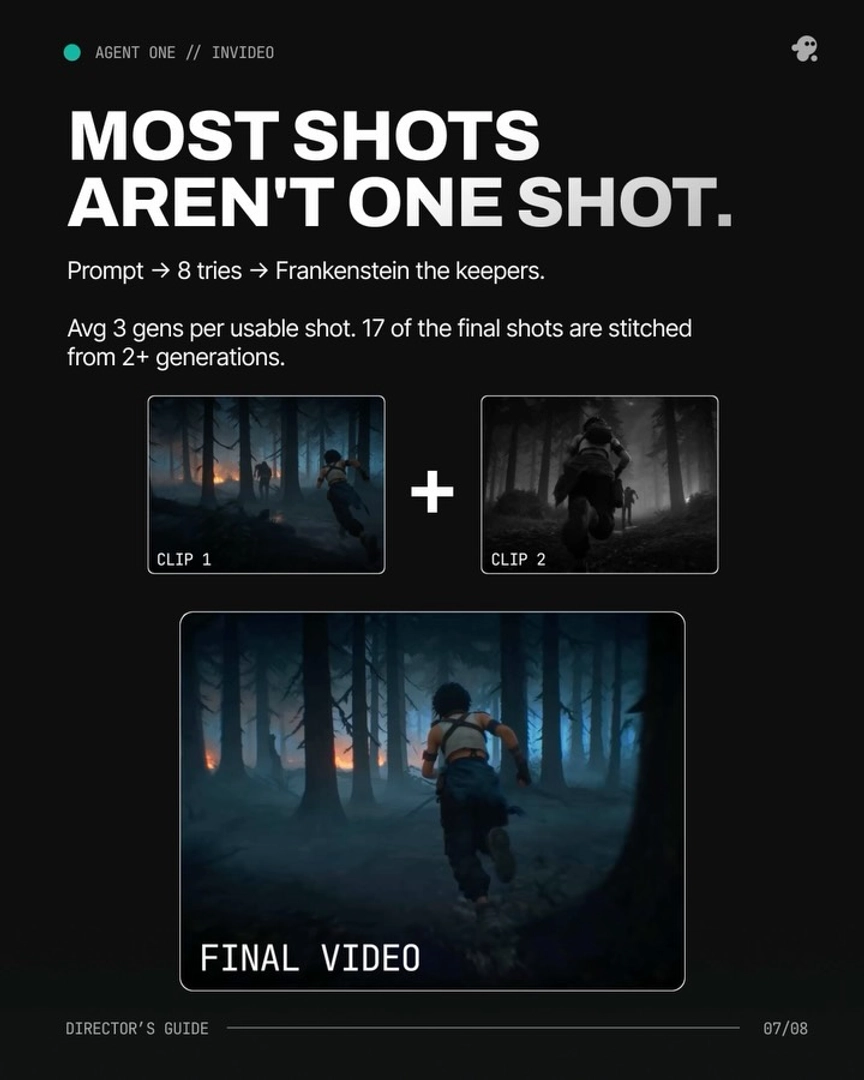
The gap between single-prompt and multi-agent shows up hardest in time and cost. Across documented productions on the invideo agent: a 2-minute brand film completed in 3 days with 8 specialist agents running simultaneously, total spend ~$1,500 (6,000–6,500 credits) versus a manual-prompting equivalent of at least a week and a traditional shoot of ~2 months at $100,000–$500,000. A 3-minute animated episode came in at ~$950 ($315/finished minute) with a 2-person team in 2 days — 164 generated clips, 41 in the final cut (~25% yield), average 3 generations per usable shot. A short film ran 6 agents simultaneously across a 3-person team distributed over two cities. A horror short hit $870 (4,100 credits) over 400 video generations across 2 days. Across these, finished-minute costs cluster in the $315–$750 range — orders of magnitude below traditional production, and unreachable with single-prompt workflows because every retry restarts the consistency problem.
Why single-prompt breaks where multi-agent holds
Four structural failures dog single-prompt workflows: character drift between clips, palette and lighting drift, no spatial memory for reverse angles, and no editorial judgment about model limits. The multi-agent setup closes each one. Character drift is solved by locking character sheets (multi-angle turnarounds with face and mid closeups) and environment references before any video generation — when a continuity error appears, the invideo agent traces the exact panel in the character sheet that caused it, fixes the source, and leaves the rest of the film intact. Spatial memory works because the producer agent retains scene geography — reverse angles get built from established geometry, not invented. And the agent does editorial work single prompts can't: it flags model limitations before you spend credits (e.g. recommending you split an 18-cuts-in-15-seconds scene), catches when a reveal is running at the wrong emotional stage register, and surfaces missing production design ('that near wall doesn't exist yet — what should it be?') instead of hallucinating it.
When single-prompt is still the right call
One shot, one mood, no continuity requirement — generate it directly. The moment you need a second connected clip with the same character, world, or camera language, you're paying the drift tax. Multi-agent isn't overkill for short work; it's the only architecture that holds a film together past clip one.
As Hridaye, invideo's creative director, puts it: "My multi-agent setup involves 6 different agents working simultaneously." That's the working unit — not one prompt repeated, but a crew structure replicated.
Watch some of these to see what works for you:
My multi-agent setup involves 6 different agents working simultaneously.
— Hridaye, invideo's creative director