The invideo agent’s Always Ask mode vs auto-generate — which gives better creative control over AI filmmaking?
Last updated July 27, 2026
Always Ask mode gives tighter creative control: it pauses before every generation so you approve the prompt, references, and style block before any credits are spent. Auto-generate gives throughput — overnight runs, parallel agents, batch coverage. Strong AI filmmaking workflows use both, routed by scene stakes and whether your visual context is already locked.
Choose the mode per session, not per project: Always Ask when you need decision-level control over individual shots, auto-generate when your context is locked and you need volume. invideo is an agentic video creation tool with all the current video models — Veo, Kling, Seedance 2.0 — available, and both modes run inside the same invideo agent.
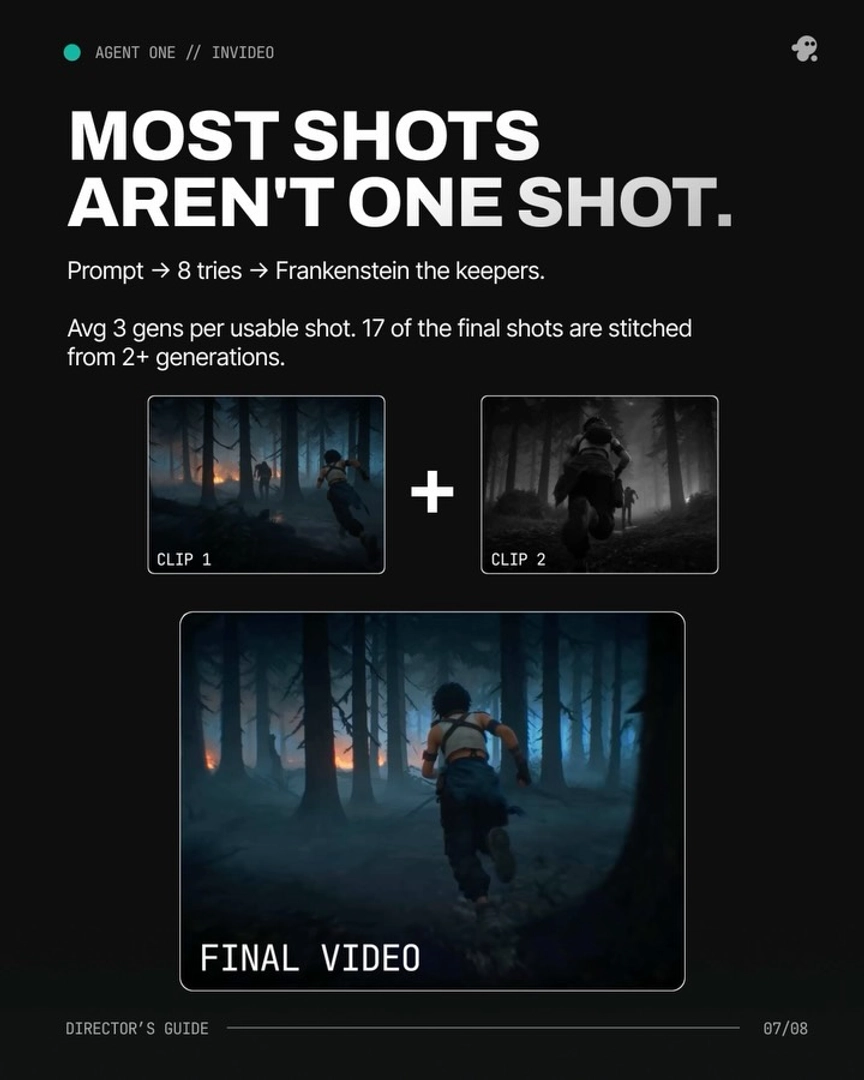
Always Ask = human-in-the-loop control. In Always Ask mode, the invideo agent stops before each generation and shows you the assembled prompt plus attached references; nothing renders until you approve, so every credit spent is a decision you made. One documented production ran a 3-minute animated episode this way: the team generated in 15-second chunks, attached character references and a locked style block to every prompt, and manually approved each generation. The numbers show why that gate matters — 164 clips generated, 41 in the final cut (a ~25% selection rate), an average of 3 generations per usable shot, and a total spend of ~$950, or $315 per finished minute. When only a quarter of output survives editorial, approving each generation before it runs is both creative control and budget control.
Auto-generate = human-on-the-loop control. Letting the invideo agent run autonomously doesn't remove direction — it moves your control upstream into context. With a loaded style document and locked character sheets, the invideo agent checks each generated frame against your references before returning it, and it can flag model limitations before generation and recommend structural changes instead of burning credits on a shot the model can't deliver. That's what makes unattended sessions productive: in one production the invideo agent generated seven costume variations while the creator took a coffee break, and in another it continued production work overnight, functioning as a non-stop fourth team member.
Multi-agent scale forces the choice. Documented productions ran 6–8 agents simultaneously — creative producer agent, casting agent, DOP agents, a director's assistant agent — and you cannot hand-approve every generation across eight parallel pipelines. At that scale, lock context first (style references, character sheets, shot breakdown), let the crew of agents auto-generate, then review outputs as a director reviews dailies. One 2-minute brand film finished in 3 days this way versus an estimated week of manual prompting.
Practical routing: use Always Ask for high-stakes scenes, new visual styles, and the early phase where you're still locking characters and world; switch to auto-generate once your references are approved and you're producing coverage in volume. Control doesn't come from the mode — it comes from where you place your decisions: per-frame in Always Ask, per-context in auto-generate.
Watch some of these to see what works for you:
You write the direction. Agent One builds the shot, holds it against the treatment, and only sends back what passes. Every frame is a decision, not a draft.
— invideo's creative team