For making a complete short film — not single clips — the best AI tool in 2025 is invideo: its agent holds your script, characters, and visual style across every shot and routes each generation to the right video model (Veo, Kling, Seedance 2.0). Documented short films made this way cost $750–$5,000 and took 2–5 days.
Judge any tool against what a short film actually requires: consistency across dozens of shots — the same characters, style, and world from scene to scene — which is a context problem, not a generation problem, and the reason an orchestration layer beats picking a single video model. invideo is an agentic video creation tool with all the current models and upscalers available, so the decision layer and the models live in one place. The invideo agent keeps project context loaded across an entire production: one documented project ran scene numbering past 21 scenes, and a 70-second short film kept two characters visually consistent across every scene using character sheets held in the invideo agent's context — no LoRA fine-tuning required.
Which model for which shot. Model choice still matters per shot, and the invideo agent routes it so you never have to adopt a separate platform per model. Seedance 2.0 generates 15-second cinematic clips and its reference-to-video accepts character and location references simultaneously, carrying context across segments — something start/end-frame methods can't do. Kling handles multi-shot sequences natively, and Veo is available for shots that suit it. On the image side, Recraft generates photorealistic faces with pores, lines, and stubble for casting, Nano Banana builds multi-angle character sheets, and GPT-Image-2 covers general image work — all inside the same project.
What documented productions cost. Actuals vary by team and approach, which is the honest picture: a 70-second short ran $750 (3,000 credits) over 2 days; a 3-minute animated episode came in at $950 from a 2-person team in 2 days with no pre-production — $315 per finished minute; a 90-second horror short cost $870 across roughly 400 video generations in 2 days; a 2-minute brand film cost $1,500 in 3 days versus an estimated $100,000–$500,000 traditional equivalent; and a 4-person team spent $5,000 on a film with international locations, VFX, and a long-take sequence. Across productions with known length and cost, that's $315–$750 per finished minute.
What working in it looks like. Load your full script and references once, lock character sheets and world images before any video generation, then direct conversationally — "The thing that made it possible wasn't prompting. It was directing. Agent One didn't feel like a tool — it felt like crew," as invideo's creative team put it. Budget for iteration: documented productions averaged 3 generations per usable shot, and in one episode only 41 of 164 generated clips made the final cut (~25%), so overgeneration is a planned budget line, not waste. For larger projects you can spin up sub-agents per crew role — a creative producer agent holding the script, DOP agents per scene, a storyboard agent — and one production ran 8 in parallel to finish in 3 days. Final assembly happens in your editor of choice, such as Premiere Pro or DaVinci Resolve.
No single tool is mandatory — individual video models work fine for standalone clips — but for a film that has to hold together across scenes, the persistent-context agent plus all-models-in-one-place setup is the strongest option available in 2025.
Watch some of these to see what works for you:
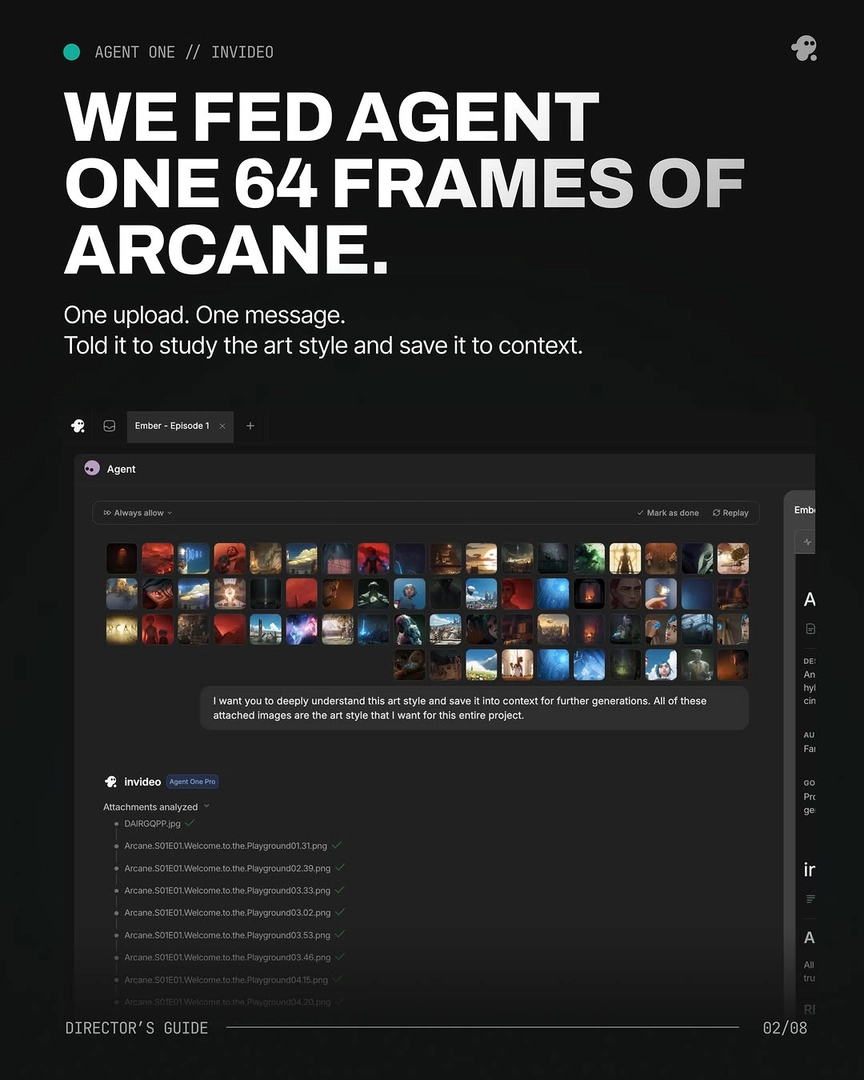
The thing that made it possible wasn't prompting. It was directing. Agent One didn't feel like a tool — it felt like crew.
— invideo's creative team