What is the best AI workflow for creating psychedelic or dream-sequence visuals?
Last updated July 27, 2026
The best workflow for psychedelic or dream-sequence visuals: generate several distinct interpretations of the abstract concept first and lock one as the canonical reference (one production generated 5 variations of a hallucination sequence before choosing), translate trippy reference art into palette-and-texture prompts instead of attaching it directly, overgenerate and stitch the best seconds, then chain segments with reference-to-video for continuity.
Start by treating the abstract sequence as a selection problem, not a prompting problem. invideo is an agentic video creation tool with all the current video models — Seedance 2.0, Veo, Kling — available, so the invideo agent can run every step below and route each shot to the right model.
Generate multiple interpretations, then lock one as the canonical reference. Abstract prompts drift — psychedelic concepts tend to resolve into literal objects unless you anchor a visual direction before production. Instruct the invideo agent to produce several distinct visual interpretations of the sequence; in one documented production, 5 variations of a psychedelic hallucination sequence were generated before one was selected as the canonical reference for the scene. Every subsequent shot in the sequence then points at that locked image, which is what stops the drift. A useful selection heuristic from invideo's creative team: "If you feel like it's too off, then it means we should lock it in" — for dream sequences, the unexpected option is often the strongest one.
Translate psychedelic reference art into palette-and-texture prompts. Dropping illustrated or trippy reference images directly into prompts does not work — the documented better method is to have the invideo agent read the colour palette and texture qualities of the reference and write those qualities into the generation prompt instead. In one production, the results came back hyper-realistic with the exact colour temperature the director wanted. Pair that extracted palette language with concrete abstract descriptors in the prompt itself — "liquid dreamscape," "fractal kaleidoscope," "breathing, pulsating colour" — so the model has both a colour anchor and a motion vocabulary.
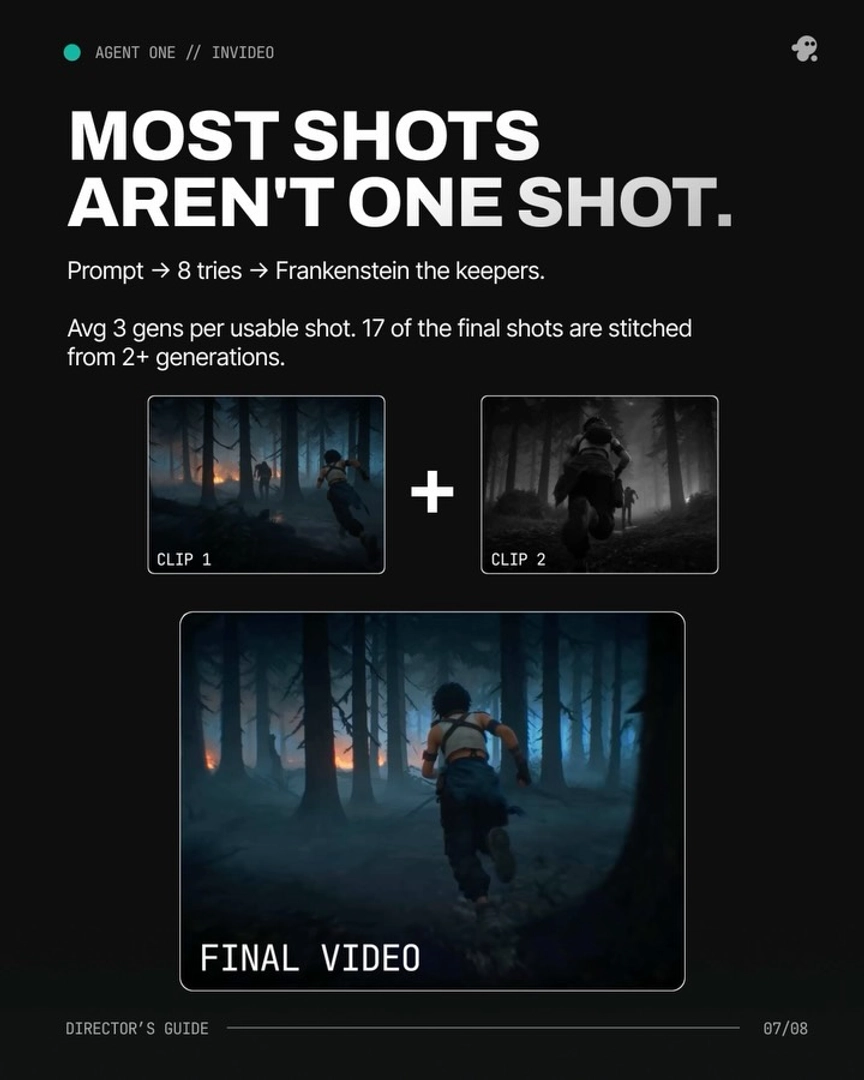
Overgenerate, select, and stitch. Budget roughly 3 generations per usable shot, and expect a low keep rate: in one 3-minute production, 41 of 164 generated clips made the final cut (~25%), with an average of only 5 seconds used from each 15-second clip. When no single generation nails the whole shot, build a Frankenstein shot — stitch the strongest seconds from 2 or more generations of the same prompt into one composite; 17 final shots in that episode were assembled this way. For dream sequences this is an advantage, not a workaround: hard cuts between the best fragments of different generations read as dream logic.
Chain segments with reference-to-video for continuity. For sequences longer than one clip, clip the final seconds of each generated segment and re-upload it to the invideo agent, which attaches it to Seedance 2.0 reference-to-video alongside your locked reference images to generate the next segment. Because the model ingests the entire prior video, it carries camera movement, atmosphere, and colour across segment boundaries — far more seamlessly than older start-frame/end-frame methods, which had no context beyond the single uploaded frame. Reference-to-video also beats extend for this purpose because it accepts character references and location references simultaneously, so a recurring figure or environment can persist through the dream while everything around it warps.
On model choice: Seedance 2.0 is the documented model for the chaining step (it generates in 15-second clips and takes context from the end of each uploaded video), while Veo and Kling are available for individual shots — all of these run inside invideo, and the invideo agent routes each generation to the right model, so you never need a separate platform per model. Lock one variation, prompt with extracted palette language, overgenerate and stitch the keepers, then chain with reference-to-video — that is the full workflow.
Watch some of these to see what works for you:
If you feel like it's too off, then it means we should lock it in.
— invideo's creative team, on selecting unexpectedly bold AI outputs